
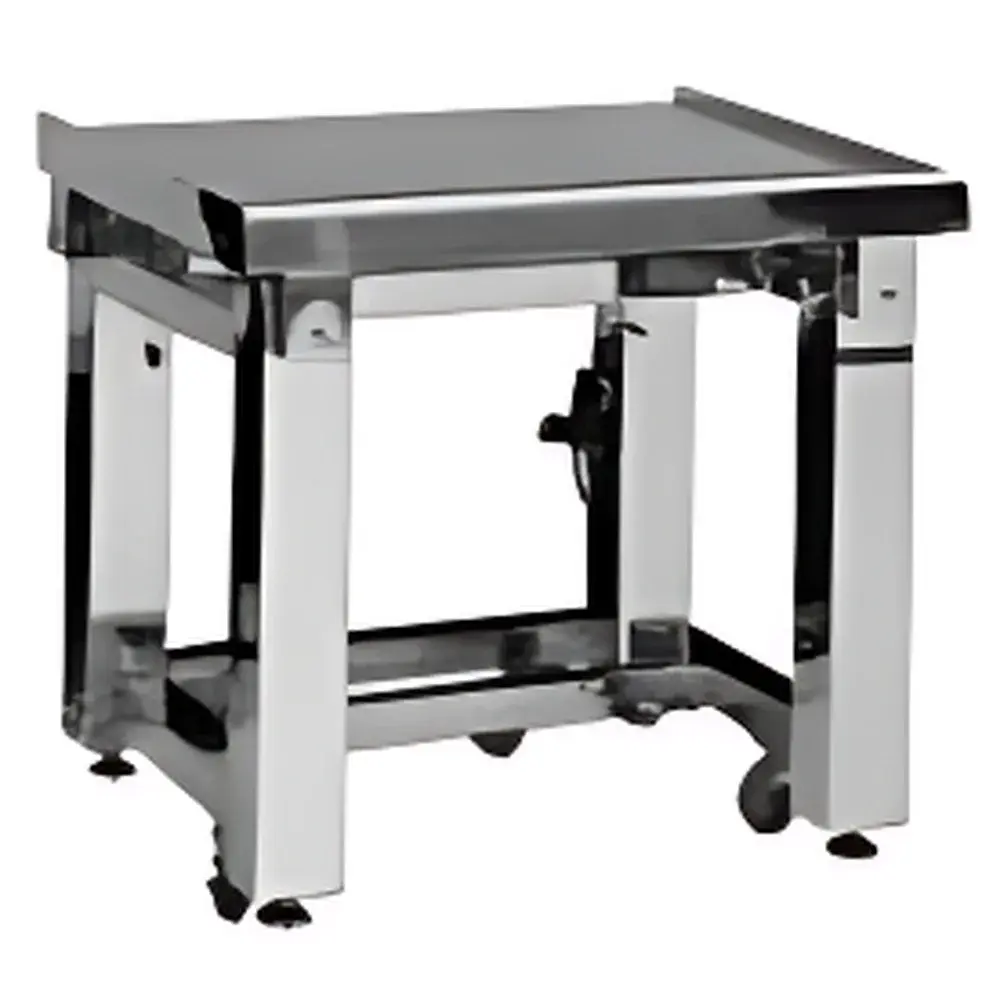
ZOLIX DVID-C Series High-Performance Vibration Isolation Platform
| Brand | ZOLIX |
|---|---|
| Model | DVID-C Series |
| Origin | South Korea |
| Manufacturer | ZOLIX (OEM Production) |
| Type | Pneumatic Air-Damped Optical Isolation Table |
| Construction | 304 Stainless Steel Frame & Top Plate |
| Operating Medium | Compressed Air (3–5 kg/cm²) or Liquid Nitrogen |
| Natural Frequency | 1.2–2.0 Hz |
| Isolation Efficiency | 75–95% @ 10 Hz, 85–98% @ 20 Hz |
| Horizontal Repeatability | ±0.1 mm |
| Static Load Capacity | 500 kg |
| Mass | 150–250 kg |
| Damping Mechanism | Orifice-Type Pneumatic Damping |
| Cleanroom Compatibility | ISO Class 1 (Fed. Std. 209E Class 1) |
| Surface Finish | Electropolished Weld Seam-Free Top Plate with Perforated Upper Deck |
Overview
The ZOLIX DVID-C Series High-Performance Vibration Isolation Platform is an engineered solution for ultra-stable optical and nanoscale metrology applications in semiconductor front-end fabrication environments. Designed specifically for ISO Class 1 cleanrooms, it employs a passive pneumatic isolation architecture based on low-frequency air-spring suspension and orifice-type damping—principles aligned with ISO 10816-1 (mechanical vibration evaluation) and SEMI S2/S8 safety and environmental compliance standards. Its fundamental design objective is to suppress broadband mechanical disturbances—particularly floor-borne ground roll (0.5–5 Hz), HVAC-induced turbulence (5–20 Hz), and acoustic coupling (>20 Hz)—to maintain sub-micron positional stability of sensitive instruments such as scanning probe microscopes and photolithographic aligners. The platform’s natural frequency range of 1.2–2.0 Hz ensures effective attenuation above its resonance band, while the perforated stainless steel top plate minimizes aerodynamic drag and particle entrapment—critical for maintaining laminar airflow integrity in Class 1 environments.
Key Features
- Full 304 stainless steel construction—including frame, top plate, and cover—resists corrosion, discoloration, and outgassing under repeated IPA/acetone cleaning and peroxide sterilization protocols.
- Electropolished, seam-free welded top surface eliminates crevices, weld spatter, and shadow zones where particulates can accumulate; compatible with ISO 14644-1 compliant wipe testing procedures.
- Integrated electrostatic discharge (ESD) grounding system (1×10⁶–1×10⁹ Ω surface resistance) meets ANSI/ESD S20.20 requirements for static control in wafer handling zones.
- Centralized exhaust recovery manifold interfaces directly with facility-grade cleanroom vacuum systems to capture displaced air and prevent turbulent eddy formation beneath the platform.
- Perforated upper deck (uniform 3-mm diameter holes, 12-mm pitch) reduces airflow impedance by >40% versus solid-top alternatives, preserving unidirectional laminar flow velocity profiles per ISO 14644-3 Annex B.
- Orifice-controlled pneumatic damping provides consistent, non-hysteretic energy dissipation across temperature ranges from 15°C to 25°C—no oil-based dampers that risk hydrocarbon contamination.
Sample Compatibility & Compliance
The DVID-C supports high-mass optical payloads up to 500 kg with horizontal repeatability of ±0.1 mm under static loading conditions—validated per ISO 9283 repeatability test methodology. It is certified for use with Class 1 cleanroom-compatible instrumentation including probe stations (e.g., Cascade Summit 12000), AFM/STM systems (Bruker Dimension Icon, Keysight 5500), mask aligners (SÜSS MA8/12), and thin-film metrology tools (J.A. Woollam M-2000). All materials comply with SEMI F57-0201 (outgassing limits) and USP for extractables profiling. No adhesives, elastomers, or lubricants are used in structural assemblies—eliminating volatile organic compound (VOC) sources that could compromise EUV lithography tool uptime.
Software & Data Management
As a purely passive mechanical system, the DVID-C requires no firmware, drivers, or embedded controllers. However, its performance integration is documented via traceable calibration reports (NIST-traceable accelerometer validation at 3, 10, and 20 Hz), included with each unit. Platform-level vibration spectra (acceleration PSDs) are provided in IEEE 1394-compliant .tdms format for import into MATLAB, Python (SciPy), or LabVIEW-based facility monitoring systems. Audit trails for installation verification—including pressure decay tests (per ISO 8573-1 Class 1 compressed air purity), ESD continuity checks, and surface roughness mapping (Ra ≤ 0.4 µm)—are archived per FDA 21 CFR Part 11 electronic record requirements when deployed in GMP-regulated R&D labs.
Applications
- Wafer-level nanoprobing and electrical characterization in 300 mm FAB environments
- Atomic force microscopy (AFM) and scanning tunneling microscopy (STM) requiring <5 nm RMS thermal drift over 4-hour acquisition windows
- Photomask inspection and repair systems operating under deep-UV (248 nm/193 nm) illumination
- In-situ ellipsometry and reflectometry during ALD/PVD process development
- High-resolution confocal and super-resolution fluorescence microscopy in shared core facilities
- Interferometric displacement metrology for EUV scanner component alignment verification
FAQ
What compressed air quality is required for stable operation?
Compressed air must meet ISO 8573-1 Class 1 (0.1 µm particle count ≤ 20/m³, dew point ≤ −70°C, oil content ≤ 0.01 mg/m³) to prevent orifice clogging and ensure damping consistency.
Can liquid nitrogen be used interchangeably with compressed air?
Yes—LN₂ is permitted as an alternative working medium for cryogenic cleanroom zones; however, thermal contraction coefficients require recalibration of leveling feet prior to use.
Is the platform compatible with active cancellation systems?
The DVID-C is designed as a standalone passive base; integration with active systems (e.g., STACIS or TS-2000) is mechanically feasible but requires third-party interface engineering and voids factory vibration warranty.
How often does maintenance require re-verification of isolation efficiency?
Annual verification is recommended per ISO 10816-1 Annex D; retesting is mandatory after relocation, seismic event exposure, or any modification to facility floor coupling.




