
ZOLIX Femtosecond Micromachining System
| Brand | ZOLIX |
|---|---|
| Origin | Beijing, China |
| Manufacturer Type | Authorized Distributor |
| Origin Category | Domestic (China) |
| Model | Femtosecond Micromachining System |
| Pricing | Available Upon Request |
Overview
The ZOLIX Femtosecond Micromachining System is an integrated ultrafast laser direct-write platform engineered for high-precision, non-thermal micro- and nano-fabrication in transparent and opaque materials. Built upon the physical principle of nonlinear multiphoton absorption induced by sub-100-fs laser pulses, the system enables true three-dimensional subsurface modification without collateral thermal damage—leveraging the intrinsic advantages of femtosecond-laser–matter interaction: extremely short pulse duration (1013 W/cm²), and negligible heat diffusion during energy deposition. This architecture supports cold ablation, diffraction-unlimited feature resolution via two-photon polymerization (TPP), and deterministic internal waveguide inscription in fused silica, borosilicate glass, and crystalline substrates. The system is fundamentally designed for research-grade applications in photonic device prototyping, microfluidic channel fabrication, optical data storage, and functional metamaterial synthesis—where spatial fidelity, repeatability, and process controllability are governed by ISO/IEC 17025-aligned laboratory practices.
Key Features
- Integrated high-power femtosecond laser source: 1030 nm center wavelength, ≥20 W average power at 50–200 kHz repetition rate, >400 µJ pulse energy at 1–50 kHz, pulse duration <290 fs—engineered for maintenance-free operation and long-term amplitude stability.
- High-stability XYZ motion control architecture: Combines a Carrier.S200.XY piezo-driven scanning stage (200 µm × 200 µm travel range, closed-loop resolution <1 nm, capacitive sensor accuracy ±0.3 nm) with optional motorized air-bearing linear stages for centimeter-scale positioning.
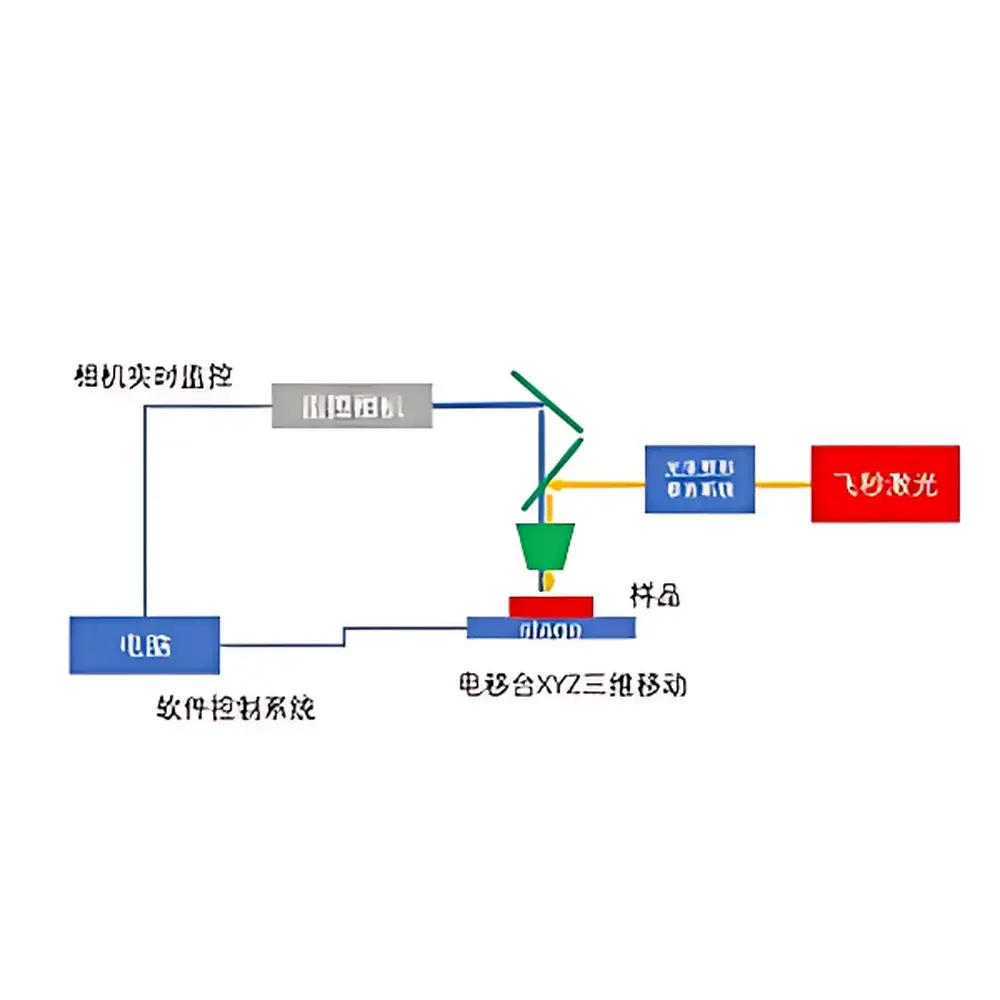
- Optically optimized microscope-integrated beam delivery: Designed for seamless integration with inverted or upright optical microscopes; includes high-NA objective lens coupling, precision galvo-free sample scanning, and real-time imaging feedback compatibility.
- Modular vacuum and magnetic compatibility: Optional .NM (non-magnetic), .HV (high-vacuum), and .UHV (ultra-high-vacuum) configurations support applications in quantum material processing, cryogenic photonics, and electron-beam lithography co-location.
- Rigid aluminum alloy mechanical frame (180 mm × 150 mm × 20 mm base footprint) with 80 mm × 60 mm central aperture—optimized for optical access, multi-axis alignment, and vibration-damped operation on optical tables compliant with ISO 10360-2 specifications.
Sample Compatibility & Compliance
The system accommodates a broad spectrum of optically transparent and absorbing substrates—including fused quartz, BK7 and SF10 glasses, sapphire, lithium niobate, polymers (SU-8, IP-L, OrmoComp), and silicon wafers. All motion control firmware and laser timing modules comply with IEC 61000-6-3 (EMC emissions) and IEC 60825-1:2014 (laser safety Class 4 operational protocols). System calibration procedures adhere to ASTM E2554–22 guidelines for uncertainty estimation in coordinate measuring systems. Data acquisition logs meet FDA 21 CFR Part 11 requirements for electronic records and signatures when paired with validated third-party software environments.
Software & Data Management
Control is executed via a modular LabVIEW-based GUI supporting synchronized laser triggering, piezo voltage ramping, and external camera synchronization (GenICam-compliant). Raw positional data, pulse count timestamps, and laser power monitoring streams are exported in HDF5 format with embedded metadata (including timestamp, environmental temperature, and stage calibration coefficients). Audit trails record all parameter modifications with user ID, timestamp, and reason-for-change fields—enabling full GLP/GMP traceability. Optional MATLAB and Python APIs facilitate custom algorithm integration for adaptive path planning, aberration correction, and machine-learning–assisted process optimization.
Applications
- Three-dimensional photonic crystal fabrication via direct laser writing in photoresists and sol-gel glasses.
- Embedded optical waveguide circuits for integrated quantum optics and telecom components.
- Micro-optical element manufacturing: microlens arrays, diffractive optical elements (DOEs), and freeform microstructures.
- Precision drilling and cutting of brittle materials (e.g., display glass, medical stents) with sub-micron kerf width and minimal microcracking.
- In-volume refractive index modification for optical memory devices and tunable meta-surfaces.
- Surface functionalization of biomedical implants through controlled topographic patterning at sub-100 nm lateral resolution.
FAQ
What is the maximum achievable feature size using this system?
Feature resolution is governed by nonlinear absorption threshold and numerical aperture—not diffraction limit. With a 1.4 NA oil-immersion objective and optimized TPP chemistry, sub-100 nm lateral features have been demonstrated in SU-8 under controlled ambient conditions.
Can the system be upgraded for vacuum-compatible operation?
Yes. The Carrier.S200.XY stage offers factory-installed .UHV variants rated for pressures down to 10−9 mbar, including UHV-compatible cabling, outgassing-tested materials, and bake-out certified actuators.
Is remote diagnostics and service support available?
ZOLIX provides secure remote access via TLS-encrypted VNC channels for firmware updates, calibration verification, and real-time performance diagnostics—subject to customer network policy approval and ISO/IEC 27001-aligned security protocols.
Does the system include alignment aids for multi-wavelength beam coupling?
Yes. Integrated dichroic mirror mounts, adjustable kinematic mirror holders, and collimated alignment lasers (635 nm and 780 nm) are provided for simultaneous visible/NIR path commissioning and co-registration validation.
What documentation is supplied for regulatory compliance in pharmaceutical R&D environments?
A complete IQ/OQ package—including installation qualification checklists, operational qualification test scripts, calibration certificates traceable to NIST standards, and risk assessment reports per ISO 14971—is delivered with each system.





