
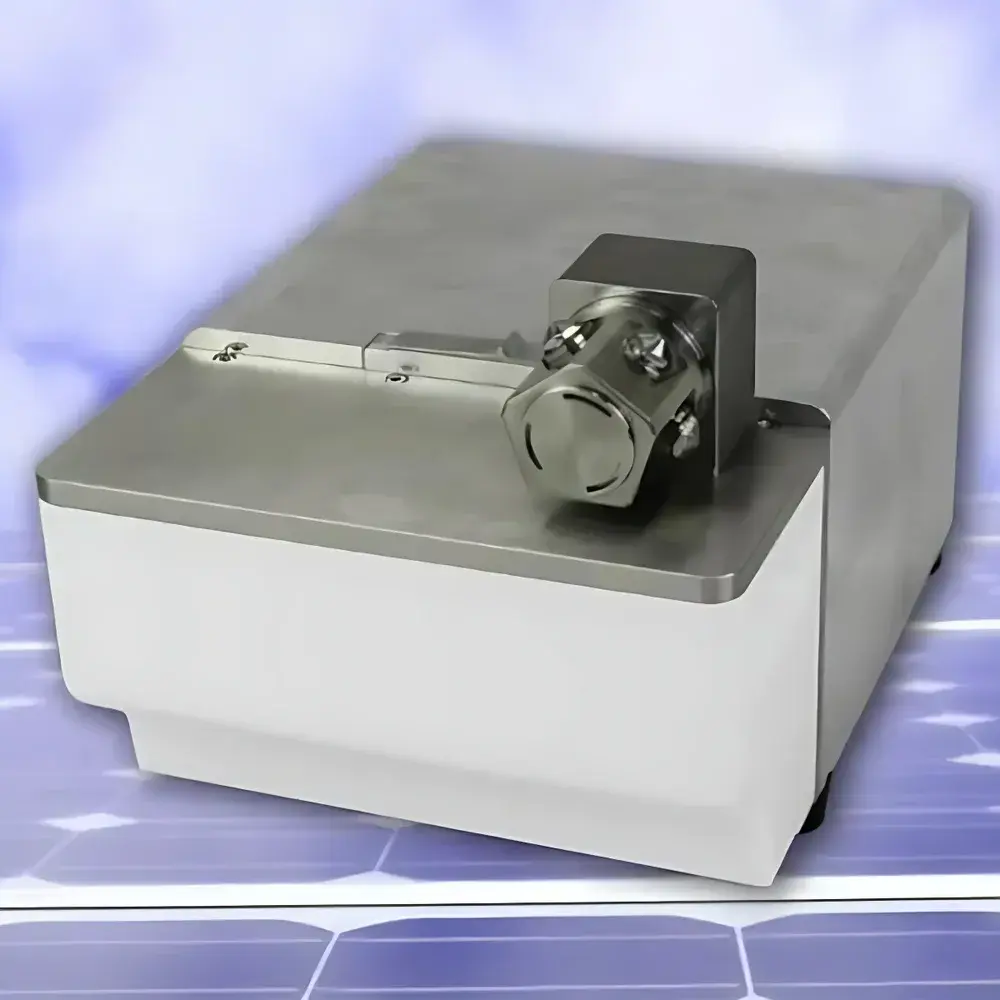
ZOLIX FI-RXF100-RT Rotating Transmission Fourier Transform Infrared Liquid Analyzer
| Brand | ZOLIX |
|---|---|
| Origin | Beijing, China |
| Manufacturer Type | Original Equipment Manufacturer (OEM) |
| Instrument Category | Domestic |
| Model | FI-RXF100-RT |
| Price Range | USD 35,000 – 42,000 |
| Instrument Type | Fourier Transform Infrared (FTIR) |
| Configuration | Benchtop Laboratory System |
| Detector Options | DLaTGS or MCT |
| Optical Window Pathlengths | 30 µm, 50 µm, 100 µm, 200 µm, and custom pathlengths |
| Transmission Module Design | Motorized 5-position rotating turret (4 sample positions + 1 cleaning position) |
| Crystal Material | High-transmission ZnSe |
| Rotation Control | Bidirectional (CW/CCW) with mechanical indexing pins for positional repeatability < ±0.1° |
Overview
The ZOLIX FI-RXF100-RT Rotating Transmission Fourier Transform Infrared Liquid Analyzer is a purpose-built benchtop FTIR system engineered for high-sensitivity, quantitative analysis of liquid-phase samples across diverse chemical matrices. Unlike conventional transmission cells requiring precise volume control and alignment, or ATR accessories limited by effective penetration depth and surface contact uniformity, the FI-RXF100-RT integrates a motorized rotating transmission module directly into the optical path of a standard FTIR spectrometer. It operates on the fundamental principle of Beer–Lambert law-based absorbance measurement in true transmission geometry—where incident infrared radiation passes through a defined liquid layer before reaching the detector—thereby delivering superior photometric accuracy and dynamic range for concentration-dependent studies. The system’s core innovation lies in its precision-machined, indexable 5-position turret: four positions accommodate interchangeable ZnSe optical windows with fixed, factory-calibrated pathlengths (30, 50, 100, or 200 µm), while the fifth serves as a dedicated solvent rinse station. This architecture eliminates manual cell swapping, minimizes operator-induced variability, and enables rapid method development across concentration gradients without recalibration.
Key Features
- Motorized 5-position rotating turret with mechanical indexing pins ensuring angular reproducibility better than ±0.1°, enabling repeatable positioning critical for quantitative inter-sample comparison.
- ZnSe transmission windows optimized for broadband IR transmission (7,800–600 cm⁻¹), offering higher throughput and lower scattering loss compared to KBr or CaF₂ alternatives.
- Modular pathlength configuration: users may deploy 1–4 distinct fixed-pathlength windows simultaneously; additional turrets or custom pathlengths (e.g., 15 µm or 500 µm) are available as factory-installed options.
- Drop-and-measure operation: sample introduction requires only 1–2 µL applied directly onto the crystal surface—no sealing, clamping, or alignment tools needed—reducing contamination risk and turnaround time per analysis.
- Dual detector compatibility: supports both thermoelectrically cooled deuterated L-alanine doped triglycine sulfate (DLaTGS) for routine stability and liquid-nitrogen-cooled mercury cadmium telluride (MCT) for enhanced signal-to-noise ratio in low-concentration or fast-scan applications.
- Benchtop integration: designed as a drop-in accessory for major FTIR platforms (e.g., Thermo Nicolet iS50, Bruker Tensor series, PerkinElmer Frontier), requiring no optical realignment or beam expansion modifications.
Sample Compatibility & Compliance
The FI-RXF100-RT accommodates a broad spectrum of liquid analytes—including volatile organic solvents (e.g., acetone, chloroform, THF), polar aqueous solutions (pH 2–12), hydrocarbon-based oils (lubricants, biofuels), and complex mixtures containing particulates or emulsified phases—provided they exhibit acceptable viscosity (< 500 cP) and do not chemically etch ZnSe. Sample residue is removed via automated solvent flush using the dedicated cleaning port, compatible with common IR-transparent rinses (e.g., CCl₄, CHCl₃, isopropanol). From a regulatory standpoint, the system supports GLP-compliant workflows when paired with validated FTIR software: spectral acquisition metadata (including turret position ID, pathlength, detector type, and timestamp) is embedded in standard .SPA or .DMG file headers. When operated with 21 CFR Part 11–compliant software extensions, audit trails, electronic signatures, and user-access controls can be implemented to meet FDA, ISO/IEC 17025, and ASTM E1421 requirements for analytical instrument qualification.
Software & Data Management
The analyzer interfaces seamlessly with industry-standard FTIR control suites (e.g., OMNIC, OPUS, Spectrum Touch) via USB 2.0 or Ethernet. Turret position selection, pathlength assignment, and cleaning cycle initiation are programmable within method files—enabling fully automated multi-pathlength sequences for calibration curve generation or batch screening. Spectral processing includes baseline correction, atmospheric compensation (H₂O/CO₂), and peak integration with pathlength-aware absorbance scaling. Quantitative modules support univariate (peak height/area vs. concentration) and multivariate (PLS, PCR) regression models; all calibration parameters are stored with traceable pathlength identifiers. Raw data and processed results export to CSV, TXT, or ASTM E1347-compliant XML formats for LIMS integration.
Applications
- Quantitative determination of functional group concentrations in organic synthesis intermediates (e.g., carbonyl content in esterification reactions).
- Impurity profiling in pharmaceutical excipients and active pharmaceutical ingredients (APIs) dissolved in deuterated or non-deuterated solvents.
- Real-time monitoring of oxidation products (e.g., hydroperoxides, carboxylic acids) in lubricant degradation studies.
- Water content analysis in hygroscopic solvents (e.g., DMF, DMSO) using the 3700–3500 cm⁻¹ O–H stretch region, leveraging 30 µm pathlength for high-concentration sensitivity.
- Quality control of edible oils (e.g., iodine value estimation via C=C stretch at 1650 cm⁻¹) and detection of adulterants such as mineral oil or cheaper vegetable blends.
- Environmental analysis of surfactant concentrations in wastewater effluents using characteristic alkyl chain vibrations (2920/2850 cm⁻¹) under 100 µm pathlength conditions.
FAQ
How does the 100 µm pathlength correlate with ATR effective depth?
At 1000 cm⁻¹, a 100 µm transmission pathlength corresponds to an effective interaction depth equivalent to ~50 internal reflections on a typical diamond ATR crystal—providing comparable analyte interrogation volume but with higher absolute absorbance and reduced surface artifacts.
Can the turret be upgraded post-purchase with additional pathlengths?
Yes—the mechanical interface and firmware support field-upgradable turrets; users may order replacement assemblies with new pathlength configurations without hardware modification.
Is ZnSe compatible with strong acids or bases?
ZnSe exhibits limited resistance to concentrated HNO₃, HF, or NaOH >1 M; for such matrices, optional BaF₂ or CaF₂ windows (with reduced IR range) are available upon request.
What spectral resolution is achievable with this module?
Resolution is governed by the host FTIR spectrometer; the FI-RXF100-RT introduces no intrinsic line-broadening and maintains the native instrument resolution (e.g., 0.25 cm⁻¹ on a 64-scan coaddition with MCT detector).
Does the system require purging during operation?
While not mandatory, continuous dry-air or N₂ purge of the optical compartment is recommended to minimize atmospheric water vapor interference—especially when measuring weak O–H or N–H bands below 1800 cm⁻¹.




