
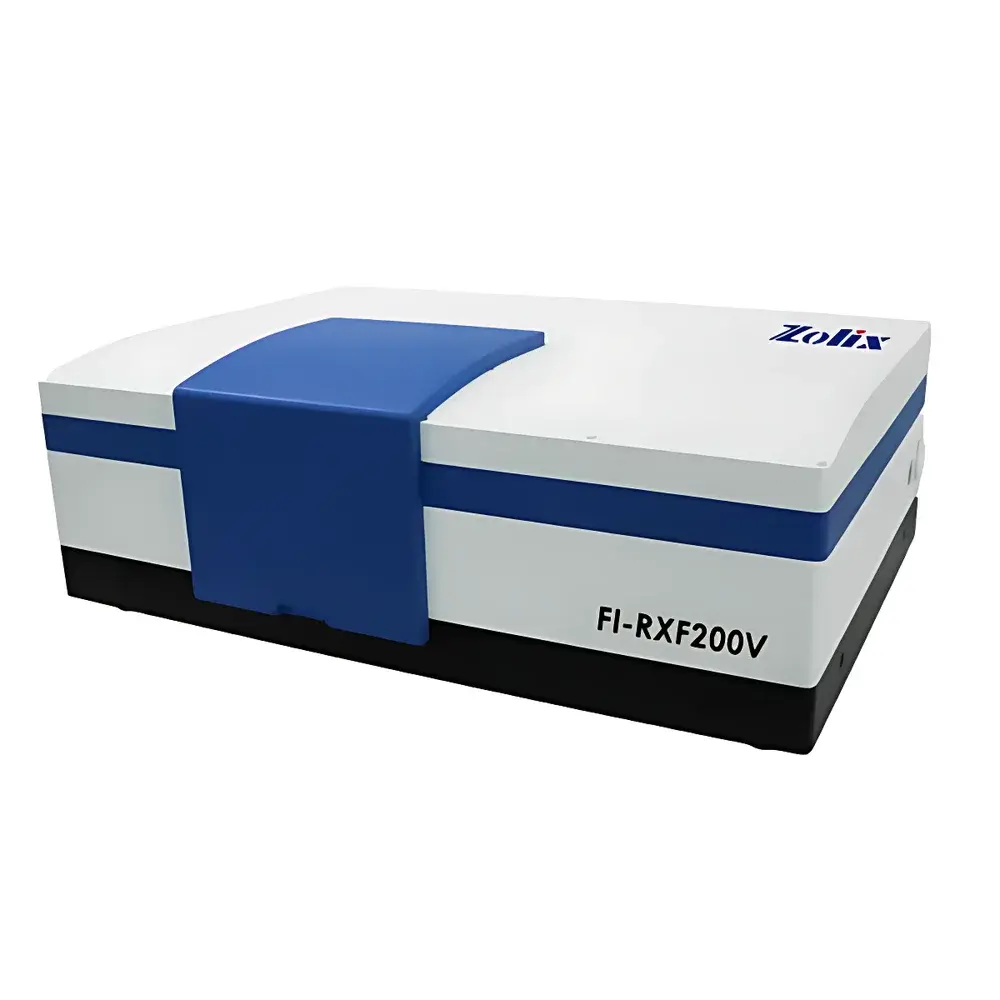
ZOLIX FI-RXF200 Research-Grade Fourier Transform Infrared (FTIR) Spectrometer
| Brand | ZOLIX |
|---|---|
| Origin | Beijing, China |
| Manufacturer Type | Direct Manufacturer |
| Instrument Type | Fourier Transform |
| Spectral Resolution | ≤0.25 cm⁻¹ |
| Signal-to-Noise Ratio (SNR) | ≥55,000:1 |
| Wavenumber Accuracy | ±0.005 cm⁻¹ |
| Spectral Range (Standard) | 8000–350 cm⁻¹ |
| Extended Range (Optional) | 12800–4000 cm⁻¹ |
| Interferometer | Cube Corner Retroreflector-Based Michelson Design |
| Detector Interface | Dual-Channel 32-bit ADC Architecture |
| Standard Detector | Room-Temperature DLaTGS |
| Optional Detectors | Liquid-Nitrogen-Cooled MCT, TE-Cooled MCT, LN₂-Cooled InSb, TE-Cooled InGaAs, LN₂-Cooled Ge |
| Beam Splitter Options | Ge-Coated KBr, Quartz, CaF₂, ZnSe |
| Source Options | Ceramic Globar, Tungsten-Halogen |
| Sample Compartment | Transmission-Compatible with Vacuum/N₂-Purged External Ports |
| Optional Accessories | TGA-FTIR Coupling Module, GC-FTIR Interface, UHV-Ready External Chamber, Gas Cells (2 cm–20 m), Integrating Sphere, In Situ Transmission/DRIFTS Cells, Micro-FTIR, ATR Probes (Including Mid-IR Fiber ATR), Specular Reflection Stage |
Overview
The ZOLIX FI-RXF200 is a research-grade Fourier Transform Infrared (FTIR) spectrometer engineered for high-fidelity molecular vibrational spectroscopy in academic, pharmaceutical, and materials science laboratories. Based on a robust cube corner retroreflector interferometer architecture, the system delivers true optical path stability and phase accuracy essential for quantitative spectral analysis, time-resolved kinetics, and high-resolution spectral deconvolution. Its core design adheres to fundamental FTIR principles—namely, the acquisition of an interferogram via symmetric beam splitting and recombination, followed by fast Fourier transformation to yield intensity-vs.-wavenumber spectra with inherent wavelength calibration traceability. The instrument operates across a standard mid-infrared range of 8000–350 cm⁻¹ and supports seamless extension into the near-infrared (NIR) region (12800–4000 cm⁻¹) through automated source and beamsplitter switching—enabling dual-region characterization without realignment or hardware recalibration.
Key Features
- Ultra-high spectral resolution: ≤0.25 cm⁻¹ (apodized), fully software-adjustable down to instrument-limited values; supports resolution upgrades via firmware and optical alignment optimization.
- Exceptional signal fidelity: SNR ≥55,000:1 (at 4 cm⁻¹ resolution, 1 min scan, 2100–1900 cm⁻¹), achieved through low-noise dual-channel 32-bit analog-to-digital conversion and optimized thermal management of optical components.
- Wavenumber accuracy of ±0.005 cm⁻¹ (verified against NIST-traceable polystyrene film standards), ensuring compliance with ISO 17025 requirements for spectral metrology.
- Modular detector architecture: Standard room-temperature deuterated L-alanine doped triglycine sulfate (DLaTGS) detector; optional cryogenic and thermoelectrically cooled detectors—including MCT (HgCdTe), InSb, InGaAs, and Ge—for enhanced sensitivity in specific spectral sub-regions.
- Automated optical configuration switching: Integrated motorized turret for simultaneous selection of sources (ceramic globar, tungsten-halogen), beamsplitters (Ge-coated KBr, quartz, CaF₂, ZnSe), and detectors—enabling rapid method transitions between transmission, ATR, DRIFTS, and emission modes.
- Vacuum-compatible sample compartment with standardized flanges (CF-35 and CF-63), supporting integration with ultra-high vacuum (UHV) systems, gas-phase reaction cells (2 cm–20 m pathlength), and in situ electrochemical or catalytic cells.
Sample Compatibility & Compliance
The FI-RXF200 accommodates diverse sample forms—including solids (KBr pellets, films, powders), liquids (neat, solution, thin films), gases (static or flow-through), and surfaces (monolayers, coatings, corrosion interfaces)—via interchangeable accessories. Its NIR extension capability permits direct analysis of aqueous solutions and glass-contained samples without dilution or solvent removal, aligning with USP and ASTM E1421 guidelines for pharmaceutical excipient screening. All detector electronics meet IEC 61326-1 electromagnetic compatibility (EMC) requirements. Data acquisition and processing workflows support audit trail generation, electronic signatures, and 21 CFR Part 11-compliant user access control when deployed with validated software configurations. The system is compatible with GLP/GMP environments where spectral reproducibility, instrument qualification (IQ/OQ/PQ), and raw data integrity are mandated.
Software & Data Management
The FI-RXF200 is controlled via a native Windows-based platform featuring a bilingual (English/Chinese) GUI kernel, though all metadata, reports, and export formats adhere to international ASCII and HDF5 standards. Core capabilities include batch spectral acquisition, real-time kinetic monitoring (with configurable trigger inputs for external reactors or potentiostats), automated baseline correction (Rubberband, Concave Rubberband), peak fitting (Voigt, Gaussian, Lorentzian), and multivariate analysis (PCA, PLS regression). Spectral libraries (e.g., SDBS, NIST, Polymer, PharmaID) are integrated with similarity search algorithms compliant with ASTM E1846. Raw interferograms and processed spectra are stored with embedded acquisition parameters (apodization, zero-filling, phase correction method), enabling full traceability and reprocessing. Export options include JCAMP-DX v6, CSV, PNG, and MATLAB .mat formats—ensuring interoperability with third-party chemometric toolkits and LIMS platforms.
Applications
- Pharmaceutical Development: Quantitative analysis of active pharmaceutical ingredients (APIs) and excipients in aqueous formulations; secondary structure determination of therapeutic proteins (α-helix, β-sheet) via amide I/II band deconvolution; stability assessment under thermal stress using TGA-FTIR hyphenation.
- Materials Science: Thickness measurement of SiO₂, SiNₓ, and polymer dielectric layers on silicon wafers via interference fringe analysis; oxidation state mapping of transition metal oxides using MCT-detected far-IR modes; characterization of optical coatings (transmittance/reflectance) from 12800–350 cm⁻¹.
- Catalysis & Reaction Monitoring: In situ ATR-FTIR tracking of surface adsorbates during heterogeneous catalysis (e.g., CO oxidation on Pt/Al₂O₃); real-time monitoring of esterification kinetics using mid-IR fiber probes; electrochemical FTIR studies of SEI formation on Li-ion battery electrodes.
- Environmental & Agricultural Analysis: Soil organic carbon and clay mineral identification via DRIFTS; microplastic identification in environmental matrices using library-matched ATR spectra; quantification of NOₓ and SO₂ in ambient air using long-path gas cells.
- Life Sciences: Bacterial strain discrimination via whole-cell FTIR fingerprinting; lipid bilayer phase transition analysis using temperature-controlled transmission cells; collagen denaturation profiling in tissue engineering scaffolds.
FAQ
Is the FI-RXF200 compliant with regulatory requirements for GMP laboratories?
Yes—when configured with audit-trail-enabled software, role-based access control, and electronic signature modules, the system supports 21 CFR Part 11 and Annex 11 compliance. Full IQ/OQ documentation packages are available upon request.
Can the instrument perform simultaneous mid-IR and NIR measurements without manual intervention?
No—while the optical path supports automatic switching between mid-IR and NIR configurations (source, beamsplitter, detector), measurements must be acquired sequentially per defined method. True simultaneous dual-range detection requires separate co-aligned spectrometers.
What vacuum level is achievable in the sample compartment with optional UHV integration?
With CF-63 flanged UHV chamber integration and appropriate pumping (turbo + ion pump), base pressures below 1×10⁻⁸ mbar can be sustained during spectral acquisition, enabling surface science applications such as adsorption isotherm studies.
Does the system support external triggering from reactor temperature controllers or potentiostats?
Yes—the rear-panel TTL-compatible trigger input accepts rising/falling edge signals for synchronized start/stop acquisition, enabling precise temporal correlation with exothermic events or redox transitions.
Are spectral libraries and chemometric models provided with the instrument?
A foundational library of >2,500 reference spectra (polymers, pharmaceuticals, minerals, gases) is included. Custom model development (PLS, PCR) and validation services are available through ZOLIX Application Support, with documentation aligned to ISO 11095 and ASTM E1655.





