
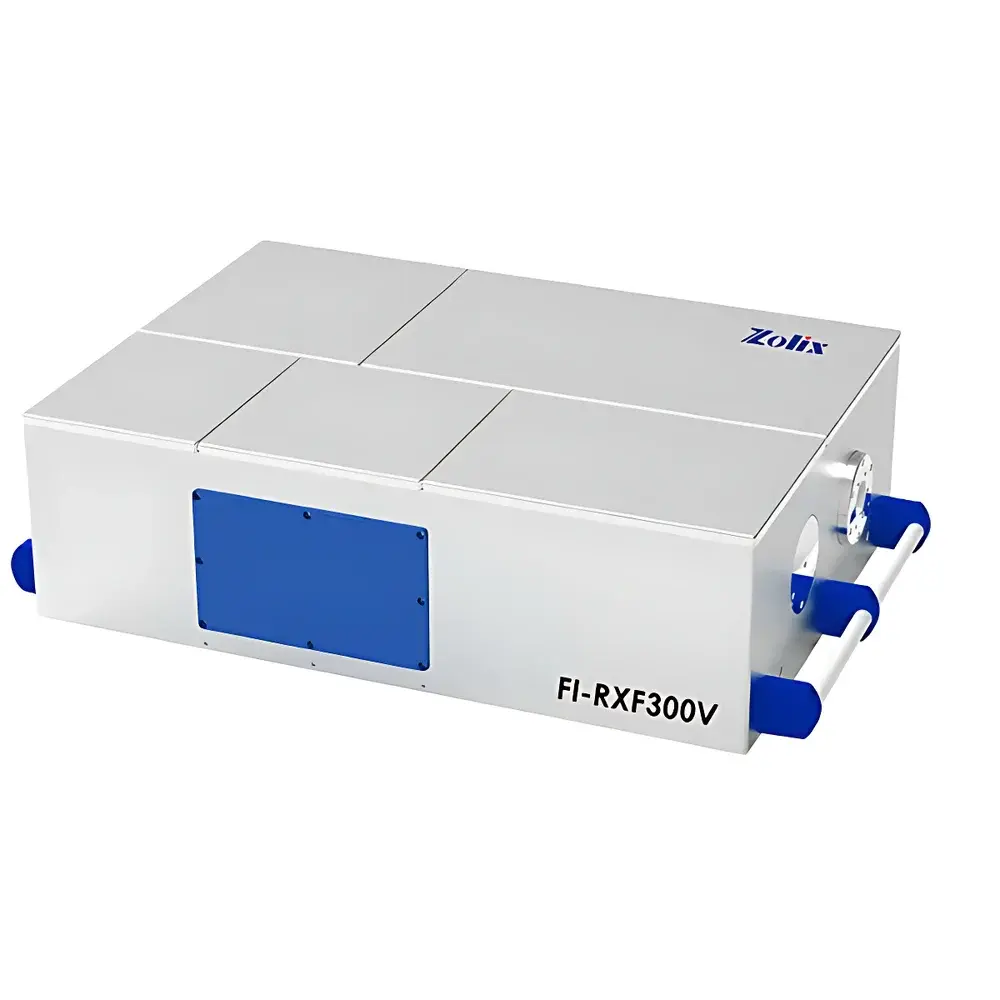
ZOLIX FI-RXF300V Vacuum Fourier Transform Infrared Spectrometer
| Brand | ZOLIX |
|---|---|
| Origin | Beijing, China |
| Manufacturer Type | Direct Manufacturer |
| Instrument Type | Fourier Transform |
| Spectral Resolution | ≤0.25 cm⁻¹ |
| Wavenumber Accuracy | <0.01 cm⁻¹ |
| Vacuum Level | ≤0.2 mbar |
| Spectral Range (Standard) | 6000–50 cm⁻¹ |
| Extended Range | 12500–10 cm⁻¹ |
| Interferometer | Domestic High-Stability Retroreflector-Based Interferometer |
| Beam Splitter Options | KBr, CaF₂, Quartz, ZnSe |
| Detector Options | DLaTGS (standard), InGaAs, MCT, Liquid-He-Cooled Bolometer |
| Light Source Options | Ceramic IR Source (standard), Water-Cooled Hg Arc Lamp, Tungsten Filament Lamp |
| ATR Accessory | Diamond Crystal (Vacuum-Compatible) |
| Software | Windows 10–Based Full Chinese GUI with Spectral Library Management, Quantitative Analysis, and Automated CO₂/H₂O Subtraction |
Overview
The ZOLIX FI-RXF300V Vacuum Fourier Transform Infrared (FTIR) Spectrometer is a research-grade analytical platform engineered for ultra-high-sensitivity vibrational spectroscopy under controlled vacuum conditions. Unlike conventional atmospheric or purged FTIR systems, the FI-RXF300V employs a fully evacuated optical path—including interferometer, beam splitter, detectors, and sample compartment—eliminating rotational-vibrational absorption bands from ambient CO₂ (∼2349 cm⁻¹) and H₂O (∼1370, 1130, 667 cm⁻¹). This vacuum architecture (≤0.2 mbar) enhances photon throughput by up to 3× compared to nitrogen-purged systems and enables detection of sub-monolayer surface species, weak lattice modes in molecular crystals, and low-intensity far-infrared rotational transitions. Its core measurement principle relies on Michelson-type interferometry with a solid-state retroreflector interferometer, delivering long-term alignment stability (>10 years operational lifetime without recalibration) and intrinsic phase accuracy critical for quantitative absorbance modeling and complex spectral deconvolution.
Key Features
- Hermetically sealed all-aluminum monolithic optical cavity with independent vacuum chambers for optics and sample compartments—enabling selective evacuation and rapid pump-down (<15 min to ≤0.2 mbar)
- Automated optical path switching for seamless integration of near-, mid-, and far-infrared detection modules (12500–10 cm⁻¹ coverage), including water-cooled Hg arc lamp and liquid-helium-cooled bolometer for THz-range measurements
- Standard 6000–50 cm⁻¹ acquisition in a single scan; optional extended range supports gas-phase rotational spectroscopy, phonon analysis in 2D materials, and low-energy excitations in superconductors
- Resolution ≤0.25 cm⁻¹ (unapodized) with wavenumber accuracy better than 0.01 cm⁻¹—certified traceable to NIST SRM 1921b polystyrene film
- Vacuum-compatible diamond ATR accessory with chemical inertness, thermal stability up to 400°C, and compatibility with corrosive liquids and reactive thin films
- Multiple external beam ports (up to 4) for coupling to UHV chambers (≤10⁻⁹ mbar), cryogenic dewars (4–300 K), high-temperature emission cells (up to 1200°C), and long-path gas cells (10–200 m effective pathlength)
Sample Compatibility & Compliance
The FI-RXF300V accommodates solid films (including self-assembled monolayers on Au/Si substrates), powders, pellets (KBr, CsI), liquids (in sealed transmission cells), and gases (via integrated 10-cm or externally coupled multi-pass cells). Its vacuum environment ensures reproducible quantification of volatile organics and moisture-sensitive catalysts during in situ DRIFTS experiments. The system complies with ISO 17025 requirements for calibration traceability and supports GLP/GMP workflows through audit-trail-enabled software logging (user actions, parameter changes, spectral acquisitions). While not FDA 21 CFR Part 11–certified out-of-the-box, its data export architecture (ASCII, JCAMP-DX, HDF5) enables integration into validated LIMS environments with third-party electronic signature modules.
Software & Data Management
The instrument is operated via a native Windows 10 application featuring full Chinese-language interface—designed specifically for non-native English-speaking research labs without compromising technical depth. Core capabilities include real-time vacuum monitoring, automatic detector/source selection based on selected spectral range, intelligent baseline correction using iterative rubber-band algorithms, and spectral subtraction of diamond ATR crystal and residual CO₂/H₂O features. The embedded spectral library contains >10,000 reference spectra (inorganic salts, organometallic complexes, polymers, pharmaceutical excipients) with searchable Chinese compound names. Users may build custom libraries with metadata tagging (synthesis method, batch ID, thermal history) and apply multivariate regression models (PLS, PCA) for quantitative analysis of blend uniformity or degradation kinetics. All raw interferograms and processed spectra are stored with embedded acquisition parameters (apodization, zero-filling, phase correction method) ensuring full experimental reproducibility.
Applications
- In situ characterization of heterogeneous catalysts under UHV conditions during CO oxidation or NOₓ reduction cycles
- Low-frequency lattice vibration mapping in perovskite oxides and transition metal dichalcogenides (e.g., MoS₂ E₂g mode at 38 cm⁻¹)
- Quantitative profiling of dopants (B, P, As) in silicon wafers via substitutional site-specific IR absorption
- Far-IR rotational spectroscopy of light gases (H₂, HD, CH₄) for astrophysical line database validation
- Time-resolved studies of photoinduced charge transfer in dye-sensitized solar cell interfaces using step-scan mode
- High-resolution gas-phase analysis of isotopic variants (¹²CO vs. ¹³CO) in catalytic reforming effluents
FAQ
What vacuum level is required for optimal far-infrared performance?
A pressure ≤0.2 mbar is sufficient to suppress >99.7% of atmospheric H₂O absorption below 200 cm⁻¹; for THz operation (<15 cm⁻¹), pressures ≤1×10⁻² mbar are recommended to minimize residual O₂ rotational lines.
Can the FI-RXF300V perform step-scan time-resolved measurements?
Yes—the interferometer supports step-scan acquisition with microsecond-level timing resolution when synchronized with external triggers (e.g., laser pulses, electrochemical potentiostats).
Is the diamond ATR accessory compatible with corrosive samples like HF-treated surfaces?
Yes—the monolithic CVD-grown diamond crystal exhibits exceptional resistance to hydrofluoric acid, molten salts, and strong oxidizers, enabling direct analysis of etched semiconductor wafers without contamination.
How is spectral calibration verified across the extended 12500–10 cm⁻¹ range?
Calibration uses internal He–Ne laser referencing (632.8 nm) for interferometer mirror displacement, supplemented by external standards: polystyrene film (mid-IR), silicon wafer phonons (far-IR), and gas-phase HCl/PF₃ lines (THz).
Does the software support ASTM E1421-compliant spectral searching?
Yes—the search engine implements correlation-based matching per ASTM E1421–22, with adjustable tolerance windows for wavenumber shift, intensity scaling, and derivative preprocessing.





