
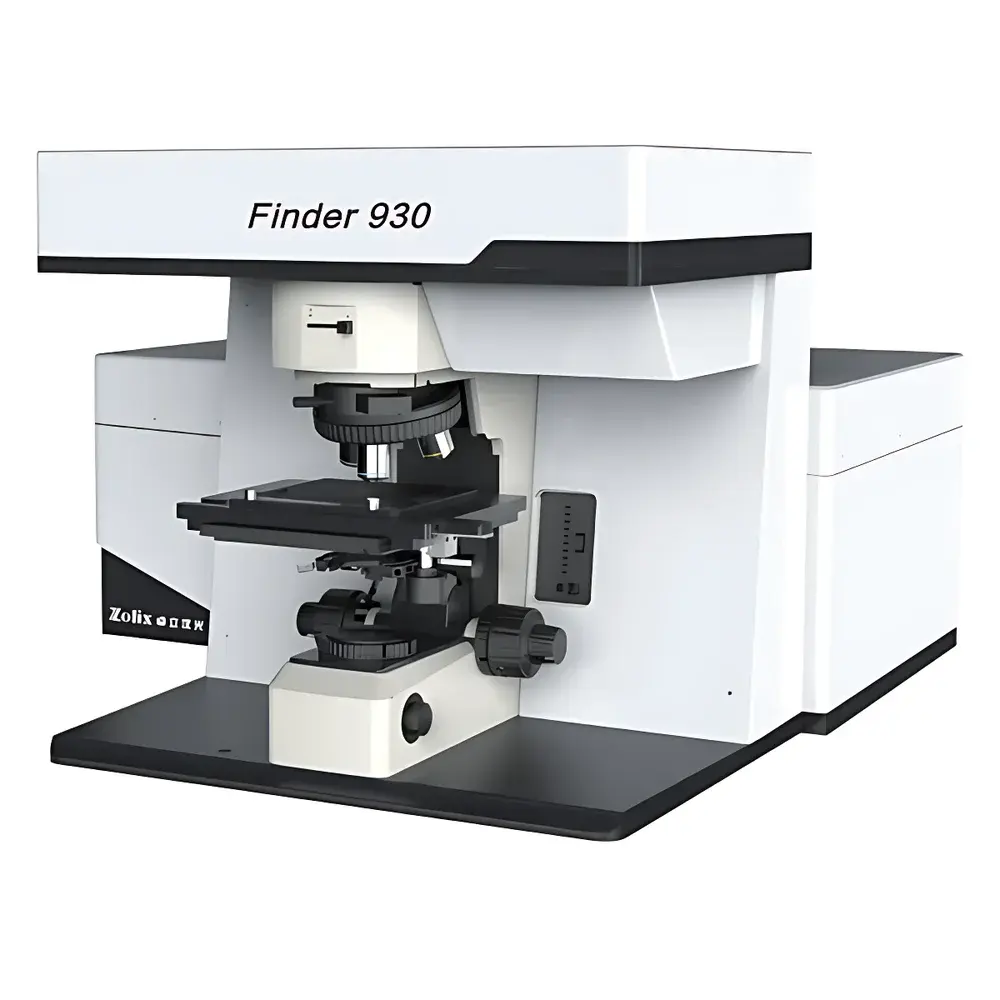
ZOLIX Finder 930 Fully Automated Raman Spectroscopy Analysis System
| Brand | ZOLIX |
|---|---|
| Origin | Beijing, China |
| Manufacturer Type | Manufacturer |
| Regional Category | Domestic (China) |
| Model | Finder 930 |
| Instrument Type | Portable/Handheld Raman Spectrometer |
| Spectral Range | 200–2500 cm⁻¹ |
| Spectral Resolution | < 1.5 cm⁻¹ |
| Spatial Resolution | 50 µm (with 532 nm excitation and 50 µm pinhole) |
| Minimum Wavenumber | See manual |
| Spectral Repeatability | See manual |
Overview
The ZOLIX Finder 930 Fully Automated Raman Spectroscopy Analysis System is an integrated, benchtop-to-field deployable instrument engineered for high-fidelity molecular fingerprinting via spontaneous Raman scattering. Unlike fluorescence-based techniques, Raman spectroscopy relies on inelastic photon scattering—where incident laser photons interact with molecular vibrational modes, resulting in energy shifts (Stokes and anti-Stokes bands) directly correlated to bond symmetries, functional groups, crystallinity, and stress/strain states. The Finder 930 employs a stabilized 532 nm solid-state laser excitation source, coupled with a high-throughput Czerny–Turner spectrometer featuring a back-illuminated CCD detector optimized for quantum efficiency across the visible–NIR range. Its core architecture integrates automated sample stage positioning, motorized optical alignment, real-time spectral acquisition, and intelligent background subtraction—enabling unattended operation for routine QC, material ID, and forensic screening.
Key Features
- Fully automated workflow: Motorized XYZ stage, auto-focus, laser power stabilization, and spectral calibration routines reduce operator dependency and improve inter-user reproducibility.
- Broad spectral coverage: 200–2500 cm⁻¹ range supports detection of low-frequency lattice modes (e.g., phonons in 2D materials), mid-frequency C–H/N–H/O–H stretches, and high-frequency triple bonds (e.g., C≡C, C≡N).
- High spectral fidelity: Optical resolution < 1.5 cm⁻¹ (FWHM) ensures resolvability of closely spaced Raman peaks—critical for distinguishing polymorphs (e.g., pharmaceutical actives), carbon allotropes (graphene vs. nanotubes), or oxidation states (e.g., Mn³⁺ vs. Mn⁴⁺ in battery cathodes).
- Sub-micron spatial profiling: With a 50 µm pinhole and diffraction-limited optics at 532 nm, the system achieves ~0.5 µm lateral resolution under optimal conditions—enabling micro-domain mapping of phase segregation in thin-film photovoltaics or compositional gradients in heterogeneous catalysts.
- Robust environmental design: Sealed optical path, thermoelectrically stabilized detector, and vibration-damped mechanical housing ensure stable performance in non-laboratory environments—including cleanrooms, production floors, and field-deployed mobile labs.
Sample Compatibility & Compliance
The Finder 930 accommodates solid powders, tablets, films, liquids, gels, and mounted biological tissues without destructive preparation. Optional accessories include fiber-optic probes for remote sampling, temperature-controlled stages (−40 °C to 200 °C), and humidity-controlled sample chambers. All hardware and firmware comply with IEC 61000-4 electromagnetic compatibility standards. Data acquisition and storage workflows support audit trails aligned with GLP and GMP requirements; spectral metadata (laser power, integration time, grating position, calibration timestamp) are embedded in vendor-neutral .spc and .csv exports. While not FDA 21 CFR Part 11–certified out-of-the-box, the system’s deterministic data handling architecture facilitates validation by end users per ISO/IEC 17025 and ASTM E1840 guidelines.
Software & Data Management
ZOLIX OmniRaman v4.x provides a unified interface for instrument control, spectral acquisition, multivariate analysis, and report generation. Key modules include:
- Real-time spectral preview with dynamic baseline correction (asymmetric least squares + polynomial fitting)
- Library search engine supporting custom spectral libraries (NIST, SDBS, commercial pharma databases) with cosine similarity and Euclidean distance scoring
- Chemometric tools: PCA, PLS-DA, and hierarchical clustering for batch classification and outlier detection
- Batch processing pipeline: Automated peak finding, intensity normalization, and spectral alignment across >1000 spectra
- Export options: ASCII, .xlsx, .spc, and HDF5 formats—with full metadata preservation for LIMS integration
All software binaries are digitally signed and compatible with Windows 10/11 LTSB editions. Remote monitoring via secure SSH tunnel or VNC is supported for centralized lab management.
Applications
The Finder 930 delivers validated performance across regulated and research-intensive domains:
- Pharmaceutical QA/QC: Polymorph identification (e.g., ritonavir Form I vs. II), counterfeit drug screening, and API-excipient interaction assessment per USP and Ph. Eur. 2.2.48.
- Materials science: Strain mapping in SiGe heterostructures, defect density quantification in CVD graphene, and phase evolution tracking during thermal annealing of Ni–Al intermetallics.
- Forensics & security: Non-invasive identification of explosives (e.g., RDX, PETN), illicit drugs (fentanyl analogues), and pigment authentication in art conservation.
- Geosciences: In situ mineral phase discrimination (e.g., quartz vs. cristobalite), fluid inclusion analysis, and carbon speciation in shale kerogen.
- Academic research: Time-resolved Raman kinetics of photocatalytic reactions, surface-enhanced Raman spectroscopy (SERS) substrate characterization, and operando battery electrode studies.
FAQ
Is the Finder 930 suitable for quantitative analysis?
Yes—when paired with internal standardization (e.g., silicon reference peak at 520.7 cm⁻¹) and calibrated using NIST-traceable Raman standards, the system achieves relative standard deviations < 3% for peak intensity ratios across repeated measurements.
Can it be used for fluorescence-suppressed measurements?
The 532 nm excitation is inherently prone to fluorescence in organic samples; however, built-in notch filters with OD > 6 and software-based fluorescence background modeling (polynomial + exponential decay fitting) enable reliable Raman extraction even from highly fluorescent matrices such as plant extracts or dyes.
What maintenance is required?
Annual wavelength calibration using neon/argon lamp standards and quarterly cleaning of optical windows with spectroscopic-grade solvents are recommended. No consumables or recalibration fees apply during the standard warranty period.
Does it support external triggering or synchronization with other instruments?
Yes—the system features TTL-compatible trigger I/O ports for synchronization with pulsed lasers, electrochemical workstations, or environmental chambers, enabling time-resolved or stimulus-coupled Raman acquisition protocols.
Is remote operation supported?
Full remote control—including stage navigation, spectral acquisition, and real-time data visualization—is available via encrypted RDP or web-based dashboard (optional add-on module).




