
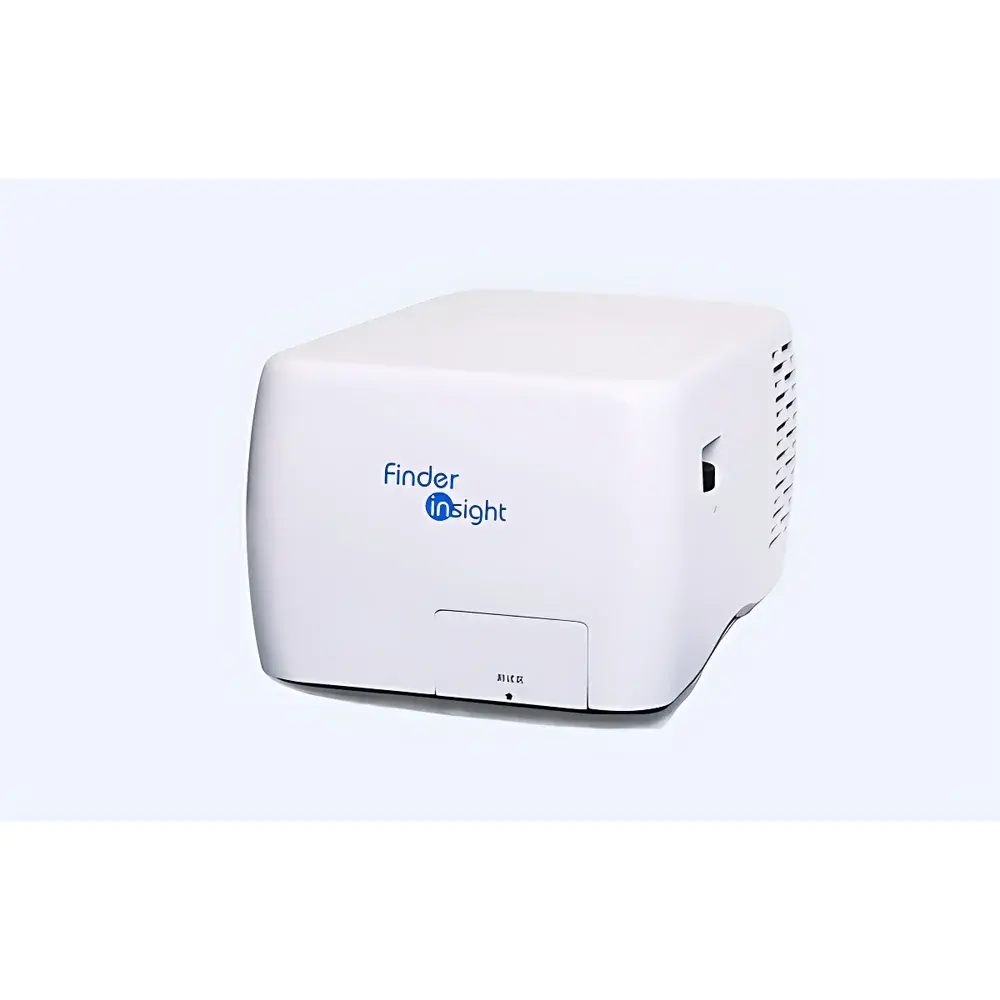
ZOLIX Finder Insight FI-R-A Portable Raman Spectrometer
| Brand | ZOLIX |
|---|---|
| Origin | Beijing, China |
| Manufacturer | ZOLIX (Producer) |
| Type | Portable / Handheld Raman Spectrometer |
| Spectral Range | 200–2000 cm⁻¹ (optional: 150–2300 cm⁻¹) |
| Spectral Resolution | 6–10 cm⁻¹ |
| Spatial Resolution | 1 µm |
| Minimum Wavenumber | 200 cm⁻¹ |
| Spectral Reproducibility | 0.01 cm⁻¹ |
| Excitation Wavelength | 785 nm |
| Laser Power | 100 mW |
| Detector | Scientific-grade Thermoelectrically Cooled CCD (NIR-enhanced) |
| F-number | f/3 |
| Power Supply | 110/220 V AC (12 V @ 4 A DC output) |
| Dimensions (W×H×L) | 216 × 166 × 352 mm |
| Weight | 5 kg |
| Baseline Subtraction | Real-time & post-acquisition polynomial fitting and subtraction |
| Monitoring Pathway | Integrated coaxial visible-light monitoring optical path with on-screen crosshair positioning and focus-point memory |
| Standard Sample Carrier | Microscope slide (25 × 75 mm), customizable |
Overview
The ZOLIX Finder Insight FI-R-A Portable Raman Spectrometer is a compact, research-grade instrument engineered for high-fidelity vibrational spectroscopy in field-deployable and benchtop-limited environments. It operates on the principle of inelastic light scattering—Raman scattering—where monochromatic laser excitation (785 nm) induces molecular vibrational transitions, yielding characteristic wavenumber-shifted spectral signatures. The system integrates a deep-cooled, NIR-optimized CCD detector with a high-throughput f/3 spectrometer optical design to maximize photon collection efficiency and signal-to-noise ratio—even under low-light or fluorescence-prone conditions. Unlike conventional handheld units relying on silicon photodiode arrays or uncooled CMOS sensors, the FI-R-A maintains spectral stability and reproducibility (±0.01 cm⁻¹ wavenumber repeatability) across thermal and mechanical perturbations, making it suitable for quantitative and comparative analysis in regulated laboratory workflows.
Key Features
- Research-Grade Optical Architecture: Utilizes a thermoelectrically cooled, back-illuminated CCD detector with >95% quantum efficiency in the 700–1000 nm range—critical for detecting weak Stokes-shifted Raman signals from 785 nm excitation.
- Direct-Coupled Optical Path: Eliminates fiber-optic losses by integrating the laser delivery, collection, and dispersion optics into a rigid, alignment-stable monolithic platform—ensuring consistent throughput and minimal spectral distortion.
- Integrated Coaxial Monitoring Pathway: A proprietary visible-light imaging channel co-aligned with the Raman excitation axis enables real-time visual confirmation of sample position, laser focus, and spot targeting. Crosshair coordinates are digitally saved for repeatable repositioning—essential for multi-sample mapping or time-series measurements.
- Fluorescence Mitigation Suite: Combines hardware-level laser line filtering (OD >6 rejection at 785 ± 2 nm), optimized grating blaze, and software-based baseline correction algorithms (polynomial, asymmetric least squares) to suppress broad fluorescent backgrounds without compromising peak integrity.
- Vertical Illumination Geometry: Supports flat, curved, irregular, or powder samples without reorientation—compatible with standard microscope slides (25 × 75 mm), custom holders, or direct surface interrogation.
- Regulatory-Ready Data Handling: All spectra are timestamped, instrument-parameter-tagged, and stored with metadata (laser power, integration time, detector temperature, calibration coefficients)—supporting audit trails aligned with GLP and ISO/IEC 17025 documentation requirements.
Sample Compatibility & Compliance
The FI-R-A accommodates solid, liquid, gel, and powdered specimens—including pharmaceutical tablets, polymer films, environmental filter extracts, biological tissues, forensic trace evidence, and cultural heritage artifacts. Its non-destructive, contact-free measurement mode preserves sample integrity. The instrument complies with IEC 61000-4 electromagnetic compatibility standards and meets CE safety directives for Class 1 laser products (IEC 60825-1:2014). While not certified for FDA 21 CFR Part 11 out-of-the-box, its data export formats (ASCII, CSV, JCAMP-DX) and metadata-rich HDF5 archives enable integration into validated LIMS or ELN systems supporting electronic signature and change-control protocols.
Software & Data Management
ZOLIX SpectraView Pro software provides full instrument control, spectral acquisition, real-time baseline correction, peak identification (library matching against >15,000 reference spectra), and multivariate analysis (PCA, PLS regression). Raw data files include embedded calibration polynomials, wavelength calibration maps, and detector gain/offset parameters—enabling traceable recalibration. Export options support ASTM E131, ISO 11171, and USP spectral data interchange conventions. Batch processing scripts allow automated QA/QC pass/fail evaluation against user-defined spectral thresholds or peak intensity ratios—particularly valuable for raw material verification or counterfeit detection workflows.
Applications
- Pharmaceutical Quality Control: Identification of active pharmaceutical ingredients (APIs), polymorph screening (e.g., carbamazepine Form III vs. Form I), and excipient compatibility assessment using SERS-active substrates.
- Food Safety & Authenticity: Detection of adulterants (melamine in milk powder), pesticide residues on produce surfaces, and geographic origin verification of olive oil or honey via fingerprint region (1200–1700 cm⁻¹) classification.
- Environmental Monitoring: In-situ identification of microplastics (PET, PE, PP) in water filtration membranes and heavy metal speciation (e.g., Cr(VI) vs. Cr(III)) in soil leachates using surface-enhanced approaches.
- Forensic Science: Non-invasive analysis of drug crystals (fentanyl analogues), explosive residues (TNT, PETN), and ink differentiation on questioned documents—without sample transfer or preparation.
- Materials Characterization: Stress/strain mapping in 2D materials (graphene G/2D band ratios), carbon nanotube chirality assignment, and crystallinity assessment in battery cathode materials (LiCoO₂ vs. NMC).
FAQ
What laser safety class does the FI-R-A operate under?
The instrument is classified as a Class 1 laser product per IEC 60825-1:2014 when operated with the integrated enclosure and shutter mechanisms engaged—no external laser safety interlocks required during routine use.
Can the FI-R-A perform quantitative analysis?
Yes—when coupled with internal standard references (e.g., silicon Raman peak at 520.7 cm⁻¹) and calibrated against NIST-traceable standards, it supports semi-quantitative concentration estimation with RSD <5% for homogeneous solid-phase samples.
Is SERS capability built-in or requires external accessories?
SERS functionality is enabled via optional gold/silver nanoparticle substrates or structured metallic chips; no hardware modification is needed—the optical path and software support sub-micron spot targeting and integration time optimization for enhanced sensitivity.
How is wavelength calibration maintained over time and temperature?
The system performs automatic daily calibration using an onboard neon-argon emission lamp; users may also run manual recalibration using certified polystyrene or silicon standards—calibration coefficients are stored per session and applied during spectral reconstruction.
Does the instrument support remote operation or network deployment?
Yes—SpectraView Pro includes TCP/IP and REST API interfaces for integration into automated lab networks, robotic sample handlers, or centralized data lakes compliant with ISA-95 or ASTM E2500 frameworks.
Related Products





