
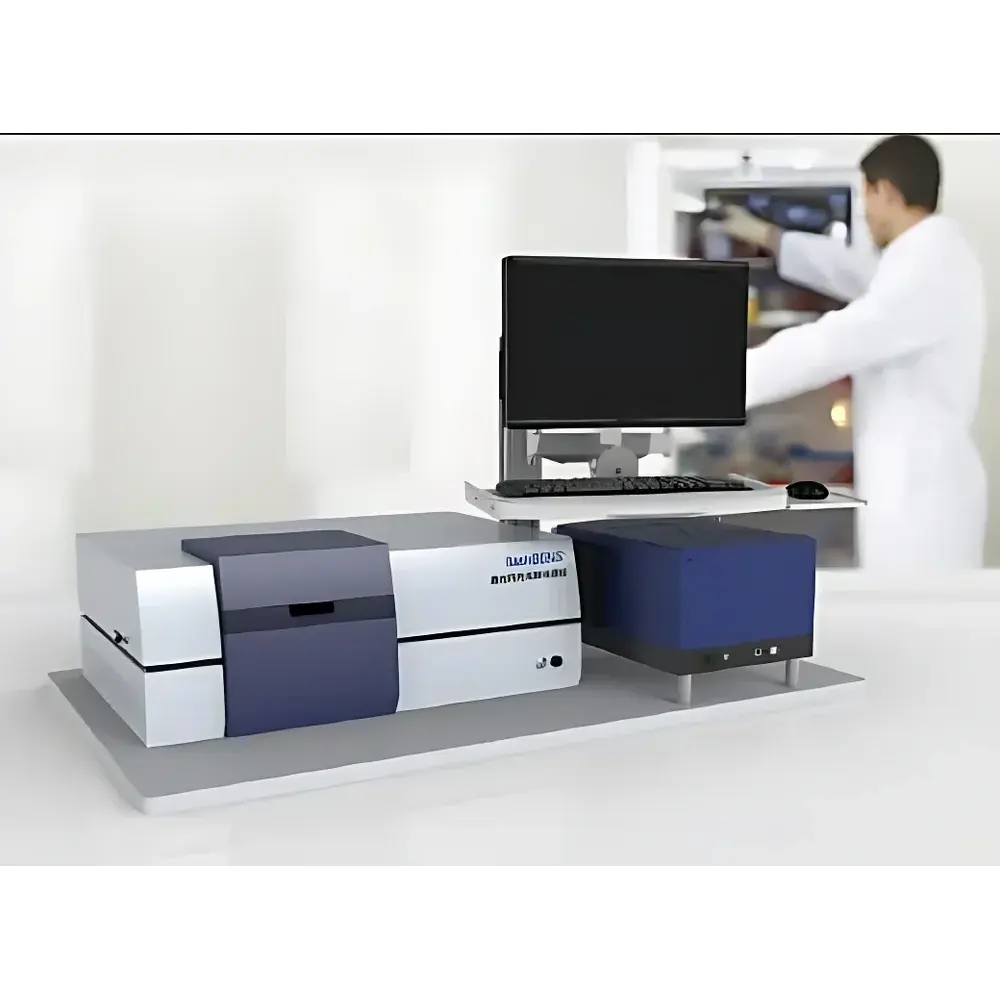
ZOLIX FlashSENS Laser Flash Photolysis Spectrometer
| Brand | ZOLIX |
|---|---|
| Origin | Beijing, China |
| Manufacturer Type | Original Equipment Manufacturer (OEM) |
| Product Origin | Domestic (China) |
| Model | FlashSENS |
| Price | USD 84,000 (FOB Beijing) |
| Dispersive Element | Holographic Grating |
| Slit Width (Spectral Bandpass) | 0.01–3 mm (motorized, programmable) |
| Spectral Resolution | 0.6 nm @ 300 grooves/mm |
| Sensitivity | 0.00024 OD (optical density) |
| Wavelength Accuracy | ±0.8 nm @ 300 grooves/mm |
| Detection Light Source | LDLS-based Supercontinuum White Light (190–2100 nm) |
| Time Resolution | <7 ns (optional ultrafast mode: 3 ns) |
| Sample Compatibility | Solid films, liquid solutions, colloidal suspensions, thin-film devices |
| Measurement Modes | Transient Absorption Kinetics (ΔA vs. t), Transient Absorption Spectra (ΔA vs. λ), Dual-mode (kinetics + spectra) |
| Monochromator | Omni-λ300i, 300 mm focal length |
| Detector Options | Si photodiode (300–1100 nm), InGaAs array (900–1600 nm), ICCD (180–850 nm, gated, -25°C thermoelectric cooling) |
| Pump Laser Compatibility | Nd:YAG harmonics (1064/532/355/266 nm), tunable OPO (210–2400 nm) |
Overview
The ZOLIX FlashSENS Laser Flash Photolysis Spectrometer is a turnkey transient absorption system engineered for quantitative investigation of photoinduced ultrafast processes in molecular and nanoscale systems. It operates on the principle of laser flash photolysis (LFP), where a short-pulse pump laser initiates non-equilibrium electronic excitation, and a time-delayed, broadband white-light probe pulse monitors spectrally resolved changes in optical density (ΔOD) across nanosecond to microsecond timescales. This enables direct observation of transient species—including singlet and triplet excited states, radical ions, charge-separated states, and vibrationally hot intermediates—without chemical labeling or perturbation. The system is designed for rigorous kinetic modeling, spectral deconvolution, and mechanistic validation in photochemical, photophysical, and photobiological research environments.
Key Features
- Integrated optical alignment architecture with rigid kinematic mounts and pre-aligned beam paths, ensuring long-term stability and reproducibility across thermal and mechanical drift cycles.
- Sub-7 ns time resolution (standard); optional ultrafast gating module achieves 3 ns temporal resolution with ICCD detection, enabling resolution of early-stage solvation dynamics and geminate recombination events.
- LDLS-driven supercontinuum probe source (190–2100 nm) provides orders-of-magnitude higher photon flux and spectral continuity compared to pulsed xenon arc lamps—critical for high signal-to-noise ratio (SNR) in low-concentration or weakly absorbing samples.
- Motorized, software-controlled slit (0.01–3 mm) coupled with the Omni-λ300i monochromator (300 mm focal length, selectable grating options) delivers calibrated spectral resolution down to 0.1 nm (@1200 g/mm) and flexible trade-offs between throughput and dispersion.
- Dual operational modes: kinetics mode (fixed wavelength, ΔA vs. time) and spectral mode (time-sliced ΔA vs. wavelength), both fully automatable via LabVIEW-based control suite with hardware-triggered synchronization.
- Modular detector configuration supports simultaneous multi-range coverage: Si photodiode (UV-Vis-NIR), InGaAs linear array (SWIR), and gated ICCD (deep UV–visible), each with factory-calibrated quantum efficiency curves and dark-current compensation routines.
- Expandable platform: native interface for integration with external transient photocurrent/voltage modules (e.g., for time-resolved photoconductivity in perovskite or organic photovoltaic devices), satisfying requirements for device-relevant photophysics characterization.
Sample Compatibility & Compliance
The FlashSENS accommodates standard cuvette-based liquid cells (1 cm pathlength), solid-state sample holders for thin films and powders, and custom vacuum/N2-purged stages for oxygen-sensitive systems. All optical paths comply with ISO 17025 traceability guidelines for radiometric calibration; spectral response functions are NIST-traceable via certified reference standards (e.g., NIST SRM 2036). Data acquisition meets GLP/GMP documentation standards: audit trails record instrument parameters, environmental conditions (temperature/humidity logs), user authentication, and raw data checksums. Optional FDA 21 CFR Part 11 compliance package includes electronic signatures, role-based access control, and immutable data archiving.
Software & Data Management
ZOLIX ControlSuite v4.2 provides full system orchestration—including laser firing sequence, delay generator programming, monochromator wavelength scanning, detector gain/offset optimization, and real-time SNR monitoring. Raw transient datasets (ΔOD(t,λ)) are stored in HDF5 format with embedded metadata (pump fluence, probe intensity, integration time, grating position). Built-in analysis tools support global fitting (singular value decomposition, target modeling), kinetic decay series extraction, isosbestic point identification, and principal component analysis (PCA). Export modules generate ASTM E2912-compliant reports and support direct import into OriginPro, MATLAB, or Python (via h5py and SciPy).
Applications
- Charge transfer kinetics in dye-sensitized solar cells (DSSCs) and metal–organic frameworks (MOFs)
- Exciton dissociation and carrier trapping dynamics in perovskite and quantum dot thin films
- Triplet–triplet annihilation upconversion efficiency quantification
- Photoinduced electron injection from molecular sensitizers into TiO2 or SnO2 nanoparticles
- Proton-coupled electron transfer (PCET) pathways in biomimetic catalysts
- Singlet fission yield and triplet diffusion length measurement in acene derivatives
- Nonlinear absorption cross-section determination via two-photon induced transient absorption
- Photostability assessment of fluorescent probes under repeated pulsed irradiation
- Time-resolved ligand-field transitions in transition-metal complexes (e.g., Ru(bpy)32+, Ir(ppy)3)
FAQ
What pump laser sources are compatible with the FlashSENS system?
The system accepts standard Q-switched Nd:YAG lasers (1064 nm fundamental, plus harmonics at 532 nm, 355 nm, and 266 nm) and tunable OPO systems covering 210–2400 nm. Laser energy monitoring and automatic fluence normalization are supported via integrated pyroelectric sensor feedback.
Can the FlashSENS perform measurements under inert or controlled-atmosphere conditions?
Yes—sample compartments accept standard glovebox-integrated stages or vacuum/N2-purged cuvette holders. Optical windows are fused silica (190–2100 nm transmission) with AR coatings optimized for probe light throughput.
Is spectral calibration traceable to international standards?
All wavelength calibration is performed using Hg/Ar/Ne emission line standards, with residuals ≤±0.1 nm across the 190–2100 nm range. Certificate of Calibration includes uncertainty budget per ISO/IEC 17025 Annex A.
How is data integrity ensured during long-duration kinetic acquisitions?
Real-time baseline correction algorithms compensate for probe source drift; each scan includes reference-only (no pump) acquisitions interleaved at user-defined intervals. Raw data files embed SHA-256 hashes for tamper-evident archival.
Does the system support kinetic modeling beyond mono- or bi-exponential fits?
Yes—ControlSuite integrates with commercial kinetic simulation engines (e.g., Kinetiscope, Gepasi) via ASCII export. Users may define multi-step reaction schemes, include solvent relaxation terms, and constrain rate constants based on Arrhenius or Marcus theory parameters.





