
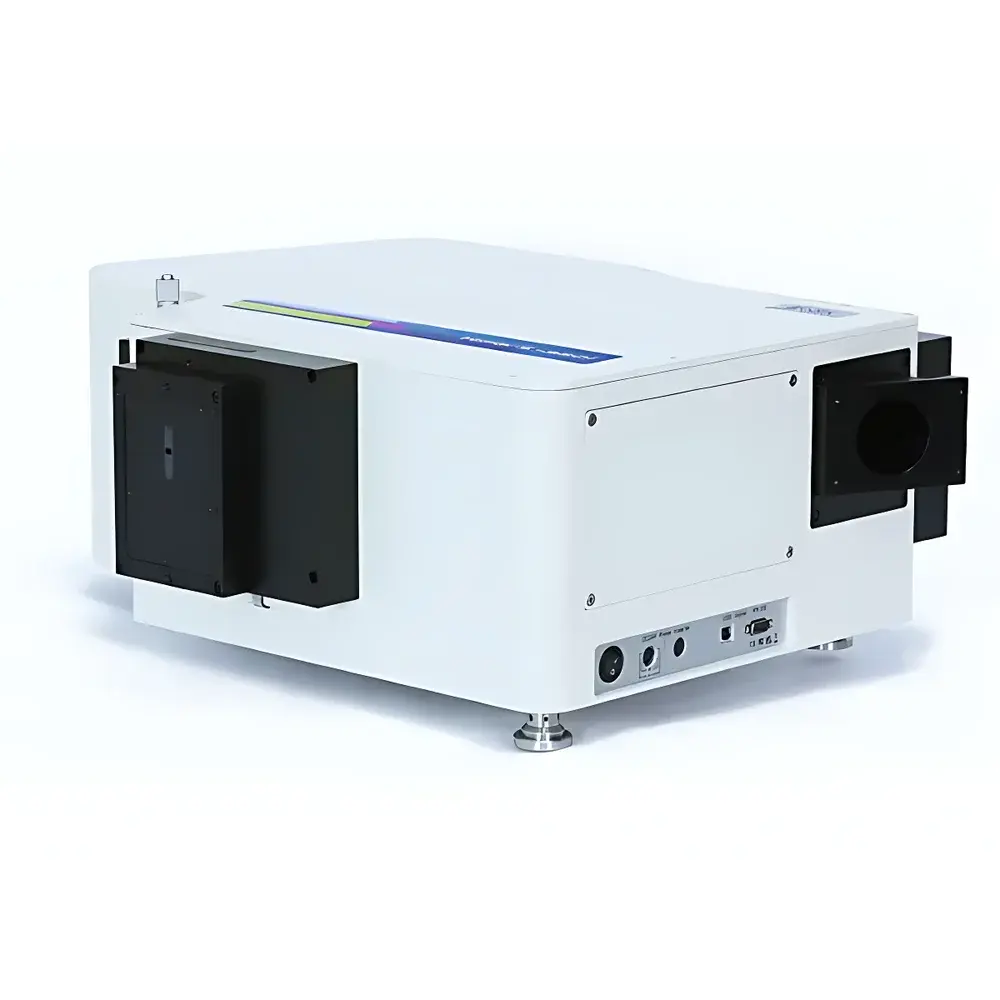
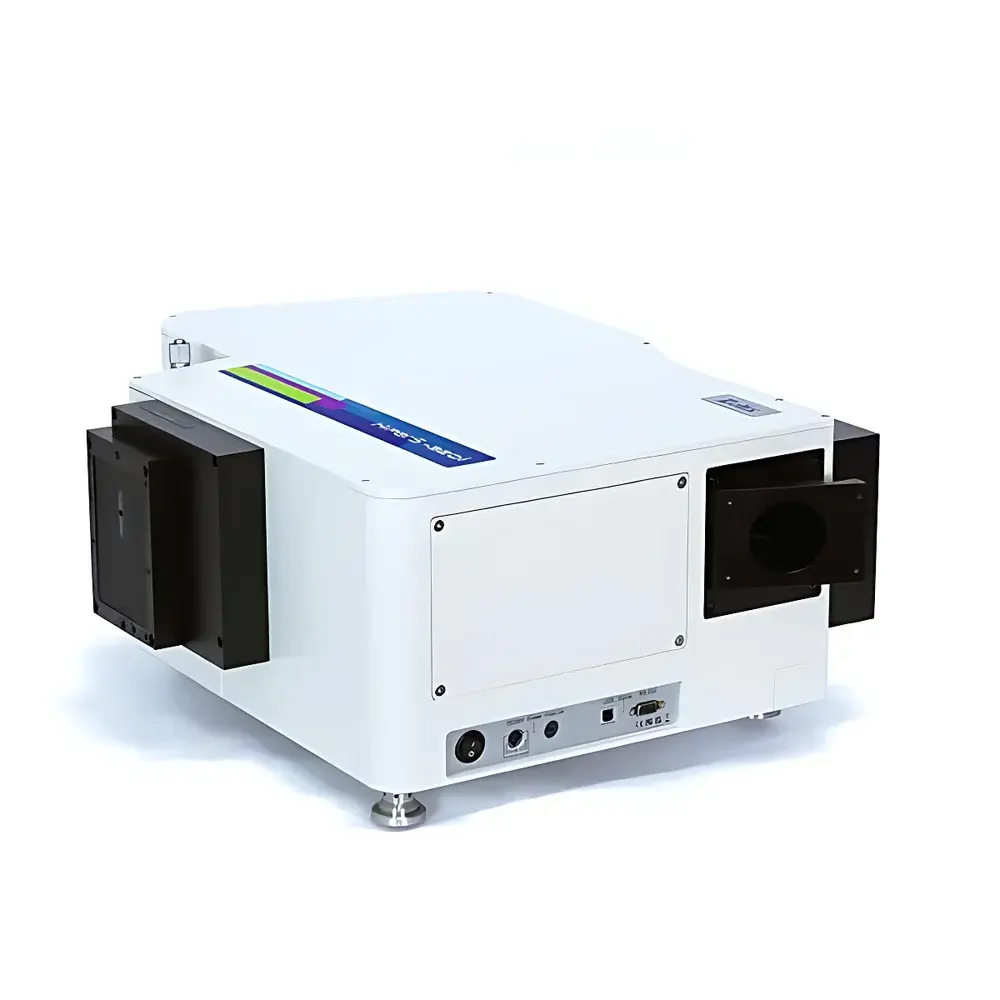
ZOLIX HiperS-320i Full-Field Imaging-Corrected Grating Spectrometer
| Brand | ZOLIX |
|---|---|
| Origin | Beijing, China |
| Manufacturer Type | Original Equipment Manufacturer (OEM) |
| Product Origin | Domestic (China) |
| Model | HiperS-320i |
| Application System | Universal |
| Grating Mount | Triple-grating in-axis rotating turret |
| Spectral Resolution | 0–1430 nm range (with resolution down to 0.06 nm @ 1200 g/mm grating, PMT detection) |
| Linear Dispersion | 2.29 nm/mm (@ 435.83 nm) |
| Wavelength Accuracy | ±0.2 nm |
| Stray Light Level | 5×10⁻⁵ |
Overview
The ZOLIX HiperS-320i is a high-performance, full-field imaging-corrected grating spectrometer engineered for demanding spectroscopic applications requiring simultaneous spatial and spectral fidelity. Unlike conventional Czerny–Turner or Paschen–Runge configurations, the HiperS-320i implements an asymmetric full-field imaging correction architecture—designed to suppress coma, astigmatism, field curvature, and spherical aberration across the entire focal plane. This optical design enables diffraction-limited imaging performance over a 29 mm (W) × 14 mm (H) flat focal plane, supporting multi-channel, spatially resolved detection with CCD arrays or fiber-optic bundles (e.g., 9-core, 100 µm core diameter). With a 320 mm focal length and F/4.4 relative aperture, the instrument balances light throughput, resolution, and compact mechanical footprint—making it suitable for integration into Raman microspectroscopy setups, plasma diagnostics, synchrotron beamline endstations, and time-resolved photoluminescence systems.
Key Features
- Asymmetric full-field imaging correction: Minimizes off-axis aberrations across the entire focal plane, delivering uniform spectral resolution and peak symmetry from UV to NIR (190–1100 nm, depending on grating and detector choice).
- Triple-grating in-axis rotating turret: Enables rapid, repeatable grating exchange without realignment; increases effective grating utilization by 15% compared to off-axis mounts (measured at 1200 g/mm, 550 nm).
- Resolution enhancement module: Optional hardware-based optical compensation that improves spectral resolution by up to 20% while maintaining imaging fidelity—particularly beneficial for narrow-line emission sources or high-resolution absorption studies.
- Dual-input/dual-output configuration support: Configurable for side entrance + dual CCD exits, side entrance + slit + CCD exits, or dual entrance ports—enabling flexible coupling to lasers, lamps, fiber bundles, or microscope objectives.
- Intelligent auto-focusing mechanism: Dynamically adjusts mirror position during grating switching to maintain optimal focus at the detector plane—ensuring maximum resolution and signal-to-noise ratio across all gratings and wavelength ranges.
- Precision mechanical drive: Minimum wavelength step of 0.005 nm (at 1200 g/mm), repeatability of ±0.025 nm, and absolute accuracy of ±0.2 nm—traceable via internal calibration reference lines (e.g., Hg/Ne lamp lines).
Sample Compatibility & Compliance
The HiperS-320i is compatible with standard spectroscopic detectors including back-illuminated CCDs (15 µm pixel pitch), scientific CMOS sensors, and PMTs. Its 29 mm wide focal plane accommodates linear array detectors and custom fiber-optic image conduits. Slit height options (2 mm, 4 mm, 14 mm) allow optimization for throughput versus resolution in emission, absorption, or fluorescence measurements. The system complies with ISO 14785:2022 (spectrometer performance characterization) and supports GLP/GMP-aligned workflows through optional hardware-triggered acquisition synchronization and external shutter control. While not inherently FDA 21 CFR Part 11 compliant, its USB2.0 and RS-232 interfaces enable integration into validated laboratory information management systems (LIMS) when paired with audit-trail-capable third-party acquisition software.
Software & Data Management
The spectrometer operates via ZOLIX’s SpectraMaster™ control suite (Windows-based), providing wavelength calibration, grating selection, slit control, motorized focus adjustment, and real-time spectrum preview. Raw data export is supported in ASCII, CSV, and FITS formats—ensuring compatibility with Igor Pro, MATLAB, Python (NumPy/Pandas), and OriginLab for advanced spectral processing. Batch acquisition modes support kinetic series, mapping scans, and multi-grating sequential sweeps. All parameter changes—including grating position, slit width (0.01–3 mm manual adjustment; motorized option available), and detector integration time—are logged with timestamps and user IDs, forming a complete experimental metadata trail.
Applications
- Micro-Raman spectroscopy: Coupled with confocal microscopes for chemical mapping with sub-micron spatial registration and <0.1 nm spectral resolution.
- Plasma emission analysis: Simultaneous multi-line monitoring of atomic and ionic species (e.g., O I, N II, Ar II) in low-pressure discharge environments.
- Time-resolved photoluminescence: Gated detection synchronized with pulsed lasers (ns–µs domain) to resolve decay kinetics across multiple emission bands.
- Astronomical calibration: High-accuracy wavelength referencing using hollow-cathode lamps for echelle cross-calibration in observatory instrumentation.
- UV-Vis-NIR material characterization: Reflectance, transmittance, and absorbance quantification across extended spectral ranges with minimal stray light interference (5×10⁻⁵).
FAQ
What is the difference between “slit spectral resolution” and “CCD spectral resolution”?
Slit spectral resolution refers to the theoretical minimum resolvable wavelength interval under ideal point-source illumination and infinitely narrow slit. CCD spectral resolution accounts for pixel sampling, readout noise, and spatial averaging across finite pixel dimensions (e.g., 15 µm); it represents the practical limit for broadband or extended-source measurements.
Can the HiperS-320i be used with vacuum UV optics?
Standard configurations operate in air (190–1100 nm). For VUV operation (<190 nm), optional MgF₂-coated optics and purged/vacuum-compatible versions (e.g., HiperS-3247i/HiperS-3248i) are available upon request.
Is motorized slit control included by default?
No—manual slit adjustment (0.01–3 mm) is standard. Motorized slits are optional accessories and must be specified at time of order.
How is wavelength calibration performed?
Factory calibration uses Hg/Ar/Ne spectral lamp lines traceable to NIST standards. End-users may perform secondary calibration using internal or external reference sources via SpectraMaster™’s multi-point fitting algorithm.
What detector interfaces are supported?
The system provides standard analog voltage output for PMTs and TTL/CMOS trigger signals for external CCD/CMOS cameras. Direct detector integration (e.g., Andor iDus, Hamamatsu C12880) requires model-specific SDKs and is supported through ZOLIX application engineering.
Related Products




