
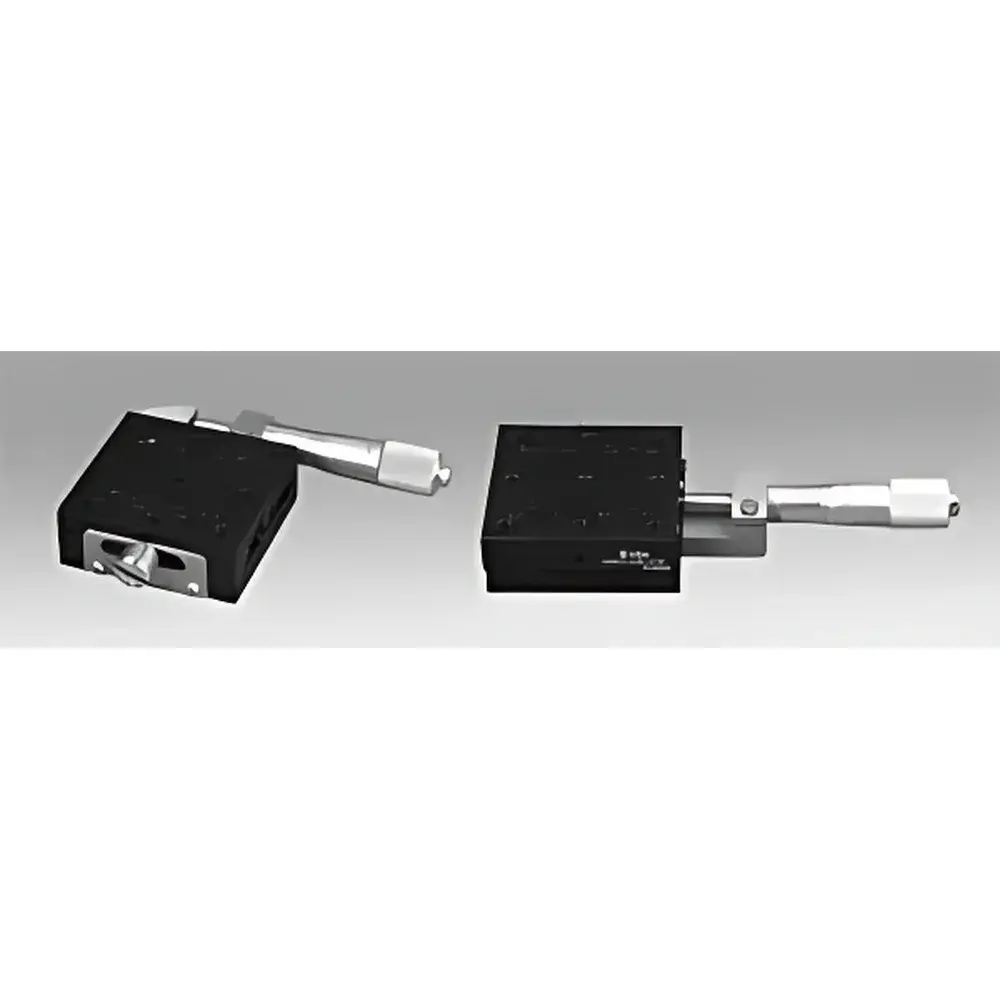
ZOLIX KSMT Series High-Precision Translation Stage
| Brand | ZOLIX |
|---|---|
| Model | KSMT Series |
| Origin | Beijing, China |
| Manufacturer Type | Direct Manufacturer |
| Drive Options | Micrometer Knob (Central/Left/Right), Precision Threaded Rod (Central/Left/Right) |
| Travel Range | ±12.5 mm |
| Platform Dimensions | 65 mm × 65 mm |
| Total Thickness | 23 mm |
| Motion Parallelism | <10 µm |
| Pitch | <30 arcseconds |
| Yaw | <20 arcseconds |
| Maximum Load Capacity | 5 kg |
| Guidance System | Imported Crossed-Roller Bearings |
| Base & Platform | Precision Ground Stainless Steel |
| Preload Mechanism | Dual-Spring Anti-Backlash Compensation |
| Compliance | Designed for ISO 9001-certified manufacturing and compatible with GLP-aligned optical alignment workflows |
Overview
The ZOLIX KSMT Series High-Precision Translation Stage is an engineered mechanical positioning solution designed for demanding optical alignment, interferometry, microscopy, and photonics integration applications. Built upon the foundational principles of kinematic constraint and low-hysteresis motion transmission, the stage employs a rigid monolithic base structure paired with high-stiffness crossed-roller linear bearings to deliver sub-micron repeatability and minimal parasitic motion. Its core architecture eliminates thermal drift-induced misalignment through symmetric design and matched coefficient-of-thermal-expansion materials. Unlike belt- or motor-driven stages, the KSMT series relies exclusively on manual, tactile actuation—ensuring zero electromagnetic interference (EMI), no power dependency, and full compatibility with vacuum-compatible or EMI-sensitive environments such as laser cavity alignment or quantum optics setups.
Key Features
- Precision-ground stainless steel base and platform surfaces ensure dimensional stability and surface flatness better than λ/10 over the full 65 mm × 65 mm aperture—critical for wavefront-sensitive optical paths.
- Crossed-roller bearing guides—sourced from ISO 10012-compliant suppliers—provide consistent rolling contact with negligible stick-slip, enabling smooth, continuous translation across the full ±12.5 mm travel range.
- Three standardized drive configurations: micrometer knob (with 10 µm scale resolution and vernier-assisted readout), fine-pitch threaded rod (0.25 mm pitch, direct 1:1 displacement coupling), and differential micrometer option (offering 1 µm effective resolution via dual-thread engagement).
- Spring-loaded dual-preload mechanism actively compensates for axial clearance in both forward and reverse directions, eliminating backlash without compromising torque transmission efficiency.
- Modular mounting interface includes four M4 threaded holes on the base (ISO 2768-mK tolerance) and two orthogonal sets of M3 locating holes on the platform, facilitating rapid integration into multi-axis goniometric stacks or OEM optical breadboards.
Sample Compatibility & Compliance
The KSMT stage is fully compatible with standard optical components—including lens mounts, mirror holders, fiber couplers, and photodetector carriers—within its 5 kg static load limit and 65 mm platform footprint. It meets mechanical interface requirements defined in ISO 10110-7 (optical element mounting) and supports traceable calibration protocols under ISO/IEC 17025-accredited laboratories when used with certified displacement measurement systems (e.g., HeNe interferometers or capacitive sensors). While not intrinsically certified for cleanroom Class 100 use, its non-outgassing stainless steel construction and absence of lubricants make it suitable for ISO 14644-1 Class 5 environments when assembled using vacuum-grade fasteners. No electrical certification (e.g., CE, UL) applies, as the device contains no powered elements.
Software & Data Management
As a purely manual, non-motorized stage, the KSMT series does not integrate with digital control software or host interfaces. However, its mechanical resolution and repeatability support quantitative documentation within laboratory information management systems (LIMS) and electronic lab notebooks (ELN). Users may log positional settings manually using the engraved scale and vernier markings—or pair the stage with external metrology tools (e.g., Keysight 5530 Laser Calibration System) to generate traceable position reports compliant with FDA 21 CFR Part 11 audit-trail requirements when deployed in regulated QC/QA optical testing workflows.
Applications
- Laser beam steering and cavity length tuning in Ti:sapphire and fiber laser resonators
- Active alignment of single-mode fiber arrays in photonic integrated circuit (PIC) packaging
- Sub-pixel registration of CCD/CMOS sensors during telescope focal plane assembly
- Calibration reference positioning in NIST-traceable optical null testing setups
- Thermal expansion coefficient measurement via differential displacement tracking under controlled temperature ramps
FAQ
Is the KSMT stage compatible with vacuum environments?
Yes—the stage uses vacuum-compatible stainless steel (AISI 304), dry-running crossed-roller bearings, and no organic lubricants. Optional vacuum-rated versions (KSMT-V) are available with helium-leak-tested assemblies and baked-out hardware.
Can multiple KSMT stages be stacked for XYZ motion?
Yes—each stage features orthogonal mounting patterns and ≤23 mm total height, enabling stable three-axis stacks with cumulative pitch/yaw error below 1 arcminute when aligned per ISO 10360-2 guidelines.
What is the typical repeatability under 2 kg load?
Measured repeatability is ±0.8 µm (3σ) over 100 cycles at room temperature (22 ± 1°C) with micrometer-driven operation, verified using a Zygo Verifire™ interferometer and calibrated gauge blocks.
Does ZOLIX provide calibration certificates with purchase?
Standard delivery includes a factory verification report documenting motion parallelism, pitch, yaw, and travel linearity. NIST-traceable calibration certificates are available as an optional add-on service.
Are custom platform sizes or travel ranges offered?
Yes—ZOLIX offers OEM engineering support for modified base geometries, extended travel (±25 mm), and specialized surface treatments (e.g., black oxide, gold plating) under non-disclosure agreement terms.






