
ZOLIX Laser-Induced Fluorescence & Planar Laser-Induced Fluorescence (LIF & PLIF) Diagnostic System
| Brand | ZOLIX |
|---|---|
| Origin | Beijing, China |
| Manufacturer Type | Original Equipment Manufacturer (OEM) |
| Instrument Form Factor | Benchtop |
| Model | LIF&PLIF Diagnostic System |
| Key Features | Tunable Dye Laser (220–780 nm), Sub-nanosecond ICCD Gating (≤2 ns optical gate width), 5 ps Timing Resolution, 4-Channel Digital Delay Generator, Planar Laser Sheet Formation (0.1–0.3 mm thickness), PIV-Compatible Architecture |
| Compliance | Designed for ASTM E2912-compliant combustion diagnostics |
Overview
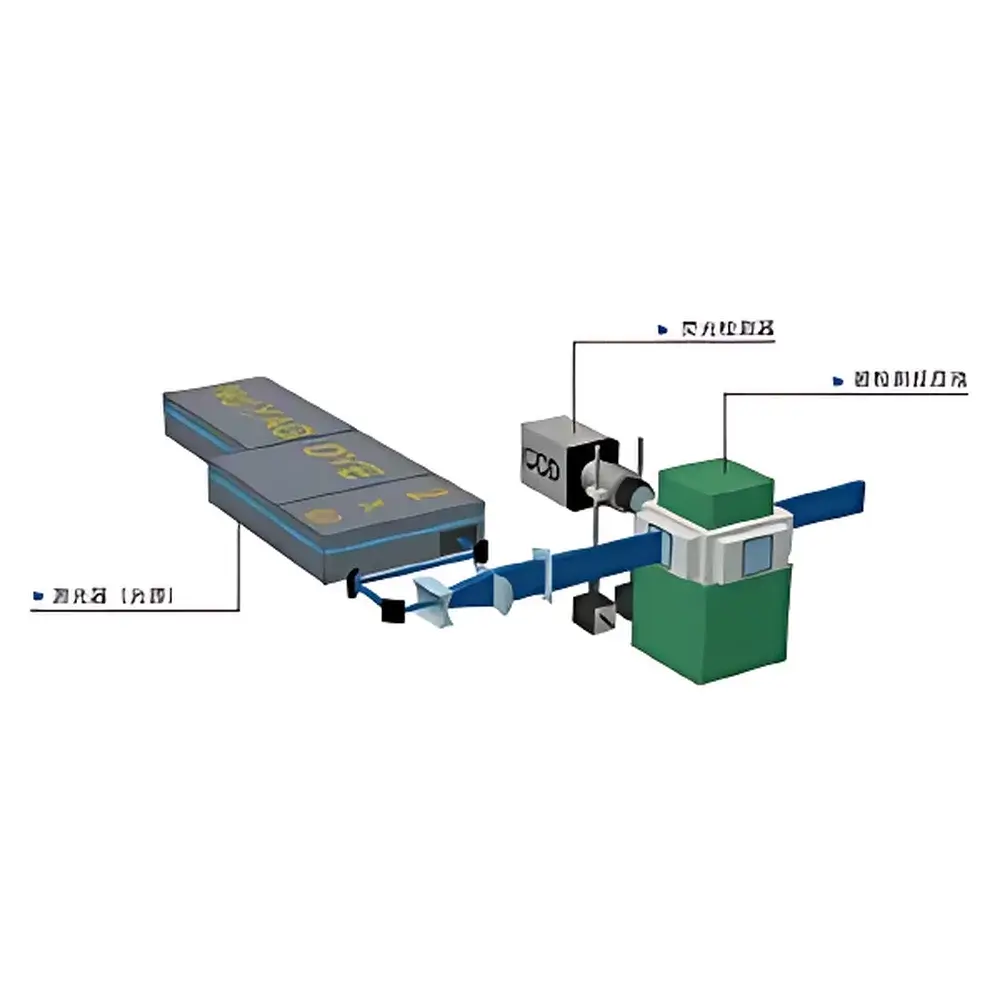
The ZOLIX Laser-Induced Fluorescence & Planar Laser-Induced Fluorescence (LIF & PLIF) Diagnostic System is a modular, research-grade optical diagnostic platform engineered for quantitative, non-intrusive two-dimensional measurement of reactive species, temperature, and mixture fraction in transient combustion environments. Operating on the physical principle of resonant laser excitation—where tunable narrowband laser radiation (220–780 nm) selectively promotes target molecular or radical species (e.g., OH, CO, CH, NO) from a lower electronic/vibrational state to an excited state—the system captures spontaneous fluorescence emission upon radiative decay. In PLIF mode, the laser beam is transformed into a thin, collimated light sheet (0.1–0.3 mm thickness) using cylindrical and spherical optics, enabling spatially resolved planar interrogation of flame structures, ignition kernels, fuel spray distributions, and reaction zones. The system’s core architecture integrates time-resolved detection with sub-nanosecond temporal precision, making it suitable for high-speed combustion phenomena including turbulent flame propagation, lean blowout, and transient ignition events in gas turbine, scramjet, and internal combustion engine research.
Key Features
- Integrated tunable dye laser system with continuous wavelength coverage from 220 nm to 780 nm (extendable to 200–4500 nm with optional modules), linewidth ≤ 0.06 cm⁻¹, pulse energy up to 110 mJ @ 560 nm, and 10 Hz repetition rate.
- Optical sheet-forming train incorporating precision cylindrical lens (f = 50 mm) and spherical focusing lens (f = 500 mm), enabling reproducible laser sheet geometry with minimal divergence and uniform intensity profile across the measurement plane.
- High-sensitivity, time-gated intensified CCD (iStar series) featuring true optical gate widths < 2 ns, 5 ps timing resolution, 19 ns minimum insertion delay, and built-in multi-channel digital delay generator (4 standard channels, expandable to 8).
- Thermoelectrically cooled detector (–40 °C operating temperature), selectable Gen II/Gen III photocathodes, P43/P46 phosphor screens, and UV-optimized Intelligate™ gating technology ensuring >10⁸:1 extinction ratio in deep-UV spectral regions.
- Full software suite supporting synchronized acquisition, real-time image preview, spectral calibration, Abel inversion, temperature mapping (via dual-line or Boltzmann plot methods), and concentration quantification using calibrated reference cells or Rayleigh scattering normalization.
- Modular mechanical architecture compatible with particle image velocimetry (PIV) integration, enabling simultaneous velocity–scalar field measurements in single-shot or double-pulse configurations with inter-frame delays down to 200 ns.
Sample Compatibility & Compliance
The system is validated for quantitative detection of key combustion intermediates—including hydroxyl (OH), carbon monoxide (CO), polycyclic aromatic hydrocarbons (PAHs), formaldehyde (CH₂O), and nitric oxide (NO)—in gaseous, spray, and sooting flame environments. It supports both single-species and multi-species sequential imaging through rapid laser wavelength tuning and synchronized detector gating. All hardware components comply with IEC 61000-6-3 (EMC emissions) and IEC 61000-6-2 (immunity) standards. Data acquisition workflows are structured to support traceable, auditable records per GLP and ISO/IEC 17025 requirements, with embedded timestamps, instrument configuration logs, and user-defined metadata fields. While not FDA 21 CFR Part 11-certified out-of-the-box, the software architecture permits integration with third-party electronic lab notebook (ELN) systems for regulated environments requiring electronic signature and audit trail functionality.
Software & Data Management
The proprietary ZOLIX PLIF Control Suite provides unified control of laser parameters, ICCD settings, delay generator sequencing, and image acquisition—all accessible via intuitive graphical interface. Raw images are stored in TIFF-64 or HDF5 format with embedded EXIF-like metadata (laser wavelength, pulse energy, gate delay, gain, binning, ambient pressure/temperature). Batch processing pipelines include background subtraction, flat-field correction, spectral deconvolution (when coupled with spectrograph), Abel inversion for axisymmetric flames, and ratiometric thermometry. Export options include CSV for concentration profiles, VTK for 3D visualization in ParaView, and MATLAB-compatible .mat files. The software supports scripting via Python API for custom analysis workflows and integrates with LabVIEW via shared memory buffers for hybrid experimental setups.
Applications
This system serves as a foundational tool in fundamental and applied combustion science. Typical use cases include: characterization of laminar flame speed and Markstein length under varying equivalence ratios; quantitative mapping of OH radical distribution during autoignition in HCCI engines; visualization of fuel–air mixing dynamics in direct-injection gasoline sprays; validation of large-eddy simulation (LES) and chemical kinetics models against experimental scalar fields; investigation of soot precursor formation pathways via PAH-LIF; and development of closed-loop combustion control strategies using real-time PLIF feedback. Its modularity also supports adaptation to non-combustion domains such as plasma diagnostics, microfluidic reaction monitoring, and atmospheric chemistry studies involving trace gas detection.
FAQ
What combustion species can be measured with this system?
OH, CO, CH, NO, CN, C₂, HCHO, and selected PAHs—dependent on available laser wavelengths and detector quantum efficiency in the relevant spectral bands.
Is the system compatible with existing PIV hardware?
Yes. The timing controller includes dedicated TTL outputs synchronized to laser pulses and ICCD gates, enabling seamless integration with commercial PIV lasers and cameras for combined velocity–scalar field measurements.
Can temperature be quantified without additional calibration hardware?
Yes—using dual-line OH-PLIF (Q₁/Q₂ band ratio) or Boltzmann-plot analysis of OH rotational spectra when coupled with a spectrograph; absolute calibration requires known reference temperature conditions or NIST-traceable blackbody sources.
What level of spatial resolution is achievable in PLIF imaging?
Typical in-plane resolution is 50–100 µm, governed by laser sheet thickness (0.1–0.3 mm), optical magnification, and pixel size of the ICCD sensor; axial resolution is limited by sheet thickness and cannot be improved beyond optical sectioning constraints.
Does the software support automated data reduction for publication-ready figures?
Yes—batch processing modules generate annotated contour plots, line-integrated profiles, and statistical maps (mean, RMS, probability density functions) directly exportable to SVG, EPS, or PNG formats with customizable color scales and units.
Related Products





