
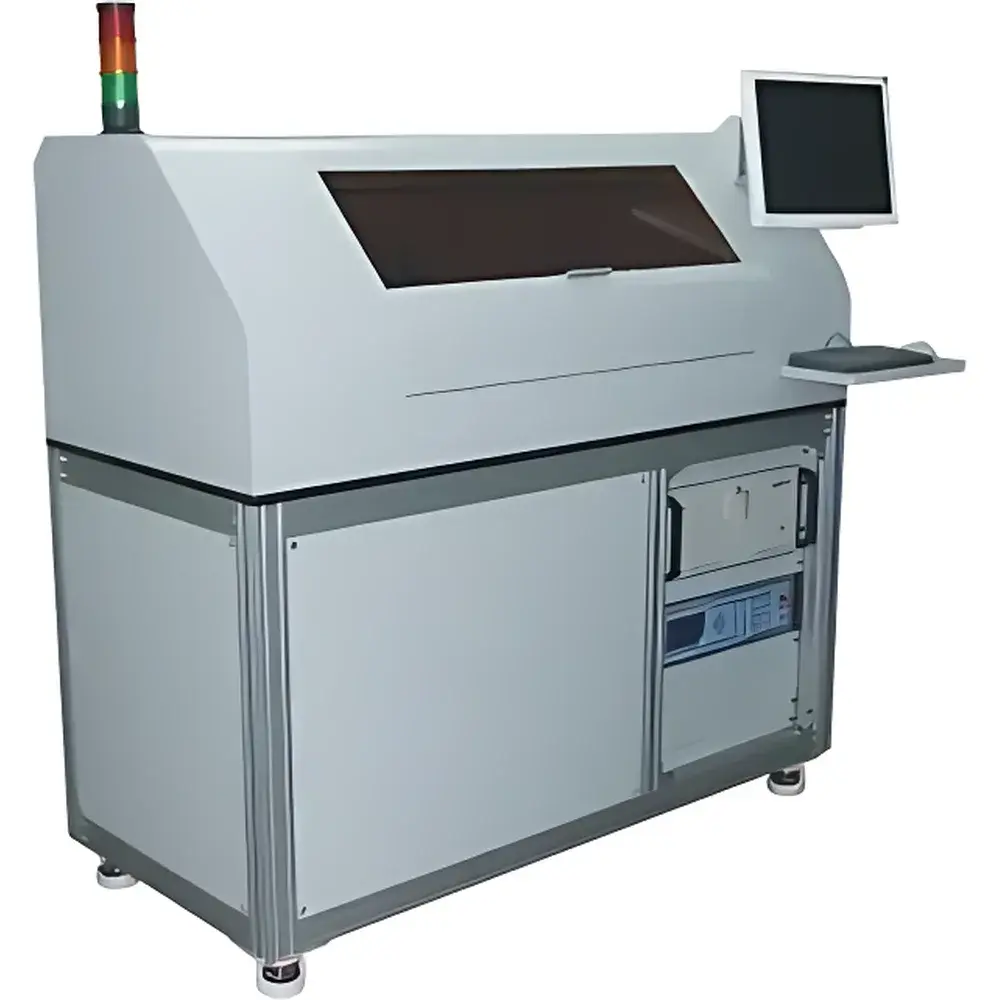
ZOLIX LB-700 LightBar Optical Test System
| Brand | ZOLIX |
|---|---|
| Origin | Beijing, China |
| Manufacturer Type | OEM/ODM Manufacturer |
| Country of Origin | China |
| Model | LB-700 |
| Dimensions (W×D×H) | 1500 × 700 × 1500 mm |
| Luminous Intensity Range | 100–50,000 mcd |
| Photometric Accuracy (Luminous Intensity) | < ±5% |
| Repeatability (Luminous Intensity) | < ±3% |
| CIE x,y Chromaticity Accuracy (CIE 127-B) | < ±0.004 |
| CIE x,y Repeatability | < ±0.003 |
| Spectrometer | Chameleon Series, 380–780 nm, Optical Resolution: 1 nm, A/D: 16-bit |
| XY Translation Stage | 2-axis, X: 600 mm, Y: 145 mm, Positioning Accuracy: ±0.02 mm |
| Power Supply | 0–250 V, 0–1 A |
| Voltage Accuracy | 0.05% + 2 LSB |
| Current Accuracy | 0.15% + 5 LSB |
| Data Export Format | Excel |
Overview
The ZOLIX LB-700 LightBar Optical Test System is a fully automated, CIE 127-compliant measurement platform engineered for high-throughput photometric and spectroradiometric characterization of LED-based light bars used in LCD backlight units. It implements a dual-path optical architecture: direct LED emission measurement (for luminous intensity, spectral power distribution, peak wavelength λp, dominant wavelength λd, FWHM, CCT, CIE x,y coordinates, and luminous flux) and post-LCD transmission analysis—enabling evaluation of the *actual* chromatic performance as perceived by the display panel. Unlike conventional binning systems that rely solely on tristimulus color matching (CIE x,y), the LB-700 resolves metamerism at the spectral level, distinguishing between metameric (same-color, different-spectrum) and isomeric (same-color, same-spectrum) LED populations—a critical capability for eliminating white balance drift, color shift, and batch-to-batch inconsistency in mass-produced TV and monitor backlights.
Key Features
- CIE 127-B standard-compliant absolute spectral calibration with traceable NIST-referenced reference lamps
- Dual-mode illumination path: direct LED emission measurement + integrated LCD-transmission simulation module for post-filter spectral assessment
- Automated XY translation stage (±0.02 mm positioning accuracy) supporting single or multi-bar configurations, rigid or flexible PCB substrates, and side-emitting or top-emitting architectures
- Chameleon-series spectrometer (380–780 nm, 1 nm optical resolution, 16-bit A/D) enabling full SPD acquisition per LED die
- Simultaneous real-time display of per-LED photometric data (luminous intensity in mcd, forward voltage Vf) and post-LCD metrics (transmitted luminance, CCT shift, NTSC gamut coverage ratio)
- Statistical overlay of chromaticity distributions across all LEDs on a single LightBar to quantify SMD supplier consistency and process stability
Sample Compatibility & Compliance
The LB-700 accommodates a broad range of LightBar form factors: rigid FR4, flexible polyimide substrates, COB-integrated modules, and discrete 2835/3528/5050 SMD arrays. It supports both front-emitting (top-view) and edge-emitting (side-fire) geometries without mechanical reconfiguration. All photometric measurements adhere strictly to CIE Publication 127:2007 (“Measurement of LEDs”) and are traceable to national metrology institutes via factory-installed calibration certificates. The system’s spectral acquisition and chromaticity computation comply with CIE 15:2018 and ISO/CIE 11664-1:2019. For regulated manufacturing environments, audit trails, user access logs, and electronic signature support can be enabled to meet FDA 21 CFR Part 11 and ISO 17025 documentation requirements.
Software & Data Management
The proprietary ZOLIX LightBar Analysis Suite provides a deterministic workflow for spectral binning, metamerism detection, and display-ready qualification. Each LED is assigned a unique spectral fingerprint; the software identifies metameric pairs by computing spectral similarity indices (e.g., CIE DE2000 in spectral domain, not just CIE x,y). Results include CIE 1931 chromaticity diagrams with cluster overlays, NTSC 1953 and Rec. 709 gamut boundary comparisons, and statistical summaries (mean, σ, Cp/Cpk) for each photometric parameter. Raw spectral data, photometric tables, and XY coordinate maps are exported natively to Excel (.xlsx) with metadata headers compliant with ASTM E308-22. Version-controlled firmware and software updates ensure long-term compatibility with evolving display standards (e.g., DCI-P3, Rec. 2020).
Applications
- Final QA screening of LightBars prior to LCD module assembly
- Root-cause analysis of white point deviation in mass-produced panels
- Supplier qualification and incoming material inspection (SMD LED lots)
- Process validation for phosphor-coating uniformity and die placement accuracy
- Development of spectral binning protocols that replace traditional CIE x,y-only sorting
- Correlation studies between LED spectral shape and human visual response under LCD filtering
FAQ
Does the LB-700 measure LEDs after actual LCD panel transmission, or is it simulated?
The system uses calibrated, spectrally neutral diffusers and fixed-angle collimation optics to replicate the angular and spectral filtering characteristics of standard LCD backlight stacks. While not requiring physical panel insertion, its transmission model is empirically validated against production-grade IPS and VA panels per IEC 62341-6-3.
Can the LB-700 detect metamerism without requiring reference spectra?
Yes. It performs unsupervised spectral clustering using principal component analysis (PCA) on normalized SPDs. Metameric outliers are flagged when Euclidean distance in the first three PCA components exceeds user-defined thresholds.
Is the system compatible with Industry 4.0 data infrastructure?
It supports OPC UA server mode for real-time streaming of measurement results to MES/SCADA platforms and includes RESTful API endpoints for integration with factory automation systems.
What maintenance is required for long-term photometric stability?
Annual recalibration of the spectrometer and photometric head against NIST-traceable standards is recommended. The internal thermal stabilization subsystem maintains detector temperature within ±0.1°C during operation.
How does the LB-700 handle variations in LED drive current during testing?
Integrated programmable current source (0–1 A, ±0.15% + 5 LSB accuracy) ensures stable forward bias. Pulse-width modulation (PWM) and DC modes are selectable to match production test conditions and mitigate self-heating effects.




