
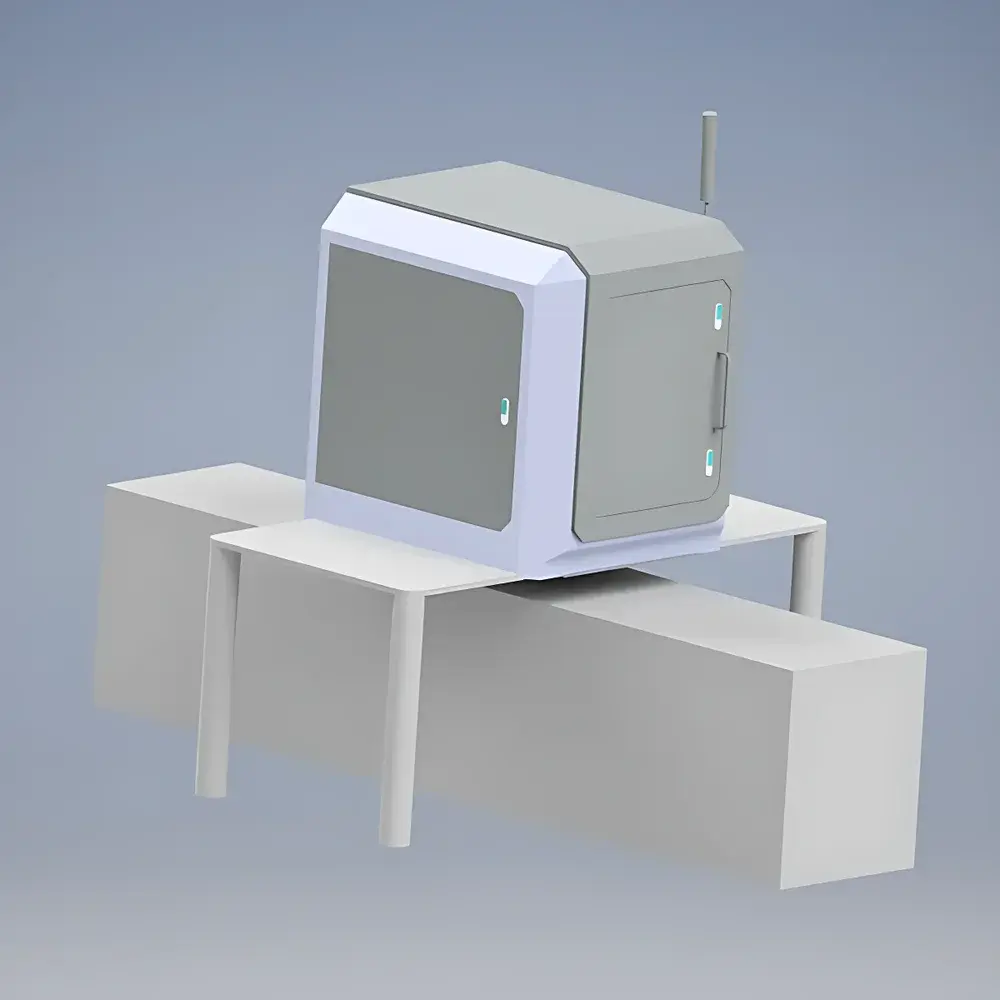
ZOLIX LIBS-OL900 Industrial Online Laser-Induced Breakdown Spectroscopy System
| Brand | ZOLIX |
|---|---|
| Origin | Beijing, China |
| Manufacturer Type | Original Equipment Manufacturer (OEM) |
| Product Category | Domestic |
| Model | LIBS-OL900 |
| Instrument Form Factor | Benchtop |
| Price | USD 280,000 (approx.) |
| Spectral Range | 200–1000 nm |
| Optical Resolution | 0.1 nm |
| Conveyor Belt Speed Compatibility | ≤5 m/s |
| Data Acquisition Mode | Real-time spectral mapping with automated focus tracking |
| Software Features | Peak identification, FWHM analysis, auto-save, pseudo-color elemental distribution visualization, database-assisted quantification, multi-interface data export (CSV, HDF5, SQL-compatible) |
Overview
The ZOLIX LIBS-OL900 is an industrial-grade, benchtop Laser-Induced Breakdown Spectroscopy (LIBS) system engineered for real-time, in-line elemental analysis of solid, liquid, and gaseous samples in demanding production environments. It operates on the fundamental principle of pulsed-laser ablation: a high-energy, nanosecond-class laser pulse is focused onto the sample surface, generating a transient microplasma (>10,000 K). As the plasma cools, excited atoms and ions emit element-specific photons across the ultraviolet–near-infrared spectrum (200–1000 nm). The emitted light is collected via fiber-coupled optics, dispersed by a high-resolution Czerny–Turner spectrometer (0.1 nm resolution), and detected using a back-illuminated CCD or CMOS array. Quantitative and qualitative elemental composition is derived from spectral line intensity, wavelength position, and calibration-free or matrix-matched chemometric models—enabling direct, calibration-light analysis without consumables or sample preparation.
Key Features
- Robust, fully enclosed safety-rated enclosure compliant with IEC 60825-1 Class 4 laser safety standards—designed for rapid deployment and zero-config commissioning on factory floors.
- Distributed hardware architecture based on modular optical cavity design—supports both inline integration (e.g., conveyor-mounted) and offline lab-based operation without mechanical reconfiguration.
- Integrated vision-guided autofocus subsystem combining coaxial imaging and real-time centroid tracking—maintains optimal focal spot size (<50 µm) across uneven, oxidized, or thermally unstable surfaces (e.g., raw ore, hot rolled steel).
- Real-time spectral mapping engine: acquires >100 spectra per second across user-defined XY grids; generates pseudo-color elemental distribution maps synchronized with conveyor motion (≤5 m/s) via encoder-triggered acquisition.
- Embedded chemometric processing unit trained on >12,000 reference spectra—including low-Z elements (C, Si, Mg, B, Li, Na) and refractory species (Cr, Mo, W)—enabling quantification accuracy within ±5% RSD for major and minor constituents under GLP-aligned conditions.
- Unified software interface with one-click workflow: automatic plasma gating, background subtraction, peak deconvolution, line identification (NIST Atomic Spectra Database v2023), and ISO/IEC 17025-compliant reporting templates.
Sample Compatibility & Compliance
The LIBS-OL900 accommodates heterogeneous, unprepared industrial samples—including raw ores with thick oxide layers, hot-rolled metals (up to 300°C surface temperature), slurry suspensions, and polymer-coated substrates. Its high peak-power laser source (≥100 mJ/pulse, 5–10 ns) ensures reliable ablation of high-hardness materials (e.g., hematite, bauxite, tungsten carbide) where conventional EDXRF or XRF systems exhibit poor sensitivity for light elements. The system meets CE marking requirements for electromagnetic compatibility (EN 61326-1) and laser product safety (EN 60825-1). All spectral data acquisition and processing logs comply with FDA 21 CFR Part 11 audit trail requirements—including user authentication, timestamped parameter changes, and immutable raw-data archiving. Optional GMP-ready configuration includes electronic signatures, role-based access control, and IQ/OQ documentation packages.
Software & Data Management
ZOLIX SpectraStudio v4.2 provides a deterministic, deterministic, audit-ready computing environment. Core modules include: (1) Real-time spectral viewer with dynamic baseline correction and Voigt-profile fitting; (2) Automated mapping module with spatial registration (pixel-to-mm calibration via integrated scale bar); (3) Quantitative engine supporting univariate calibration curves, partial least squares regression (PLSR), and principal component regression (PCR); (4) Cross-platform database connector (ODBC/JDBC) for bidirectional synchronization with LIMS, MES, or SAP QM modules. Raw spectral files are stored in vendor-neutral HDF5 format with embedded metadata (laser energy, delay time, gate width, ambient temperature/humidity). All reports export to PDF/A-2b or CSV with traceable uncertainty budgets per ISO/IEC Guide 98-3 (GUM).
Applications
- Metal alloy verification: Rapid grade identification of stainless steels (304/316), aluminum alloys (6061/7075), and titanium grades (Gr2/Gr5) directly on production lines—replacing destructive spark-OES sampling with 100% inspection coverage.
- Ore beneficiation control: In-situ Si, Al, Fe, Ca, and P quantification in iron ore, bauxite, and phosphate rock—enabling real-time feed-forward adjustment of crushing/grinding parameters and flotation chemistry.
- Light element metrology: Reliable detection of carbon (193.0 nm), silicon (288.1 nm), boron (249.7 nm), and lithium (670.8 nm) in battery cathode precursors and aerospace aluminum alloys—where traditional XRF fails below atomic number Z=11.
- Toxic element surveillance: Continuous monitoring of Pb, Cd, As, and Hg in food packaging films and medical device polymers—meeting EU RoHS Directive Annex II limits with sub-ppm LODs (3σ).
- Process deviation diagnostics: Correlating temporal spectral drift (e.g., Fe I line broadening) with furnace temperature excursions or slag composition shifts during continuous casting—supporting predictive maintenance workflows.
FAQ
Does the LIBS-OL900 require sample preparation?
No—solid samples are analyzed in ambient air or inert gas purge mode without polishing, pressing, or dissolution.
Can it quantify light elements such as carbon and silicon in steel?
Yes—the 200–1000 nm spectral range and sub-0.1 nm resolution enable robust detection of C I (247.8 nm), Si I (288.1 nm), and Si II (233.6 nm) with certified reference material (CRM) traceability.
How does the system handle fast-moving conveyor belts?
Encoder-synchronized acquisition ensures <100 µs timing jitter; spectral capture rate scales dynamically up to 200 Hz at 5 m/s belt speed, maintaining spatial resolution ≤2 mm per pixel.
Is spectral calibration stable over long-term operation?
Yes—built-in neon/argon hollow-cathode lamp enables daily automated wavelength recalibration; thermal drift compensation algorithms maintain pixel-to-wavelength mapping within ±0.02 nm over 8-hour shifts.
Can third-party databases be integrated for quantification?
Yes—via ODBC drivers, users may import proprietary calibration libraries or connect to commercial databases (e.g., Thermo Fisher’s ChemiQuant, Bruker’s Quantax) without code modification.






