
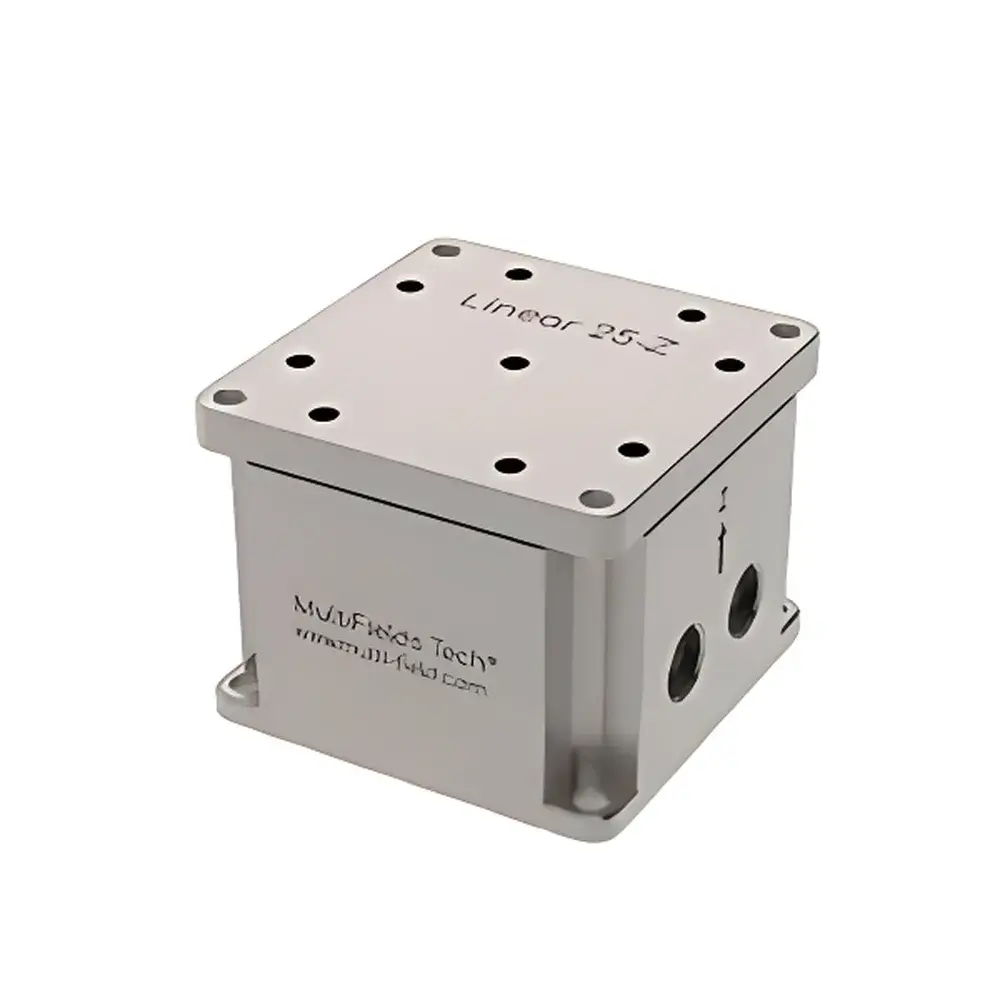
ZOLIX Linear25-z Closed-Loop Piezoelectric Linear Translation Stage
| Brand | ZOLIX |
|---|---|
| Model | Linear25-z |
| Type | Motorized Translation Stage |
| Series | 25 mm Compact Piezo Stage |
| Control | Closed-Loop |
| Vacuum Rating | UHV (2×10⁻¹¹ mbar) |
| Cryogenic Compatibility | Down to 30 mK |
| Magnetic Field Tolerance | Up to 18 T |
| Body Material | Pure Titanium & Beryllium Copper |
| Travel | 6 mm |
| Load Capacity | 300 g |
| Push Force | 3 N |
| Position Resolution (Sensor) | ~150 nm |
| Repeatability | 1–2 µm |
| Dimensions | 25 × 25 × 19.6 mm |
| Mass | 34 g |
| Drive Voltage | ≤200 V |
| Max Speed @300 K | ~2 mm/s |
| Sensor Type | Resistive Position Sensor |
| Cable | Phosphor Bronze Twisted Pair, 20 cm |
| Connector Pins | Drive – 2 or 4 (advanced), Sensing – 3 |
| Insulation | Glass-Fiber-Reinforced Polyester (PEEK/BeCu) |
Overview
The ZOLIX Linear25-z is a high-precision, closed-loop piezoelectric linear translation stage engineered for demanding ultra-low-temperature, ultra-high-vacuum (UHV), and high-magnetic-field environments. Unlike conventional stepper- or servo-driven stages, the Linear25-z employs direct piezoelectric actuation with integrated resistive position feedback—enabling sub-micron repeatability and deterministic motion control without mechanical backlash or hysteresis-induced drift. Its core architecture adheres to fundamental principles of piezoelectric displacement transduction: applied voltage induces controlled lattice strain in the actuator stack, generating nanoscale dimensional change translated into precise linear motion via a friction-based inertial drive mechanism. This design eliminates gears, leadscrews, or rotary-to-linear conversion elements—critical for minimizing thermal noise, outgassing, and magnetic interference in cryogenic dilution refrigerators, scanning probe microscopy setups, quantum device alignment stations, and synchrotron beamline endstations.
Key Features
- Compact footprint: 25 × 25 × 19.6 mm — optimized for space-constrained cryostat inserts and multi-axis nanopositioning stacks.
- UHV-compatible construction: All-welded titanium (Grade 2) and beryllium copper (BeCu) body; validated for continuous operation at pressures down to 2×10⁻¹¹ mbar per ISO 10110-7 and ASTM E595 outgassing specifications.
- Cryogenic resilience: Fully functional from 1.4 K to 400 K; qualified for 30 mK operation in He-3 and dilution refrigerator environments with zero cold-welding or thermal contraction-induced misalignment.
- Non-magnetic integrity: No ferromagnetic components; certified for static magnetic fields up to 18 Tesla — suitable for integration within superconducting magnet bores and MRI-compatible optical platforms.
- Closed-loop precision: Integrated resistive position sensor with 6 mm full-scale range and ~150 nm resolution ensures real-time positional verification and active error correction per motion cycle.
- High-force capability: Delivers 3 N push force while supporting 300 g static load — enabling stable positioning of objective lenses, fiber couplers, or quantum dot sample holders under gravitational or thermal stress.
Sample Compatibility & Compliance
The Linear25-z meets stringent material and environmental compliance requirements common to advanced physical science laboratories. Its titanium and BeCu construction complies with ASTM F136 (medical-grade Ti-6Al-4V biocompatibility standards) and ISO 15510 (corrosion-resistant stainless alternatives). The phosphor bronze twisted-pair cable and glass-fiber-reinforced polyester (PEEK/BeCu) connector meet NASA ASTM E595 low-outgassing thresholds (<1.0% TML, <0.1% CVCM) for space-qualified instrumentation. Electrical insulation and pin layout conform to IEC 61000-4-2 (ESD immunity) and MIL-STD-810G for shock/vibration robustness. For regulated QC/QA workflows, the stage supports traceable calibration protocols aligned with ISO/IEC 17025—particularly when paired with NIST-traceable interferometric verification systems.
Software & Data Management
The Linear25-z operates via standard analog voltage input (0–200 V) and outputs a proportional resistive signal (0–10 kΩ over 6 mm), compatible with widely deployed motion controllers including Thorlabs Kinesis, Newport ESP300, and PI E-712. Digital integration is supported through optional ADC/DAC modules enabling synchronization with LabVIEW, MATLAB, or Python-based automation frameworks (e.g., PyVISA + NI DAQmx). Sensor output enables real-time position logging with timestamped audit trails—facilitating GLP-compliant experiment documentation. While the stage itself does not embed firmware, its analog interface ensures compatibility with FDA 21 CFR Part 11–compliant data acquisition systems when implemented with electronic signature and access-control layers at the host controller level.
Applications
- Quantum computing infrastructure: Precise alignment of microwave waveguides, superconducting qubit readout resonators, and Josephson junction probes inside dilution refrigerators.
- Low-temperature scanning tunneling microscopy (LT-STM): Sub-nanometer sample approach control under UHV and sub-K conditions.
- Synchrotron X-ray optics: Fine-tuning of monochromator crystals or Kirkpatrick-Baez mirrors where thermal drift and magnetic perturbation must be eliminated.
- Fiber-optic quantum communication: Active stabilization of polarization-maintaining fiber couplers in cryogenic quantum memory nodes.
- Nanoscale metrology: Integration into custom-built atomic force microscope (AFM) scanner frames requiring orthogonal Z-motion with minimal parasitic capacitance.
FAQ
Is the Linear25-z compatible with liquid helium cryostats?
Yes — it has been validated for continuous operation at 4.2 K and transient exposure to 1.4 K, with no degradation in position repeatability or sensor linearity.
Can multiple Linear25-z stages be synchronized for multi-axis motion?
Yes — identical analog I/O characteristics and matched electrical time constants enable hardware-synchronized motion using shared voltage references and trigger signals.
What vacuum feedthrough options are available?
Standard configuration includes a 20 cm twisted-pair cable with ConFlat-compatible ceramic feedthroughs; custom-length cables with CF-16 or CF-35 flanges are available upon request.
Does the resistive sensor require external excitation current?
Yes — a constant current source (typically 1 mA) is required to convert resistance changes into measurable voltage; this is provided internally by most compatible controllers.
How is thermal drift compensated during long-duration experiments?
The closed-loop architecture continuously corrects for thermal expansion-induced offset; for sub-100 nm stability over hours, we recommend active temperature stabilization of the mounting base to ±10 mK.




