
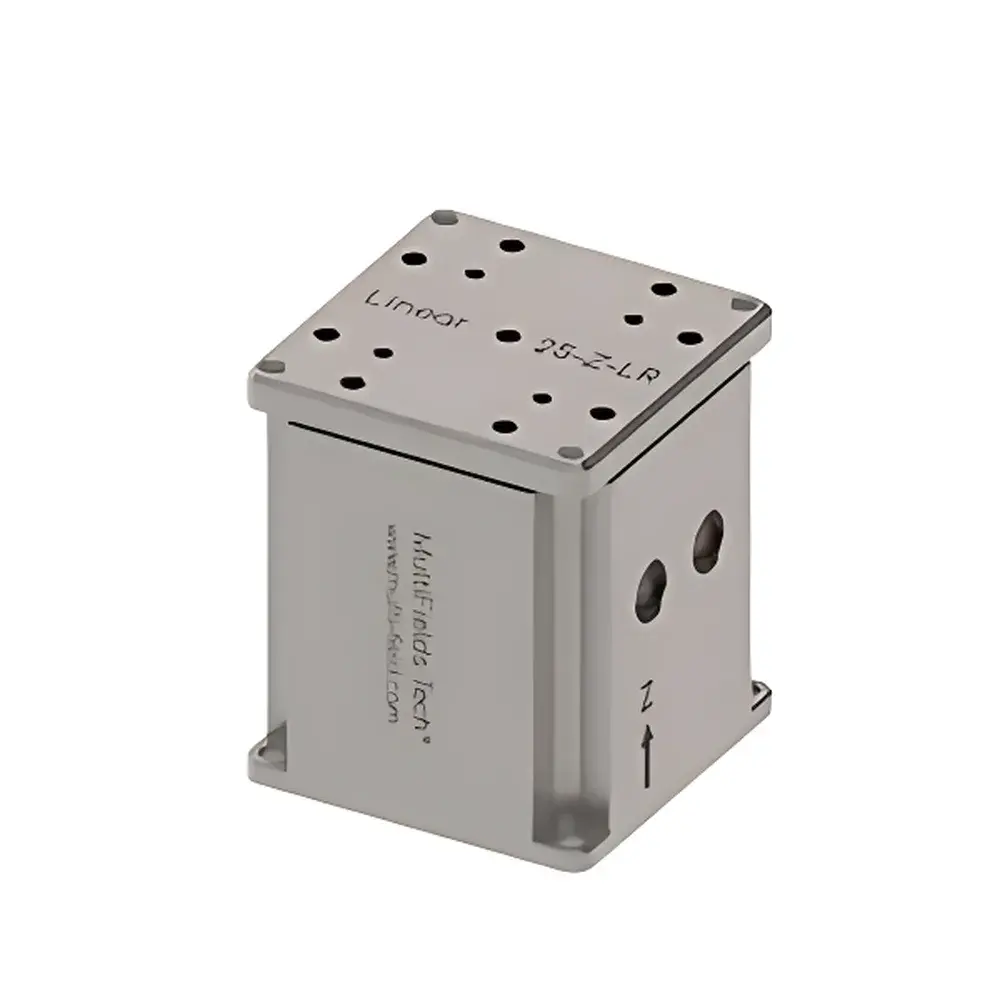
ZOLIX Linear25-z-LR Piezoelectric Linear Translation Stage with Closed-Loop Control
| Brand | ZOLIX |
|---|---|
| Model | Linear25-z-LR |
| Type | Motorized Piezoelectric Translation Stage |
| Dimensions (L×W×H) | 25 × 25 × 29.6 mm |
| Mass | 34 g |
| Travel Range | 16 mm |
| Max Load | 300 g |
| Max Thrust Force | 3 N |
| Operating Temp Range | 1.4 K – 400 K |
| Ultimate Vacuum Compatibility | 2 × 10⁻¹¹ mbar |
| Magnetic Field Tolerance | Up to 18 T |
| Drive Voltage | ≤ 200 V |
| Max Speed @ 300 K | ~2 mm/s |
| Sensor Type | Resistive Position Sensor |
| Sensor Resolution | ~150 nm |
| Repeatability | 1–2 µm |
| Materials | Pure Titanium (Ti) & Beryllium Copper (BeCu) |
| Cable | Phosphor Bronze Twisted Pair, 20 cm |
| Connector Pins | 2–4 drive pins + 3 sensor pins |
| Insulation | Glass-Fiber-Reinforced Polyetheretherketone (PEEK) & BeCu |
Overview
The ZOLIX Linear25-z-LR is a high-performance piezoelectric linear translation stage engineered for extreme-condition optical and quantum experimental environments. Unlike conventional stepper- or servo-driven stages, the Linear25-z-LR employs direct piezoelectric actuation combined with integrated resistive position sensing to deliver nanometer-class closed-loop motion control without mechanical backlash or hysteresis-induced drift. Its core architecture leverages the inverse piezoelectric effect—applying voltage across precisely poled ceramic elements to generate controlled, sub-micron displacements via electrostrictive expansion. This principle enables deterministic, repeatable positioning in cryogenic, ultra-high vacuum (UHV), and high magnetic field settings where traditional motorized stages fail due to outgassing, thermal contraction mismatch, or Lorentz-force interference. Designed explicitly for integration into scanning probe microscopy (SPM), dilution refrigerator-based quantum device characterization, and synchrotron beamline end-stations, the Linear25-z-LR maintains structural integrity and metrological fidelity across temperature gradients from 1.4 K to 400 K and vacuum pressures down to 2 × 10⁻¹¹ mbar.
Key Features
- Compact monolithic footprint: 25 × 25 × 29.6 mm with only 34 g mass—optimized for space-constrained cryostat inserts and multi-axis nanopositioning stacks.
- Ultra-low outgassing construction: Body fabricated entirely from vacuum-compatible pure titanium and beryllium copper; no adhesives, epoxies, or polymer seals in the load path.
- Full magnetic immunity: Non-ferromagnetic materials certified for stable operation up to 18 Tesla—enabling use inside superconducting magnet bores for magneto-optical spectroscopy and spin-resolved transport measurements.
- Closed-loop precision: Integrated resistive position sensor spans full 16 mm travel with ~150 nm resolution and 1–2 µm repeatability, enabling traceable displacement calibration without external interferometry.
- High-force capability: Delivers 3 N static thrust force while supporting 300 g payload—sufficient for mounting objective lenses, fiber couplers, or miniature spectrometers directly on-stage.
- Multi-environment configurability: Factory options include HV (high vacuum), ULT (ultra-low temperature), and UHV (ultra-high vacuum) variants—each validated per ISO 10110-7 and ASTM E595 outgassing specifications.
Sample Compatibility & Compliance
The Linear25-z-LR is compatible with standard optical mounts (e.g., SM1-threaded adapters, kinematic baseplates) and integrates seamlessly with industry-standard motion controllers supporting analog ±10 V position command inputs and differential sensor outputs. It complies with ISO 2768-mK general tolerances and meets material requirements for GLP-compliant low-background experiments. All metallic components conform to ASTM F136 (medical-grade Ti-6Al-4V equivalent) and ASTM B194 (beryllium copper alloy) specifications. The stage is fully compatible with helium-3 refrigerators, dilution refrigerators, and liquid-helium cryostats. For regulatory traceability, each unit ships with a certificate of conformance listing batch-specific vacuum bakeout history, magnetic susceptibility test data (≤ 1.05 × 10⁻⁵ emu/g), and thermal contraction coefficients measured over 1.4–300 K.
Software & Data Management
The Linear25-z-LR operates as a hardware-transparent actuator—requiring no proprietary firmware or driver stack. Analog voltage input enables plug-and-play integration with third-party motion control platforms including Thorlabs Kinesis, Newport ESP300, and National Instruments PXI systems. Sensor output is ratiometric and noise-immune (typical SNR > 65 dB at 1 kHz bandwidth), supporting real-time position logging at ≥1 kHz sampling rates when paired with 16-bit DAQ hardware. Raw sensor data is fully compatible with MATLAB, Python (via PyVISA or NIDAQmx), and LabVIEW environments. Audit trails—including commanded voltage, sensed position, timestamp, and ambient temperature feedback—can be exported in CSV or HDF5 format to satisfy FDA 21 CFR Part 11 and ISO/IEC 17025 documentation requirements for metrologically critical applications.
Applications
- Quantum computing testbeds: Precise alignment of microwave waveguides, superconducting qubit couplers, and Josephson junction probes inside dilution refrigerators.
- Low-temperature scanning tunneling microscopy (LT-STM): Coarse approach and fine Z-positioning under <10 mK conditions with sub-nanometer stability.
- Ultrafast laser beam steering: Synchronization of delay lines in pump-probe setups requiring <5 ps timing jitter and vacuum compatibility.
- Space-qualified optical bench calibration: Thermal cycling validation of alignment stability across 4 K–300 K for satellite-borne spectrometers.
- In-situ TEM sample manipulation: Integration into double-tilt holders for atomic-resolution strain mapping under magnetic fields up to 15 T.
FAQ
What vacuum level is the standard Linear25-z-LR rated for?
The default HV version is rated for continuous operation down to 2 × 10⁻⁷ mbar. The optional UHV variant is qualified to 2 × 10⁻¹¹ mbar after 24-hour 150 °C vacuum bakeout.
Can this stage be used in liquid helium immersion?
Yes—the ULT configuration is fully compatible with direct immersion in liquid helium (4.2 K) and vapor-cooled operation down to 1.4 K. Thermal anchoring is achieved via direct Ti-to-cryocooler interface.
Is the resistive position sensor affected by magnetic fields?
No—resistive sensors are inherently insensitive to static and dynamic magnetic fields up to 18 T, unlike capacitive or inductive encoders which suffer signal distortion or eddy-current heating.
What is the recommended drive amplifier specification?
A bipolar high-voltage amplifier with ≤100 mV RMS noise, ≥200 V output range, and ≤1 µs slew rate is required. ZOLIX recommends the Trek 623B or Piezo Systems EPA-105 for optimal linearity.
How is thermal drift compensated during long-duration scans?
The integrated sensor provides real-time position feedback independent of thermal expansion; closed-loop control maintains absolute position accuracy within ±2 µm over 12-hour dwell periods at constant temperature.





