
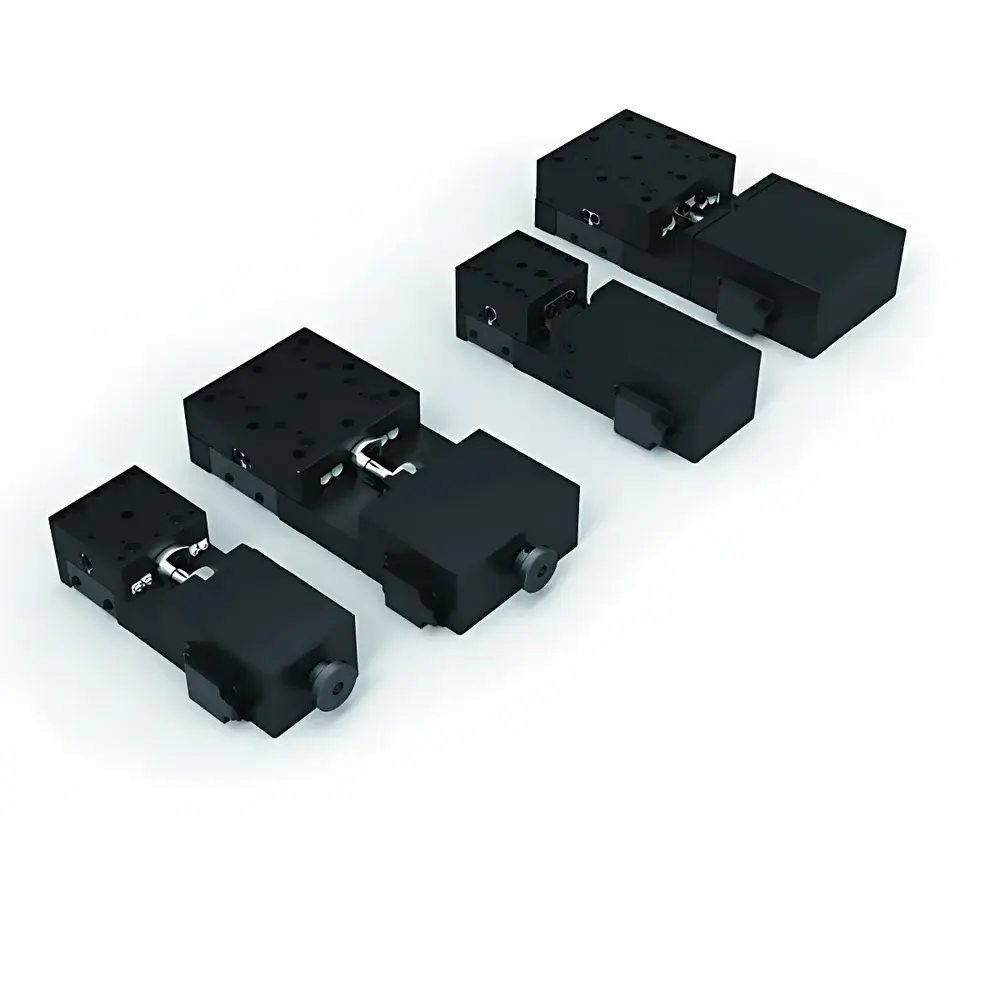
ZOLIX MD Series Miniature Precision Motorized Translation Stage
| Brand | ZOLIX |
|---|---|
| Model | MD |
| Type | Motorized Translation Stage |
| Origin | Beijing, China |
| Manufacturer | ZOLIX (OEM Producer) |
| Product Category | Domestic |
| Key Specifications | Travel Range ±6.5–±12.5 mm |
| Guide Rail | Imported 2 mm Crossed Roller Bearings |
| Lead Screw | C3/C5 Grade, Φ6 mm × 1 mm Lead |
| Resolution | 1–2.5 µm/step (Half-Step Mode) |
| Max Speed | 10 mm/s |
| Positioning Accuracy | ±10–±30 µm |
| Repeatability | ±1–±3 µm |
| Backlash | ≤2–6 µm |
| Static Parallelism | 30–80 µm |
| Motion Parallelism | 15–30 µm |
| Pitch/Yaw | 20–30 arcsec |
| Max Holding Torque | 16–80 mN·m |
| Central Load Capacity | 3–5 kg |
| Mass | 0.4–0.8 kg |
| Limit & Home Sensors | Dual Limit + Single Home |
| Surface Finish | RoHS-Compliant Black Anodized Aluminum |
Overview
The ZOLIX MD Series Miniature Precision Motorized Translation Stage is an engineered solution for high-accuracy linear positioning in space-constrained optical and photonics applications. Based on a direct-drive architecture—where a two-phase stepper motor couples directly to a precision ground C3 or C5 grade ball screw (Φ6 mm, 1 mm lead)—the MD stage eliminates coupling-induced backlash and torsional compliance. Its motion principle relies on microstepping control of the integrated encoder-equipped stepper motor, enabling closed-loop operation with sub-micron resolution capability (down to 1 µm per half-step pulse). The stage employs imported 2 mm crossed roller bearings for ultra-low friction, minimal hysteresis, and exceptional straightness performance—critical for alignment-sensitive tasks such as fiber coupling, interferometer adjustment, and confocal microscopy sample scanning. Constructed entirely from aerospace-grade anodized aluminum (6061-T6), each MD unit undergoes single-setup CNC milling and proprietary precision grinding to maintain tight dimensional and geometric tolerances. Final assembly is verified in real time using laser interferometry and coordinate measuring machine (CMM) metrology, ensuring traceable compliance with ISO 9001 manufacturing protocols.
Key Features
- Direct-coupled stepper motor with onboard incremental encoder for closed-loop positional feedback and step-loss immunity
- Crossed roller bearing guideway (2 mm pitch, Japan-sourced) delivering ≤30 µm static parallelism and ≤15 µm motion parallelism across full travel
- High-resolution motion: 1 µm/step (half-step mode) on MDP variants; 2.5 µm/step on MDT variants—optimized for fine-tuning and nanoscale alignment
- Compact footprint: platform sizes range from 40 × 40 mm to 65 × 65 mm; overall height < 25 mm; mass as low as 0.4 kg
- Rigorous mechanical stability: ≤3 µm repeatability, ≤6 µm backlash, and pitch/yaw errors controlled to ≤30 arcseconds over full stroke
- RoHS-compliant black anodized surface finish providing corrosion resistance, electrical insulation, and ESD-safe handling
- Integrated dual limit switches and single home sensor—compatible with standard TTL/5 V logic interfaces for seamless integration into automated optical benches
Sample Compatibility & Compliance
The MD series supports rigid mounting of optical components including mirrors, lenses, fiber collimators, photodetectors, and micro-optomechanical assemblies. Its central load capacity (3–5 kg) accommodates typical payloads in benchtop spectroscopy, laser cavity alignment, and quantum optics setups without compromising dynamic stiffness. All units comply with EU RoHS Directive 2011/65/EU for hazardous substance restrictions. Mechanical design adheres to ISO 2768-mK general tolerances and ISO 1101 geometric dimensioning standards. While not certified to IEC 61000-6-2/6-4 for EMC, the stages are routinely deployed in Class 1000 cleanrooms and GLP-aligned R&D laboratories where electromagnetic compatibility is managed at system level.
Software & Data Management
ZOLIX provides native support for MD stages via its ZolixBench™ control suite (Windows/Linux), offering GUI-based jog/positioning, scriptable motion sequences (Python/Lua API), and real-time position logging with timestamped CSV export. Communication occurs over USB 2.0 (virtual COM port) or RS-485 (multi-drop daisy chain). For integration into third-party environments—including LabVIEW, MATLAB, and EPICS—the SDK includes DLLs, header files, and documented command protocols (ASCII-based SCPI-like syntax). Audit trails, user-access levels, and position history buffers meet baseline requirements for ISO/IEC 17025-compliant calibration workflows. Firmware updates preserve non-volatile parameter storage, including custom zero-offset and velocity profiles.
Applications
- Precision alignment of free-space optical paths in tunable laser systems and external cavity diode lasers (ECDL)
- Sub-pixel scanning of samples in confocal fluorescence microscopes and optical coherence tomography (OCT) platforms
- Active stabilization of interferometric reference arms in Michelson and Mach-Zehnder configurations
- Automated filter wheel or grating positioning in compact spectrometers and monochromators
- Multi-axis nanopositioning when stacked with compatible rotation or tip/tilt stages (e.g., ZOLIX MR/MRT series)
- Teaching labs requiring robust, repeatable linear motion for undergraduate optics experiments (e.g., Young’s double-slit, Fabry–Pérot resonance mapping)
FAQ
What is the difference between MDP and MDT models?
MP models use finer-pitch mechanics (1 µm/step resolution) and are optimized for maximum positional fidelity; MDT variants prioritize higher torque and load capacity at slightly reduced resolution (2.5 µm/step).
Can the MD stage operate in vacuum environments?
Standard MD units are not vacuum-rated; however, custom versions with vacuum-compatible lubricants, outgassing-tested materials, and modified sensors are available upon request (base pressure ≤10⁻⁶ mbar).
Is encoder resolution configurable via software?
No—the encoder is hardware-integrated and fixed at 2000 pulses per revolution; resolution is determined solely by microstepping mode (full/half/quarter) set in the controller.
Does ZOLIX provide calibration certificates with NIST-traceable data?
Yes—optional factory calibration reports (per ISO 230-2) include laser interferometric verification of positioning error, bidirectional repeatability, and reversal error across the full travel range.
How is thermal drift mitigated in long-duration experiments?
The aluminum body’s low thermal expansion coefficient (23.1 × 10⁻⁶ /°C) combined with symmetric structural design limits thermally induced offset to <0.5 µm/°C under stable ambient conditions.





