
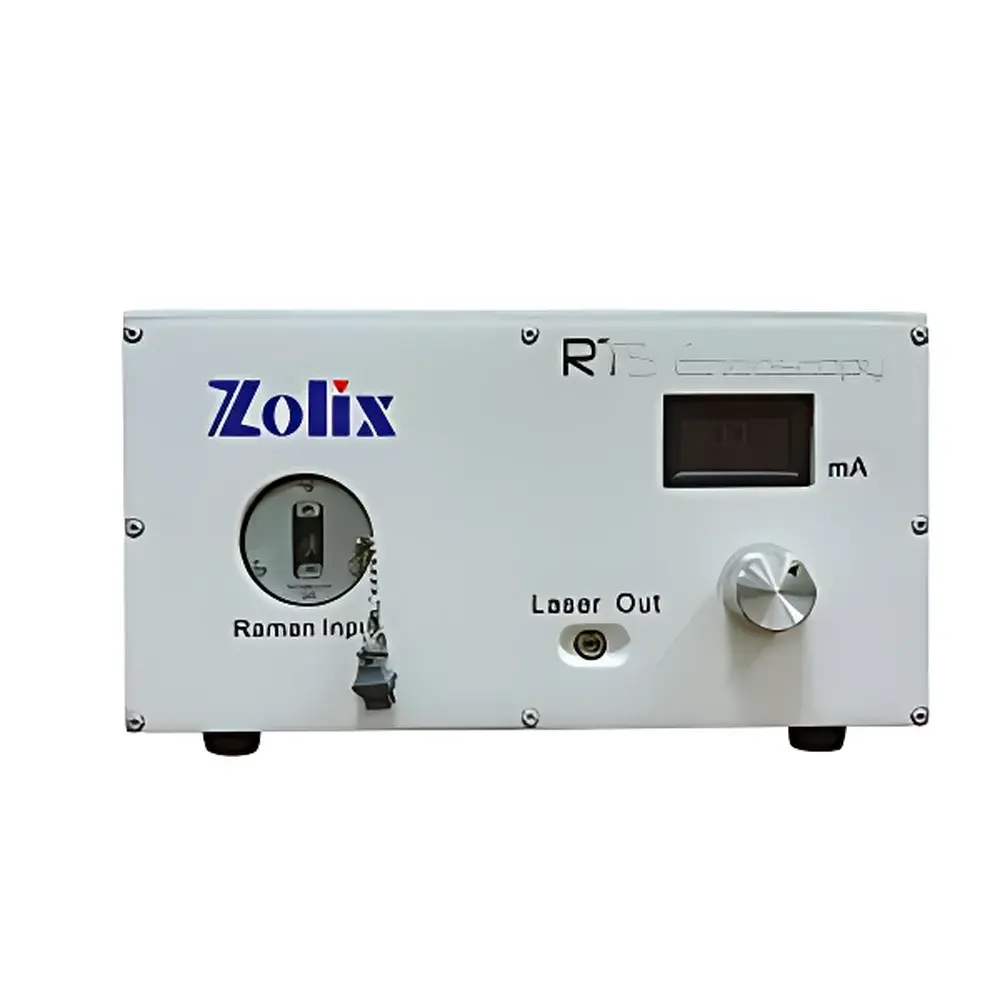
ZOLIX Medical Endoscopic Raman Spectroscopy System
| Brand | ZOLIX |
|---|---|
| Origin | Beijing, China |
| Manufacturer Type | Original Equipment Manufacturer (OEM) |
| Product Origin | Domestic (China) |
| Model | Medical Endoscopic Raman Spectroscopy System |
| Pricing | Upon Request |
Overview
The ZOLIX Medical Endoscopic Raman Spectroscopy System is an integrated clinical-grade optical diagnostic platform engineered for real-time, label-free molecular characterization of tissue during minimally invasive procedures. It operates on the principle of spontaneous Raman scattering—where monochromatic laser excitation (typically at 532 nm or 785 nm) induces inelastic photon scattering from vibrational modes of endogenous biomolecules (e.g., proteins, lipids, nucleic acids), generating a chemically specific spectral fingerprint. Unlike fluorescence-based techniques, Raman spectroscopy delivers intrinsic biochemical contrast without exogenous dyes, enabling direct interrogation of tissue metabolism, structural integrity, and pathological state at the molecular level. This system is specifically designed to interface with standard clinical endoscopes via a sterile, single-use or reusable fiber-optic probe inserted through the biopsy channel—supporting intraoperative decision-making in gastroenterology, neurosurgery, and oncology.
Key Features
- High-throughput transmissive VPH grating spectrometer (Omni-iSpecT series) with F/2.3 aperture and optimized optical path for maximum light collection efficiency from NA 0.22 fibers
- Deep-cooled, back-illuminated CCD detector with thermoelectric cooling to −60 °C, ensuring low dark current and high signal-to-noise ratio for weak Raman signals
- Medical-grade Raman probe with 2.1 mm outer diameter, 6.5 mm tip length, and integrated 500 µm focal-length high-F-number micro-lens—designed for direct insertion into standard endoscope biopsy channels (≥2.8 mm)
- Customizable probe options: 1.65 mm and 0.9 mm ultra-thin variants for intravascular applications including arterial thrombus detection
- Robust optomechanical architecture: all optical components are permanently aligned and hermetically sealed within a vibration-insensitive monolithic housing—validated for transport and operation in OR and ICU environments
- Dual-mode capability: integrated dual-fiber ports support concurrent acquisition of Raman spectra alongside either intrinsic fluorescence spectroscopy (IFS) or diffuse reflectance spectroscopy (DRS) for multimodal tissue classification
Sample Compatibility & Compliance
The system is validated for in vivo human tissue interrogation under clinical conditions compliant with ISO 13485:2016 (medical device quality management systems) and IEC 62304:2015 (software lifecycle processes). Probe materials—including medical-grade stainless steel housings and USP Class VI-certified nylon fiber cladding—meet biocompatibility requirements per ISO 10993-1. The optical design avoids UV excitation, minimizing photodamage risk during prolonged exposure. All firmware and control software adhere to FDA 21 CFR Part 11 principles for electronic records and signatures, supporting audit trails, user authentication, and data integrity protocols required in GLP/GMP-regulated clinical trials.
Software & Data Management
The system runs on ZOLIX SpectraView™ v4.x—a modular, Windows-based application supporting real-time spectral acquisition, background subtraction (fluorescence removal via polynomial fitting or iterative baseline correction), cosmic-ray spike filtering, and spectral averaging. Raw data is stored in HDF5 format with embedded metadata (laser power, integration time, probe ID, anatomical location tag). Built-in multivariate analysis tools include PCA-LDA and PLS-DA classifiers trained on reference datasets of normal colon mucosa, ulcerative colitis, Crohn’s disease, and adenocarcinoma. Export functions comply with DICOM-SR (Structured Reporting) standards for PACS integration. Software validation documentation (IQ/OQ/PQ) is provided for institutional IT security review and regulatory submission.
Applications
- Gastrointestinal oncology: real-time differentiation of neoplastic vs. non-neoplastic lesions during colonoscopy and esophagogastroduodenoscopy (EGD)
- Neurosurgical margin assessment: intraoperative identification of infiltrative glioma boundaries during craniotomy using handheld or endoscope-coupled probes
- Dermatology and oral oncology: non-invasive stratification of squamous cell carcinoma, melanoma, and dysplastic oral lesions
- Vascular diagnostics: characterization of lipid-rich vs. fibrocalcific plaque composition in coronary and carotid arteries using sub-millimeter probes
- Research applications: longitudinal monitoring of treatment response in preclinical models via serial Raman imaging of orthotopic tumors
FAQ
Is the system compatible with existing endoscopy platforms from Olympus, Pentax, or Fujifilm?
Yes—the probe features standardized SMA 905 connectors and mechanical dimensions conforming to ISO 8600-1, enabling seamless integration with all major OEM endoscopes equipped with ≥2.8 mm biopsy channels.
What laser safety class does the system operate under?
The integrated excitation source is Class 3B (IEC 60825-1), with interlocked shutter control, real-time power monitoring, and automatic beam cutoff upon probe disconnection.
Can spectral data be exported for third-party machine learning analysis?
Yes—full-resolution spectra (wavenumber vs. intensity) are exportable in CSV, TXT, and HDF5 formats, including calibration metadata and instrument configuration logs.
Does the system support quantitative analysis of biomolecular concentrations?
While primarily designed for qualitative and semi-quantitative classification, absolute quantification of select analytes (e.g., β-carotene, collagen I/III ratio) is achievable using internal reference peaks and calibrated phantoms per ASTM E1840-22 guidelines.
Is regulatory clearance available for clinical use in the EU or USA?
The system is CE-marked under MDD 93/42/EEC (Class IIa) and supports submission pathways for FDA 510(k) clearance and IVDR conformity assessment; site-specific clinical validation studies are supported by ZOLIX Application Scientists.





