
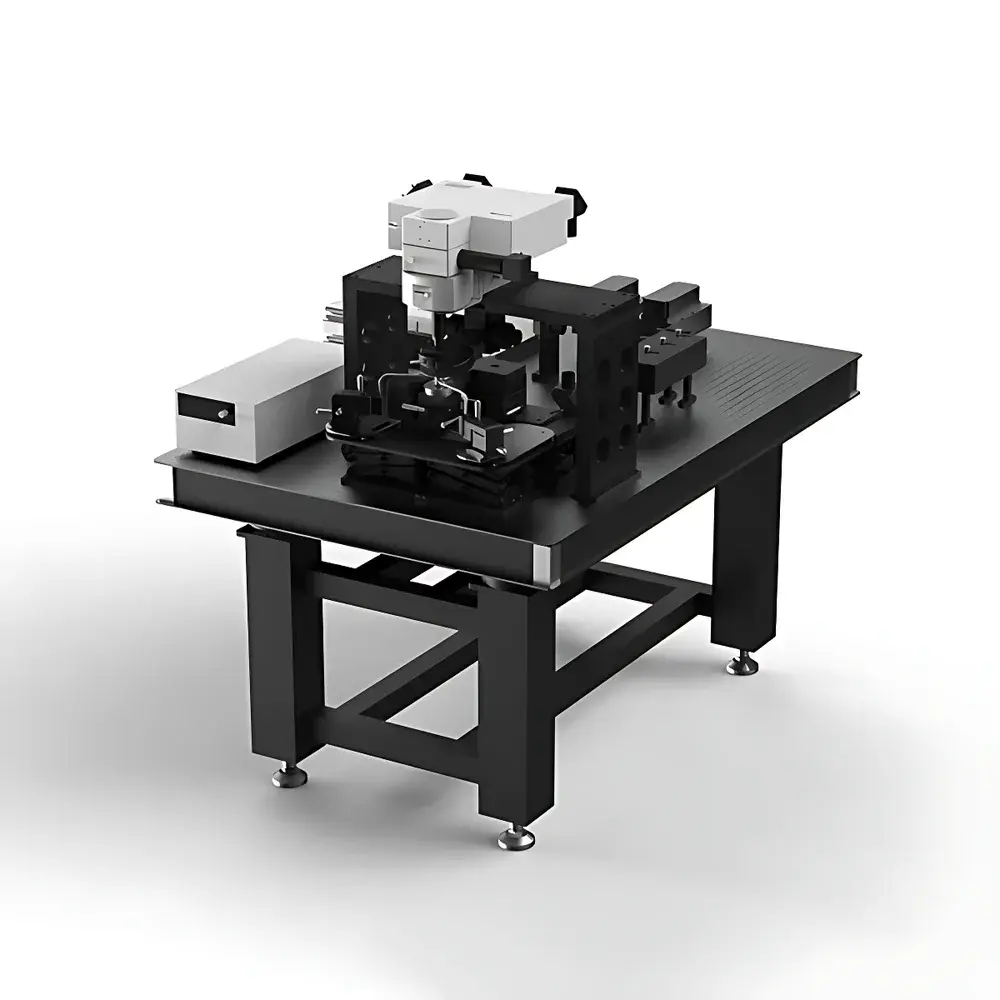
ZOLIX Micro-Laser-Induced Fluorescence System
| Brand | ZOLIX |
|---|---|
| Origin | Beijing, China |
| Manufacturer Type | Direct Manufacturer |
| Instrument Type | Steady-State & Time-Resolved Fluorescence Spectrometer |
| Dispersive Elements | Holographic Grating + Bandpass/Notch Filters |
| Excitation Sources | CW Laser Diode, Pulsed Laser (ns–ps range), Electrical Probe Station (for e-pumped lasing) |
| Detection Mode | Confocal Micro-Spectroscopy with Back-Illuminated CCD or EMCCD |
| Spatial Resolution | Diffraction-Limited (~300 nm lateral at 532 nm) |
| Spectral Range | 200–1100 nm (configurable) |
| Temporal Resolution | Down to <100 ps (with TCSPC option) |
Overview
The ZOLIX Micro-Laser-Induced Fluorescence System is a research-grade confocal micro-spectroscopy platform engineered for quantitative photoluminescence (PL), optical gain characterization, and lasing threshold analysis in semiconductor nanostructures and thin-film devices. Built upon a modular inverted microscope architecture, the system integrates spatially resolved excitation and spectral detection to enable simultaneous mapping of fluorescence quantum yield, carrier recombination dynamics, stimulated emission cross-section, and cavity mode structure. Its core measurement principle relies on laser-induced photoluminescence spectroscopy coupled with time-correlated single-photon counting (TCSPC) or fast-gated ICCD detection—providing both steady-state spectral signatures and transient decay kinetics under optical or electrical pumping. Designed for laboratory environments requiring high signal-to-noise ratio and sub-micron spatial registration, the system supports fundamental studies of perovskite nanocrystals, GaN-based micro-LEDs, 2D transition metal dichalcogenides (TMDs), organic semiconductors, and quantum dot arrays.
Key Features
- Modular excitation architecture supporting continuous-wave (CW) diode lasers (e.g., 405 nm, 450 nm, 532 nm), pulsed solid-state or diode-pumped lasers (pulse width: 50 ps–10 ns; repetition rate: 1 kHz–80 MHz), and integrated electrical probe station with DC/pulsed bias capability (±50 V, 1 A max) for direct current-injection lasing studies.
- High-throughput Czerny–Turner spectrograph with interchangeable gratings (1200–2400 grooves/mm) and motorized filter wheels for automated spectral band selection—enabling rapid switching between PL, Raman, and lasing-mode acquisition.
- Back-illuminated deep-depletion CCD or electron-multiplying CCD (EMCCD) detector with thermoelectric cooling (−70 °C), delivering quantum efficiency >90% at 600 nm and dark current <0.001 e⁻/pix/s.
- Confocal pinhole scanning unit with motorized XYZ stage (100 nm step resolution) and optional piezo-driven objective scanner for high-speed spectral imaging (up to 512 × 512 pixels per map).
- Rigorous optical alignment stability: all optomechanical mounts are kinematically constrained; beam paths are enclosed and vibration-isolated to maintain <0.5 µm positional drift over 4-hour acquisitions.
Sample Compatibility & Compliance
The system accommodates standard semiconductor substrates including Si/SiO₂ wafers, sapphire, quartz, ITO-coated glass, and flexible polymer films (PET, PI). It supports non-destructive analysis of as-fabricated devices without metallization or etching—ideal for process development labs and university cleanrooms. All firmware and control logic comply with IEEE 11073-10201 (medical device interoperability) and support GLP/GMP-aligned metadata tagging (sample ID, operator, timestamp, instrument configuration hash). Data export formats include HDF5 (with embedded calibration metadata), ASCII, and vendor-neutral JCAMP-DX for regulatory submissions. The software architecture meets audit-trail requirements per FDA 21 CFR Part 11 when deployed with network authentication and role-based access controls.
Software & Data Management
ZOLIX SpectraSuite v5.2 provides unified control of hardware modules, real-time spectral preview, and batch processing workflows. Key modules include: (1) Lasing Threshold Analyzer—automated fitting of output-input (L–L) curves using derivative-based inflection detection; (2) Lifetime Mapper—global deconvolution of multi-exponential decays across image stacks; (3) Spectral Unmixing Engine—non-negative matrix factorization (NMF) for separating overlapping emission bands from heterogeneous samples. Raw data is stored with embedded calibration coefficients (grating groove density, pixel-to-wavelength mapping, detector QE curve), ensuring traceability to NIST-traceable reference lamps (e.g., HG/Ne, tungsten-halogen). Exported datasets include full uncertainty propagation for intensity, wavelength, and lifetime parameters.
Applications
- Quantitative evaluation of optical gain and net modal gain in microcavities and distributed feedback (DFB) structures.
- Correlation of electroluminescent turn-on voltage with lasing threshold in micro-LED arrays.
- Spatially resolved mapping of defect-related non-radiative recombination centers in perovskite polycrystalline films.
- Time-resolved study of exciton–polariton condensation dynamics in GaAs-based microcavities.
- Validation of material homogeneity in roll-to-roll printed organic semiconductors via line-scan PL heterogeneity metrics.
FAQ
What excitation wavelengths are supported out-of-the-box?
Standard configurations include 405 nm, 450 nm, and 532 nm CW diodes; optional pulsed lasers extend coverage to UV (355 nm) and NIR (785 nm, 1064 nm) upon request.
Can the system perform absolute quantum yield measurements?
Yes—when equipped with an integrating sphere accessory (ZOLIX IS-200M) and calibrated reference standards (e.g., BaSO₄, Spectralon), the system achieves ±3% accuracy per ASTM E2758–21.
Is remote operation and automation supported?
Full Python API (PyZOLIX) is provided for script-driven experiments, integration with LabVIEW, and synchronization with external equipment (e.g., temperature stages, source meters).
How is spectral calibration maintained over time?
Automated daily calibration using onboard mercury-argon lamp; wavelength reproducibility is ±0.05 nm RMS over 30-day intervals.
Does the system meet ISO/IEC 17025 requirements for accredited testing labs?
Yes—full metrological documentation package (including uncertainty budgets, verification reports, and maintenance logs) is available upon order fulfillment.




