
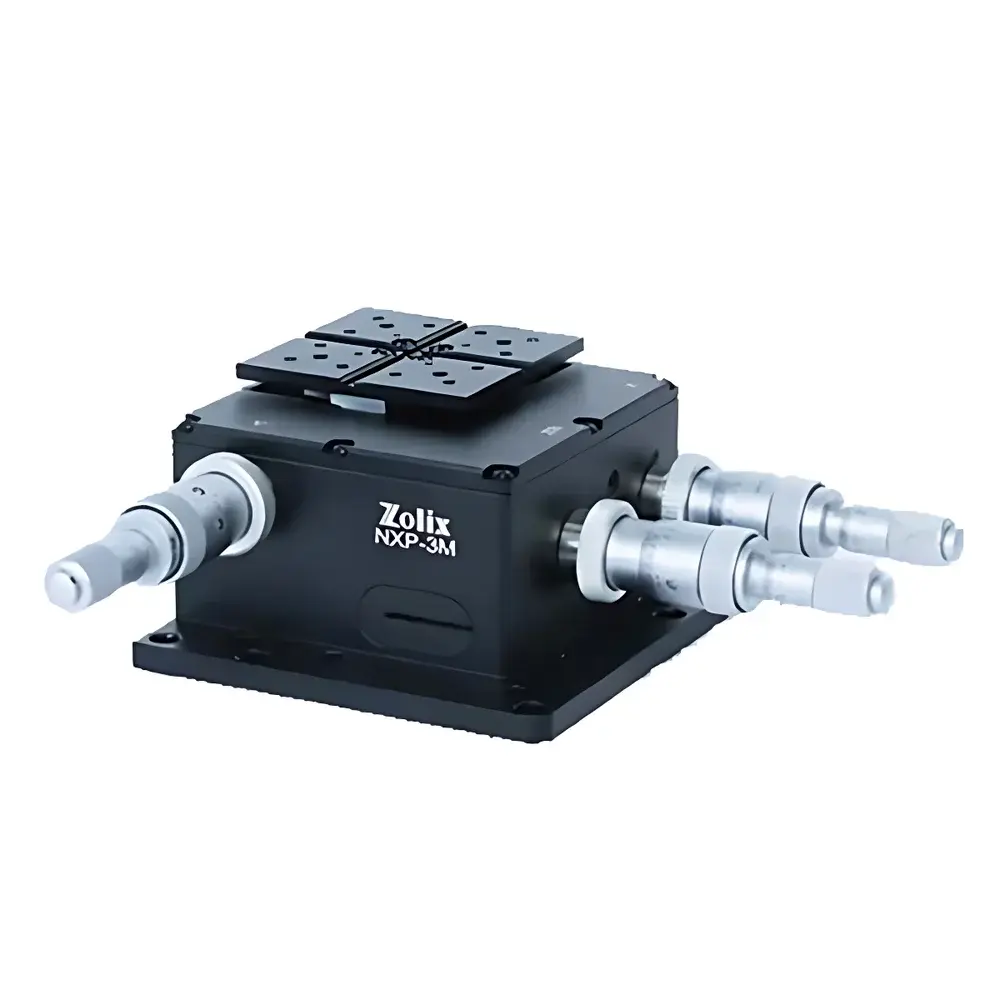
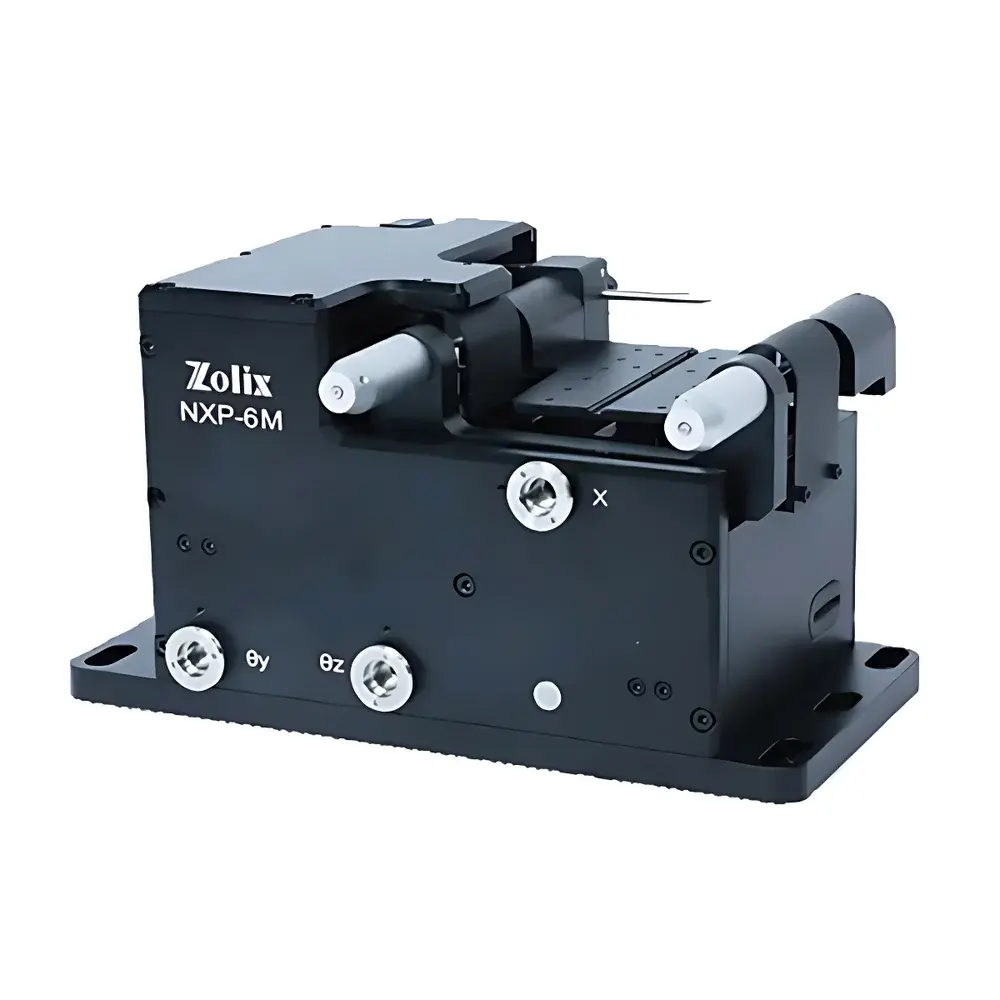
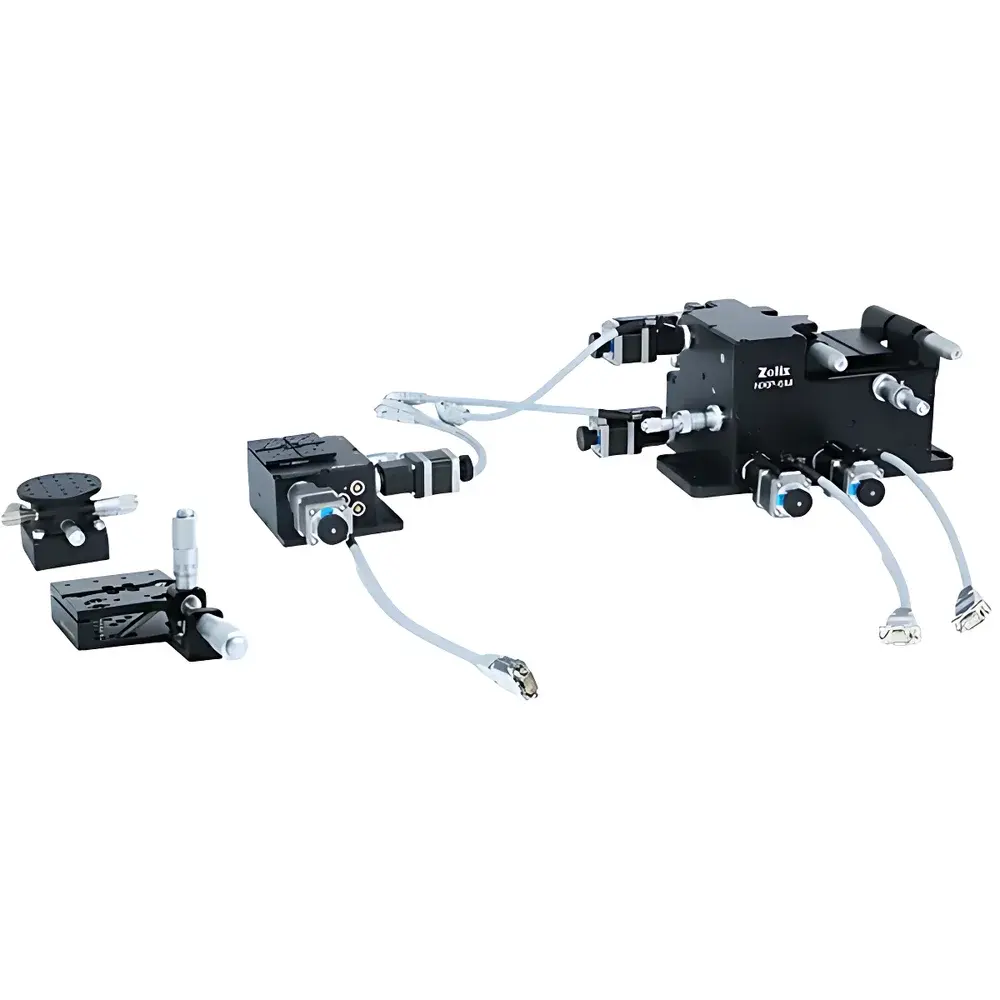
ZOLIX NXP Series Multi-Axis Optical Coupling Stage
| Brand | ZOLIX |
|---|---|
| Origin | Beijing, China |
| Manufacturer Type | Original Equipment Manufacturer (OEM) |
| Product Category | Domestic |
| Model | NXP-3M / NXP-3P / NXP-3NP / NXP-6M / NXP-6P / NXP-6NP |
| Price Range | USD 1,950 – 11,200 (FOB Beijing) |
| Drive Options | Manual (DNXP-M) or Stepper Motor–Driven (DNXP-A, 28-step, 1.8° step angle) |
| Linear Travel (X/Y/Z) | 4 mm |
| Angular Travel (Rx/Ry/Rz) | ±70 mrad (±4°) |
| Transmission Ratio | X/Y = 1:1.5, Z = 1:1, Rotational Axes = 1 µm input → 17 µrad output |
| Resolution | Linear (Open/Closed-Loop Piezo): 1 nm |
| Angular | 0.018 µrad |
| Max Load | 1 kg |
| Resonant Frequency | >130 Hz (±10%) |
| Thermal Drift | ≤1 µm/°C |
| Parallelism of Top Plate | <100 µm |
| Cross-Axis Coupling Error | ≤100 µm |
| Piezo Option | Integrated open-loop or closed-loop piezoelectric actuators (19 µm stroke) |
| Structural Design | Monolithic flexure-based, bearingless, coaxial rotation center architecture |
Overview
The ZOLIX NXP Series Multi-Axis Optical Coupling Stage is an ultra-stable, flexure-guided precision positioning platform engineered for demanding photonic alignment tasks requiring sub-micrometer repeatability and nanoradian angular resolution. Unlike conventional stacked translation/rotation stages with cascaded mechanical interfaces and cumulative backlash, the NXP series employs a monolithic parallel-kinematic architecture—eliminating traditional ball bearings, crossed rollers, or dovetail rails. All six degrees of freedom (X, Y, Z, Rx, Ry, Rz) converge at a single common pivot point, minimizing Abbe error and enabling true coaxial alignment critical for fiber-to-waveguide coupling, photonic integrated circuit (PIC) packaging, and free-space optical interconnect calibration. The stage’s stainless-steel probe-marked rotation center provides unambiguous visual and tactile reference for iterative alignment protocols. Its intrinsic thermal stability (≤1 µm/°C) and high resonant frequency (>130 Hz) ensure minimal drift and robust dynamic performance in temperature-controlled cleanroom or benchtop laboratory environments.
Key Features
- Coaxial Six-Axis Kinematics: All rotational axes share a geometrically defined common center of rotation—reducing iterative alignment cycles by up to 60% compared to sequential multi-stage setups.
- Bearingless Flexure Guidance: Full-monolithic aluminum alloy body with precision-etched flexure hinges ensures continuous, frictionless motion, zero particle generation, and long-term positional stability without lubrication or maintenance.
- Modular Drive Compatibility: Interchangeable manual (DNXP-M, 10 µm coarse / 0.5 µm fine adjustment) and motorized (DNXP-A, 28-step stepper, 1.8° step angle, built-in limit switches) actuators enable rapid reconfiguration for prototyping, production, or automated test systems.
- Piezo-Enhanced Nanopositioning: Optional integrated open-loop or closed-loop piezoelectric actuators deliver 19 µm linear stroke with 1 nm resolution and 0.018 µrad angular resolution—ideal for active feedback alignment in real-time coupling optimization.
- Thermally Invariant Design: Symmetric thermal expansion path and low-coefficient-of-expansion materials maintain sub-micron positional fidelity across ambient fluctuations typical in non-climate-controlled labs.
- GMP-Ready Mechanical Interface: Standard M4 and Ø6 mm kinematic mounting holes conform to ISO 10360-2 metrology-grade staging practices; top plate flatness <100 µm supports direct integration with vacuum-compatible optical tables and interferometric measurement systems.
Sample Compatibility & Compliance
The NXP stage is routinely deployed in applications requiring ISO/IEC 17025-compliant alignment traceability—including fiber optic component testing per IEC 61300-3-35 (attenuation measurement), photonic packaging per Telcordia GR-1209-CORE, and laser diode coupling per IEEE 802.3 Clause 88. Its bearingless construction meets Class 100 cleanroom particulate requirements (ISO 14644-1), and the absence of outgassing elastomers or greases enables compatibility with UHV environments (<1×10⁻⁶ Pa). While not certified to FDA 21 CFR Part 11, the stage’s deterministic mechanical behavior and repeatable positioning profile support audit-ready documentation for GLP/GMP-aligned photonics manufacturing workflows.
Software & Data Management
ZOLIX provides SDKs for LabVIEW™, MATLAB®, and Python (PyVISA) supporting both DNXP-M and DNXP-A drivers. Motorized variants include native support for ASCII command protocol (SCPI-like syntax) and optional EtherCAT or USB 2.0 interfaces. Position logging includes timestamped bidirectional repeatability data (±5.0 µm), thermal drift compensation coefficients, and piezo hysteresis correction tables—all exportable in CSV or HDF5 format for integration into LIMS or MES platforms. Firmware updates preserve calibration metadata per ISO/IEC 17025 Clause 6.6, ensuring measurement traceability across device lifecycles.
Applications
- Fiber-to-chip coupling in silicon photonics and InP-based PIC assembly
- Free-space collimator alignment for quantum optics experiments (e.g., SPDC source coupling)
- Active alignment of VCSEL arrays to micro-lens arrays in LiDAR module production
- Calibration of optical coherence tomography (OCT) reference arms
- Sub-pixel registration of multi-spectral imaging sensors in remote sensing instrumentation
- Alignment of electro-optic modulators in coherent communication transceivers
FAQ
What is the difference between the NXP-6M and NXP-6P models?
The NXP-6M integrates manual micrometer drives for all six axes; the NXP-6P substitutes stepper-motor actuators (DNXP-A) with onboard limit switches and microstepping capability.
Can the NXP stage be operated under vacuum?
Yes—standard configurations use only metal-on-metal flexures and vacuum-rated piezo ceramics (for NP variants); optional gold-plated surfaces and UHV-compatible cabling are available upon request.
Is cross-axis coupling error compensated in firmware?
No—cross-coupling (<100 µm) is mechanically minimized via design; users implement software-based Jacobian compensation using ZOLIX-provided kinematic models in MATLAB or custom control loops.
How is thermal drift characterized and validated?
Each unit undergoes 48-hour thermal soak testing from 20°C to 25°C; measured displacement vs. temperature is recorded and supplied as a per-unit calibration certificate compliant with ISO 10012.
Does ZOLIX provide OEM integration support?
Yes—full mechanical drawings (STEP/IGES), electrical interface schematics, and API documentation are provided under NDA; custom top-plate machining and drive integration services are available.





