
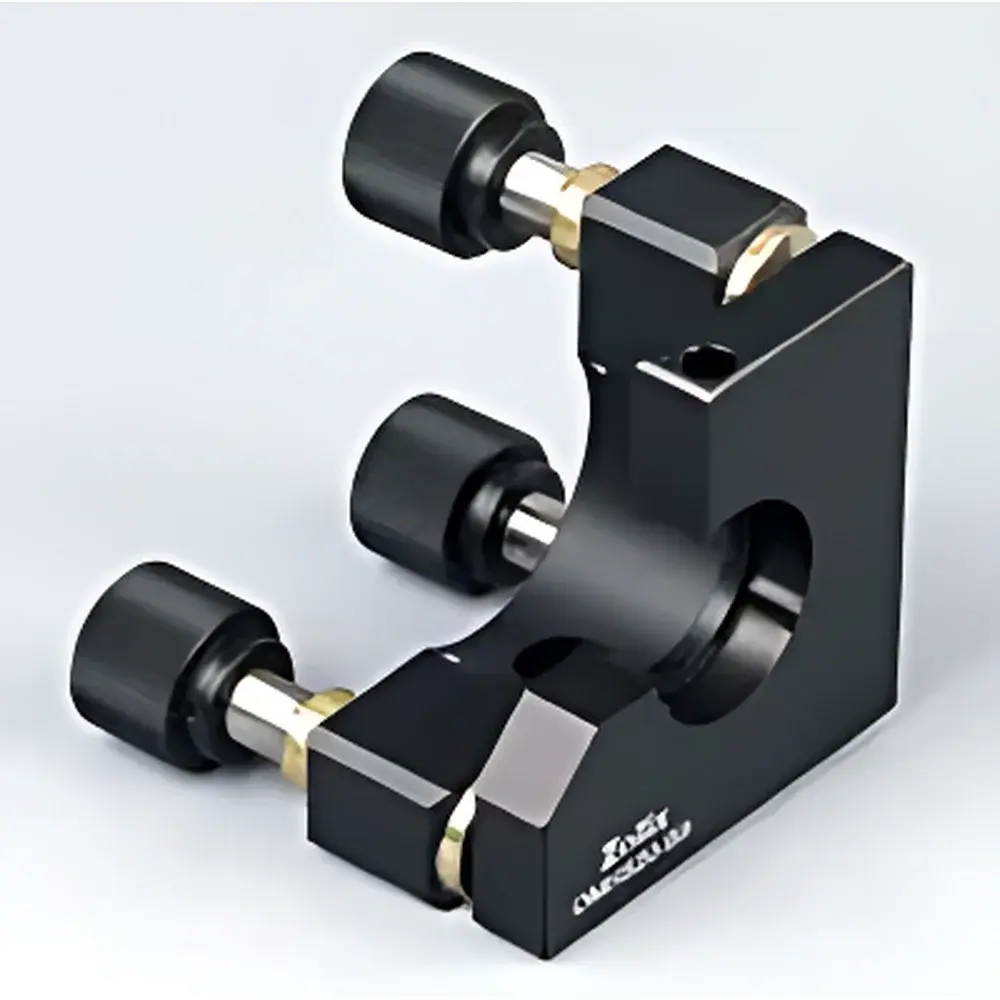
ZOLIX OMHS20(25/30)-BS Triaxial High-Stability Mirror Mount
| Brand | ZOLIX |
|---|---|
| Origin | Beijing, China |
| Manufacturer Type | Direct Manufacturer |
| Product Origin | Domestic (China) |
| Model | OMHS20(25/30)-BS |
| Pricing | Upon Request |
| Mounting Aperture (A) | 20 mm / 25 mm / 30 mm |
| Clear Aperture (B) | 18 mm / 23 mm / 27 mm |
| Angular Adjustment Range | ±3° (Pitch & Yaw) |
| Axial Translation Range | ±1.5 mm (via precision differential micrometer) |
| Base Material | Anodized 6061-T6 aluminum |
| Contact Surface | PTFE-tipped kinematic supports (3-point) |
| Mounting Options | Dual-axis threaded hole pattern (M4 and 1/4"-20) |
| Locking Mechanism | Dual-stage locking (coarse clamp + fine-set screw) |
Overview
The ZOLIX OMHS20(25/30)-BS is a triaxial high-stability optical mirror mount engineered for demanding alignment tasks in laser optics, interferometry, spectroscopy, and quantum optics laboratories. Unlike conventional two-axis tip-tilt mounts, this design integrates orthogonal axial translation—along the optical axis—into a single compact platform, enabling precise focus positioning without requiring secondary translation stages or beam realignment. Its operation relies on a kinematically constrained three-point support system with PTFE-tipped contact points, minimizing stress-induced birefringence and surface deformation in mounted optics. The mount employs a dual-screw architecture: one pair of opposing differential micrometers controls pitch and yaw with sub-arcminute resolution, while a third coaxial micrometer provides calibrated axial displacement (±1.5 mm range, 10 µm graduation), critical for cavity length tuning, confocal alignment, or focal plane optimization. Constructed from rigid 6061-T6 aluminum with hard-anodized finish, it delivers thermal stability (CTE ≈ 23.6 × 10⁻⁶ /°C) and mechanical damping suitable for vibration-sensitive setups.
Key Features
- Triaxial adjustment capability: independent, decoupled control of pitch, yaw, and axial translation—eliminating iterative realignment loops during focus optimization.
- Open-frame architecture with front-loading aperture: enables rapid optic insertion and removal without disassembling adjacent components or disturbing beam path geometry.
- Kinematic three-point PTFE support: distributes clamping force uniformly across the optic edge, preventing localized stress, coating damage, or figure distortion—particularly essential for λ/10 or better surface quality mirrors.
- Dual-standard mounting interface: integrated M4 (metric) and 1/4″-20 (imperial) threaded holes on orthogonal faces, facilitating compatibility with both domestic and international optical rails, posts, and breadboards.
- Two-stage locking system: primary coarse clamp secures gross position; secondary fine-lock screw engages after final adjustment, preserving micron-level repeatability over extended operational periods (>100 hr continuous use under ambient lab conditions).
- Modular sizing variants: OMHS20-BS (20 mm optic), OMHS25-BS (25 mm), and OMHS30-BS (30 mm) share identical adjustment mechanics and footprint—enabling scalable integration across multi-element optical trains.
Sample Compatibility & Compliance
The OMHS20(25/30)-BS accommodates plano and wedged mirrors, beamsplitters, and waveplates with thicknesses ranging from 2 mm to 12 mm. Its PTFE contact geometry is validated for fused silica, BK7, CaF₂, and UV-grade quartz substrates. The mount conforms to ISO 10110-7 (optical component mounting recommendations) and supports GLP-compliant optical alignment documentation when used with traceable calibration artifacts. While not certified to ISO 9001 as a standalone component, ZOLIX manufacturing processes adhere to ISO 9001:2015 standards, and full material certifications (RoHS, REACH) are available upon request. No active electronics or software dependencies exist—ensuring intrinsic compliance with electromagnetic compatibility (EMC) requirements in shielded laser enclosures.
Software & Data Management
This is a purely mechanical, manually operated mount with no embedded sensors, actuators, or firmware. Alignment parameters are recorded externally using standard lab notebooks, digital calipers, or integrated motion-control software (e.g., Thorlabs Kinesis, Newport APT) when paired with optional motorized micrometer adapters (sold separately). The mount’s engraved scale markings (0–1.5 mm axial, ±3° angular) are readable under 10× magnification and compatible with automated vision-based alignment systems using OpenCV or HALCON-based metrology pipelines. Audit trails for positional settings may be maintained in LIMS environments via manual entry or barcode-scanned log sheets linked to experiment IDs.
Applications
- Laser cavity alignment: fine-tuning of output coupler and HR mirror separation for TEM₀₀ mode optimization in diode-pumped solid-state (DPSS) and fiber lasers.
- Interferometric setup stabilization: maintaining fixed cavity length in Michelson, Mach-Zehnder, or Fabry-Pérot configurations under thermal drift or acoustic perturbation.
- Spectroscopic beam steering: compensating for wavelength-dependent dispersion in grating-based monochromators or tunable filter assemblies.
- Quantum optics experiments: aligning entangled photon sources, polarization analyzers, and single-photon detectors where sub-microradian angular stability is required over hours.
- Educational optics labs: demonstrating principles of ray transfer matrices, ABCD formalism, and Gaussian beam propagation with repeatable, hands-on mechanical control.
FAQ
What is the maximum recommended optic weight for OMHS20-BS?
Optics up to 80 g are supported with full angular and axial adjustability; heavier loads (up to 150 g) are permissible with reduced fine-adjustment resolution due to increased friction torque.
Can this mount be vacuum-compatible?
Yes—the anodized aluminum body and PTFE contacts are UHV-compatible up to 10⁻⁷ mbar when baked at ≤80 °C; outgassing rates comply with ASTM E595 specifications.
Is backlash compensation built into the micrometer mechanism?
No; the differential screws are non-backlash by design (dual-opposing thread engagement), eliminating hysteresis without requiring software correction.
How does the axial translation affect collimation of a divergent beam?
Axial movement changes the effective focal plane location but preserves beam directionality; collimation must be verified independently using a shear plate or autocollimator after translation.
Are replacement PTFE tips available as spare parts?
Yes—ZOLIX part number PTFTIP-OMHS is stocked globally and ships with installation tooling and torque specification sheet (0.15 N·m max).






