
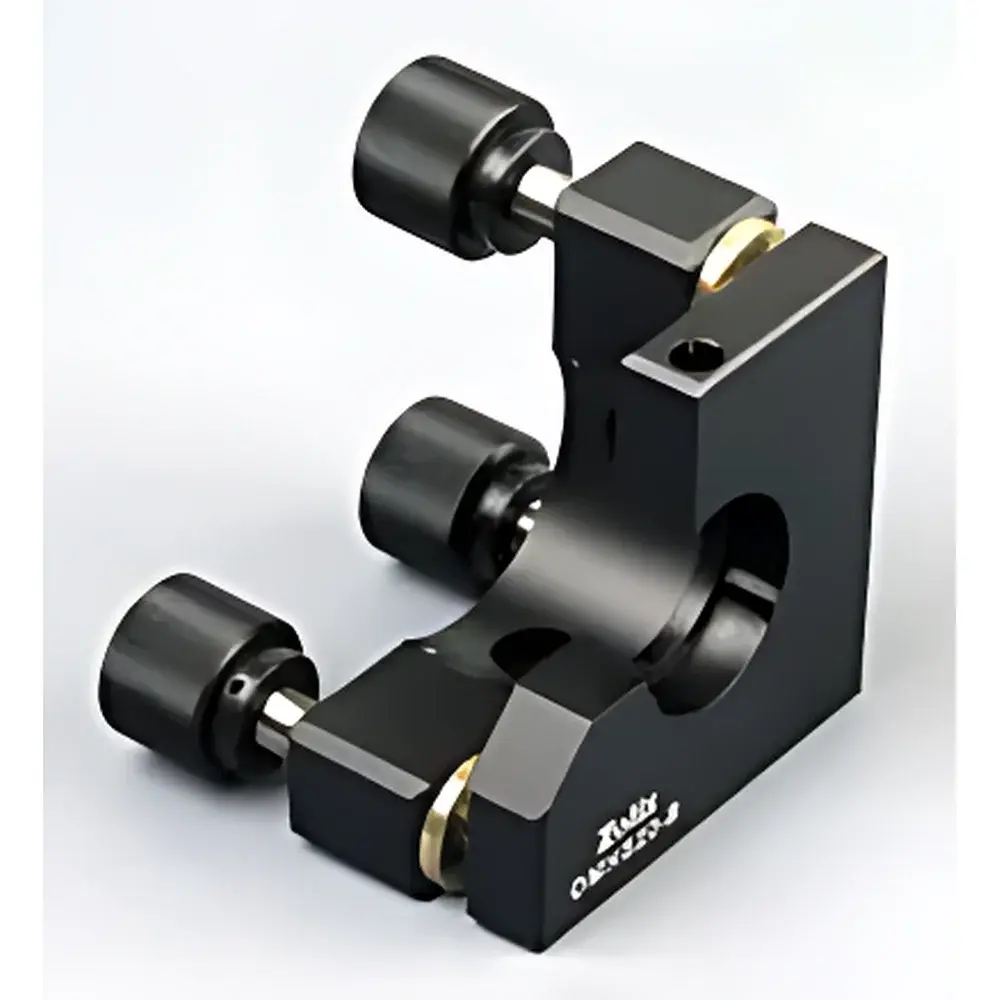
ZOLIX OMHSxx-B Series 3-Axis High-Stability Mirror Mount
| Brand | ZOLIX |
|---|---|
| Origin | Beijing, China |
| Manufacturer Type | Direct Manufacturer |
| Product Line | OMHSxx-B Series |
| Mounting Aperture (A) | 12.7–50.8 mm |
| Clear Aperture (B) | 11–47 mm |
| Tilt Range | ±3° |
| Adjustment Axes | Tip/Tilt + Axial Translation |
| Structural Design | Open-frame with PTFE Tri-point Support |
| Mounting Options | Dual-axis threaded hole pattern (M4 & M6) |
| Compliance | Designed for ISO/IEC 17025-aligned optical alignment workflows |
Overview
The ZOLIX OMHSxx-B Series 3-Axis High-Stability Mirror Mount is an engineered optical positioning solution designed for precision beam steering and alignment in research-grade optical laboratories, laser systems integration, and metrology setups. Unlike conventional two-axis kinematic mounts, this series integrates a third degree of freedom—axial translation—along the optical axis, enabling fine focus adjustment without disturbing angular alignment. The mount operates on a modified kinematic principle: two orthogonal micrometer-driven tip/tilt adjustments (X- and Y-axes) are coupled with a coaxial, backlash-free translation stage actuated via a custom-machined stainless-steel lead screw. This architecture ensures sub-arcminute angular repeatability and micron-level axial resolution while maintaining mechanical rigidity under thermal drift and vibrational load. Its open-frame geometry minimizes diffraction artifacts and facilitates rapid optic insertion and removal—critical in time-sensitive alignment sequences such as cavity locking or interferometric setup.
Key Features
- Three independent adjustment axes: dual-axis angular tilt (±3° total range per axis) plus axial translation (typically 5–8 mm travel, depending on model), all accessible from a single side for ergonomic operation
- Open-frame structural design with integrated mounting flange, eliminating shadowing and enabling unobstructed access to rear-mounted optics or detectors
- Tri-point support system using sintered polytetrafluoroethylene (PTFE) pads—chemically inert, low-friction, and non-marring—to protect coated or delicate substrates during clamping and thermal cycling
- Dual-pattern tapped hole configuration (M4 and M6) on orthogonal faces, supporting both horizontal and vertical beam path integration without adapter plates
- High-strength aluminum alloy body (6061-T6) with hard-anodized surface finish (Type II, 25 µm thickness) for enhanced wear resistance and dimensional stability across ambient temperature fluctuations (15–30 °C)
- Custom-precision ground stainless-steel adjustment screws with 100 µm pitch and knurled brass knobs for tactile feedback and consistent torque application
Sample Compatibility & Compliance
The OMHSxx-B series accommodates plano and wedged mirrors, dichroics, beamsplitters, and waveplates with diameters ranging from 12.7 mm to 50.8 mm. Each variant maintains a minimum clear aperture exceeding 90% of the clamped diameter, ensuring minimal vignetting in collimated or convergent beams up to f/4. The PTFE contact points conform to ISO 9022-3 (optical instrument environmental testing) requirements for non-reactive surface interaction. While not certified to a specific regulatory standard, the mount’s mechanical traceability, repeatable adjustment behavior, and documented thermal expansion coefficient (23.6 × 10⁻⁶ /°C for 6061-T6 Al) support compliance with GLP-aligned lab procedures and internal SOPs governing optical alignment reproducibility. It is routinely deployed in setups subject to ASTM E1317 (laser-based measurement systems) and ISO 10110-7 (surface imperfection specification for optical elements).
Software & Data Management
As a purely mechanical alignment device, the OMHSxx-B series does not incorporate embedded electronics or digital interfaces. However, its deterministic kinematic response enables seamless integration into automated alignment workflows when paired with external position sensors (e.g., quadrant photodiodes, capacitive displacement transducers) and motion controllers (e.g., Thorlabs KDC101, Newport ESP300). Users may log positional metadata—including knob rotation counts, corresponding angular deviations (calibrated per model), and axial translation values—in laboratory information management systems (LIMS) or ELN platforms compliant with 21 CFR Part 11 audit trail requirements. ZOLIX provides downloadable calibration certificates (per model batch) specifying angular sensitivity (arcmin/rev) and axial translation resolution (µm/rev), traceable to national standards via CNAS-accredited metrology labs.
Applications
- Laser cavity alignment in Ti:sapphire, diode-pumped solid-state (DPSS), and fiber laser systems
- Interferometer arm balancing in Michelson, Mach-Zehnder, and Sagnac configurations
- Beam delivery optimization in ultrafast amplifier chains and OPCPA systems
- Optical coherence tomography (OCT) reference arm stabilization
- Alignment of high-NA objectives in confocal and multiphoton microscopy platforms
- Calibration fixture mounting for spectrometer slit alignment and collimator verification
FAQ
Is the OMHSxx-B compatible with vacuum environments?
No—standard units are not vacuum-rated due to lubricant presence in the translation mechanism and lack of outgassing certification. Custom vacuum-compatible variants (with dry-film lubrication and vented housing) are available upon request with lead-time extension.
What is the maximum recommended optic weight per model?
Load capacity is determined by static moment tolerance: OMHS12.7-B supports ≤0.15 N·m; OMHS25.4-B ≤0.45 N·m; OMHS50.8-B ≤1.1 N·m. Exceeding these values risks hysteresis in tilt response and reduced axial repeatability.
Can I retrofit existing OMHS-B mounts with motorized actuators?
Yes—ZOLIX offers optional motorization kits (stepper or piezo-driven) with matching footprint and interface dimensions. Integration requires mechanical modification of the base plate and firmware-level coordination with host motion controllers.
Are replacement PTFE pads available as spare parts?
Yes—ZOLIX supplies OEM-specified sintered PTFE pads (part number PT-OMHS-B-SET) in packs of six, with dimensional tolerances held to ±0.02 mm per pad.
Does the ±3° tilt range apply to both axes simultaneously?
Yes—the specified angular range is independent per axis; compound tilt (e.g., simultaneous X and Y deflection) remains within the convex hull defined by the ±3° limits, preserving linearity up to 2.5° combined deviation.



