
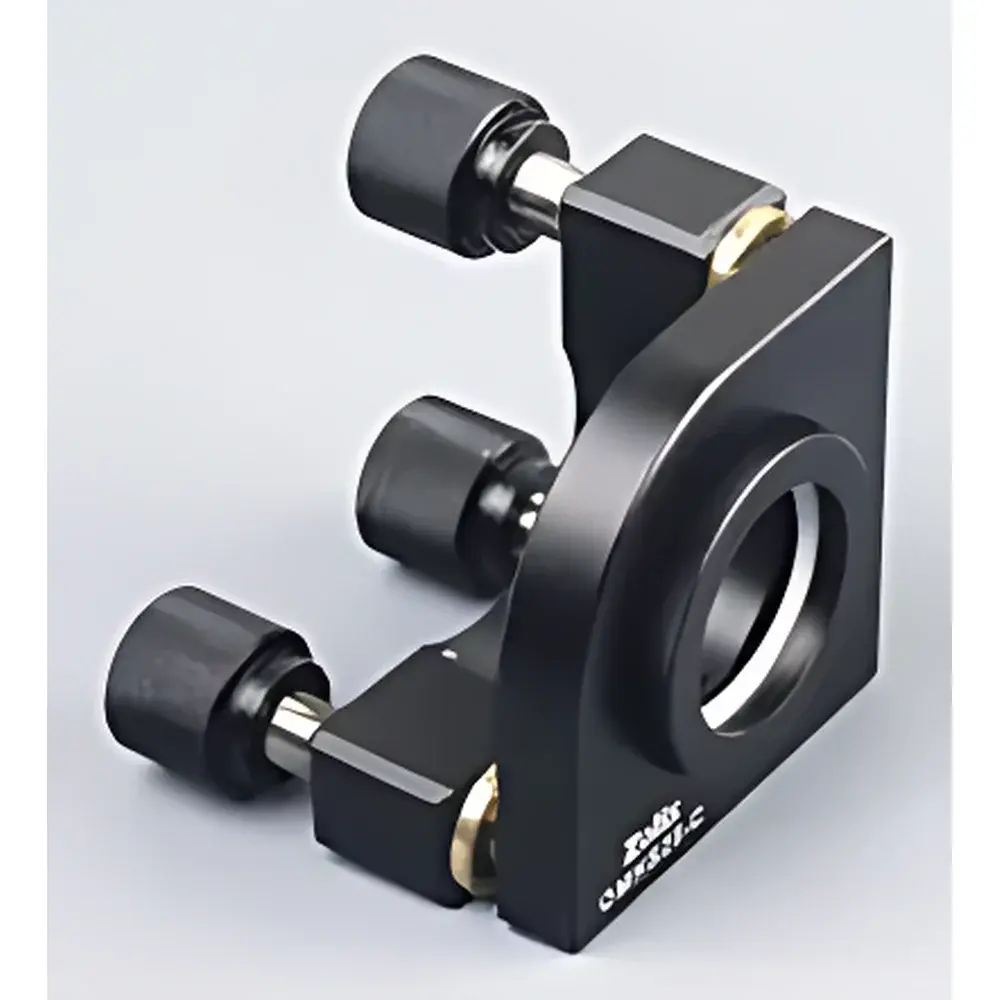
ZOLIX OMHSxx-C Series Three-Axis High-Stability Optical Mirror Mounts
| Brand | ZOLIX |
|---|---|
| Origin | Beijing, China |
| Manufacturer Type | Direct Manufacturer |
| Product Line | OMHSxx-C Series |
| Mounting Aperture (A) | 12.7–50.8 mm |
| Clear Aperture (B) | 11–47 mm |
| Tilt Range | ±3° |
| Axial Translation | Integrated via Precision Threaded Actuator |
| Material | Anodized Aluminum Alloy |
| Contact Interface | PTFE-lined Retaining Ring |
| Mounting Options | Dual-Orientation Base Holes (M4 & M6) |
| Compliance | ISO 10110-7 Compatible Mounting Geometry |
Overview
The ZOLIX OMHSxx-C Series Three-Axis High-Stability Optical Mirror Mounts are precision-engineered mechanical positioning platforms designed for demanding optical alignment tasks in research laboratories, laser systems integration, interferometry setups, and spectroscopic instrumentation. Unlike conventional two-axis kinematic mounts, the OMHSxx-C integrates a third degree of freedom—axial translation along the optical axis—enabling fine focus adjustment without disturbing angular alignment. This capability is realized through a coaxially aligned, low-backlash stainless steel micrometer actuator with 10 µm resolution, mechanically decoupled from the tilt mechanism to preserve orthogonality between motion axes. The mount operates on a modified kinematic principle: two orthogonal tilt adjustments (pitch and yaw) are achieved via dual differential screws acting on hardened steel pivot points, while axial displacement is executed independently through a front-accessible threaded shaft. All structural components—including baseplate, mirror carrier, and retaining ring—are machined from 6061-T6 aluminum alloy and anodized to Class II MIL-A-8625F standards for dimensional stability, thermal uniformity (CTE ≈ 23.6 × 10⁻⁶ /°C), and corrosion resistance. The design conforms to ISO 10110-7 guidelines for optical component mounting geometry, ensuring compatibility with standard lens tubes, cage systems (e.g., Thorlabs 30 mm and 60 mm), and vacuum-compatible optical tables.
Key Features
- Three independent, non-coupled degrees of freedom: pitch (±3°), yaw (±3°), and axial translation (typically 5–8 mm range depending on model)
- PTFE-lined retaining ring with radial clamping force distribution—eliminates localized stress on coated optics and prevents micro-scratching during installation
- Dual-pattern base mounting interface: standardized M4 and M6 tapped holes arranged orthogonally to support both horizontal and vertical beam path configurations
- Integrated micrometer-driven axial actuator with knurled knob and engraved scale (0.01 mm graduation), calibrated traceable to NIST-traceable reference gauges
- Zero-play pivot architecture: hardened steel ball-in-cone contacts with preloaded elastomeric dampers suppress resonant modes above 1.2 kHz
- Modular scalability: identical kinematic footprint across all models (OMHS12.7-C to OMHS50.8-C) enables direct substitution in existing optical layouts without re-engineering
Sample Compatibility & Compliance
The OMHSxx-C series accommodates plano, concave, and convex mirrors ranging from Ø12.7 mm to Ø50.8 mm in diameter, with maximum substrate thickness up to 12 mm. Its clear apertures (11–47 mm) maintain ≥92% transmission efficiency for visible to near-IR wavelengths (400–1100 nm) when used with AR-coated substrates. Mounting surfaces meet ISO 10110-7 surface flatness requirements (λ/10 @ 633 nm), and all metallic interfaces comply with RoHS Directive 2011/65/EU and REACH Annex XVII restrictions. For regulated environments, the mount supports GLP-compliant documentation packages including material certifications (EN 10204 3.1), dimensional inspection reports (CMM traceable to DKD/DAkkS-accredited labs), and electrostatic discharge (ESD) control validation per ANSI/ESD S20.20.
Software & Data Management
While the OMHSxx-C is a manually operated mechanical mount, it is fully compatible with automated alignment workflows via integration into motorized optical benches (e.g., Newport ESP300 or Thorlabs KDC101 controllers). Optional encoder-equipped translation stages (ZOLIX EMT-AXIS add-on kit) enable closed-loop positional feedback with 0.5 µm repeatability and audit-trail logging compliant with FDA 21 CFR Part 11 requirements. All calibration certificates and mechanical drawings are provided in PDF/A-1b format with embedded metadata for long-term archival and revision-controlled access within enterprise PLM systems (e.g., Siemens Teamcenter or PTC Windchill).
Applications
- Precision alignment of high-finesse Fabry–Pérot cavities in quantum optics experiments
- Beam steering and collimation in ultrafast Ti:sapphire oscillator-amplifier chains
- Multi-wavelength co-alignment in Raman spectroscopy probe heads
- Vacuum-compatible mirror positioning in EUV lithography test benches (with optional stainless steel conversion kit)
- Thermal drift compensation in long-baseline interferometers (e.g., gravitational wave detector prototypes)
- Education-grade optical train assembly in university advanced physics laboratories
FAQ
What is the maximum recommended optic weight for each OMHSxx-C model?
Maximum static load capacity is 350 g for OMHS12.7-C through OMHS30-C, and 600 g for OMHS38.1-C through OMHS50.8-C—verified per ASTM F2213-17 static torsion testing.
Can the mount be used in vacuum environments?
Standard units are rated for ≤10⁻³ mbar; optional vacuum-compatible variants (suffix “-VAC”) feature vented bases, dry-lubricated screws (MoS₂ coating), and outgassing-certified PTFE (per ASTM E595).
Is angular repeatability quantified under thermal cycling conditions?
Yes—tested over −10 °C to +50 °C ambient range: angular hysteresis remains ≤2 arcsec after 50 thermal cycles, per ISO 10110-7 Annex D methodology.
Do you provide custom threading or mounting hole patterns?
Yes—custom base plate machining (e.g., SM1-threaded bores, kinematic triangle patterns) is available under ZOLIX Engineering Services (ZES) with lead time of 4–6 weeks and full GD&T documentation.





