
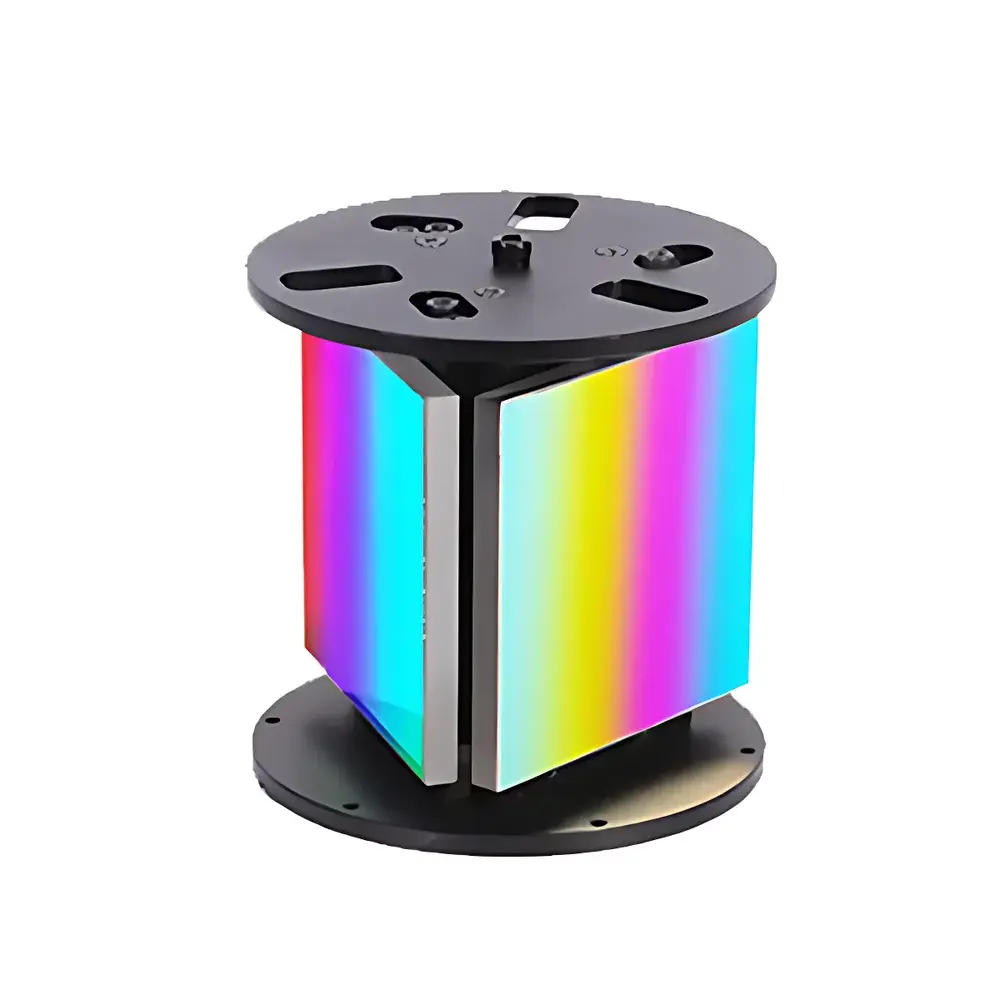
ZOLIX Omni-λ Series Spectroscopy Gratings
| Key | Brand: ZOLIX |
|---|---|
| Origin | Beijing, China |
| Manufacturer Type | Original Equipment Manufacturer (OEM) |
| Product Category | Domestic |
| Model Series | Omni-λ Grating Modules |
| Pricing | Upon Request |
Overview
ZOLIX Omni-λ Series Spectroscopy Gratings are precision optical dispersion elements engineered for high-efficiency wavelength separation in monochromators and spectrographs. Designed specifically for integration with ZOLIX’s flagship Omni-λ family—including the Omni-λ300i, Omni-λ500i, Omni-λ750i, Omni-λ180Di, and Omni-λ200i spectrometers—these gratings employ either holographic or ruled fabrication techniques to deliver optimized diffraction efficiency across ultraviolet (UV), visible (VIS), near-infrared (NIR), and mid-infrared (MIR) spectral regions. Each grating is characterized by three fundamental parameters: groove density (lines per millimeter), blaze wavelength (peak diffraction efficiency wavelength), and spectral coverage range (minimum–maximum usable wavelength). The 68 × 68 mm, 40 × 40 mm, and 50 × 50 mm standard formats ensure mechanical compatibility with ZOLIX’s kinematic mounting systems and thermal expansion-matched optical benches.
Key Features
- Two core fabrication types: high-uniformity holographic gratings (low stray light, minimal ghosting) and high-efficiency ruled gratings (optimized for specific blaze conditions)
- Comprehensive groove density selection—from 15 g/mm (for broad spectral coverage in IR) to 3600 g/mm (for high-resolution UV/VIS applications)
- Blaze wavelengths spanning 190 nm to 16 µm, enabling tailored performance from deep UV to long-wave infrared
- Standardized physical dimensions (68 × 68 mm, 50 × 50 mm, 40 × 40 mm) with precision-ground substrates and anti-reflection coatings on substrate backsides
- Inventory-optimized “blue-marked” models available for rapid delivery—reducing lead time without compromising calibration traceability
- Consistent wavefront error < λ/4 @ 633 nm (verified interferometrically per batch)
Sample Compatibility & Compliance
All gratings are validated for use in ZOLIX’s ISO 9001-certified optical alignment environment and undergo spectral efficiency mapping using NIST-traceable calibrated photodiode arrays. They comply with ISO 10110-7 (optical component surface quality) and MIL-PRF-13830B (scratch-dig specification). For regulated laboratory environments, grating installation and spectral calibration workflows support GLP/GMP documentation requirements; spectral data generated using these gratings meet ASTM E275 (standard practice for describing and measuring performance of ultraviolet, visible, and near-infrared spectrophotometers) and ISO/IEC 17025:2017 (general requirements for competence of testing and calibration laboratories). No hazardous substances are used in coating or replication processes—fully RoHS 3 compliant.
Software & Data Management
Grating identification and operational parameters are natively embedded into ZOLIX’s OmniDriver™ control software (v4.2+). Upon mounting, the system auto-detects grating model via engraved serial code and loads corresponding dispersion coefficients, efficiency curves, and order-sorting filter recommendations. All spectral acquisition sessions log grating ID, position angle, and thermal drift compensation values in machine-readable JSON metadata. Audit trails include timestamped operator credentials, firmware revision, and environmental sensor readings (temperature/humidity)—supporting full compliance with FDA 21 CFR Part 11 for electronic records and signatures when deployed in pharmaceutical or clinical QC settings.
Applications
- High-throughput fluorescence excitation/emission profiling in life science research
- Raman spectroscopy with notch-filter rejection optimization
- Plasma emission monitoring in semiconductor process tools (OES)
- Remote sensing spectrometer calibration for Earth observation platforms
- FTIR accessory modules requiring broadband, low-polarization-dependent dispersion
- Educational lab setups where reproducible resolution and signal-to-noise ratio are pedagogically critical
FAQ
Which grating type is recommended for UV resonance Raman measurements below 250 nm?
Holographic gratings with 2400 g/mm groove density and 240 nm blaze (e.g., Model 1-240-240-NP) provide optimal efficiency and minimized higher-order contamination in this region.
Can these gratings be retrofitted into non-ZOLIX spectrometers?
Mechanical interchangeability is not guaranteed due to proprietary kinematic mount geometry and collimator focal length matching; engineering consultation is required prior to integration.
Do you supply efficiency calibration reports with each unit?
Yes—each shipped grating includes a NIST-traceable spectral efficiency curve (350–1600 nm) measured at ±0.2 nm wavelength accuracy and ±1.5% relative uncertainty.
What is the maximum incident power density tolerance?
All coated gratings are rated for continuous-wave irradiance up to 5 W/cm² at 532 nm (unfocused); pulsed laser operation requires individual damage threshold verification.
Are custom groove profiles or substrate materials available?
Custom holographic master fabrication (e.g., sinusoidal vs. blazed profiles) and CaF₂ or KRS-5 substrates for extended IR transmission are offered under OEM agreement with minimum order quantities.
Related Products





