
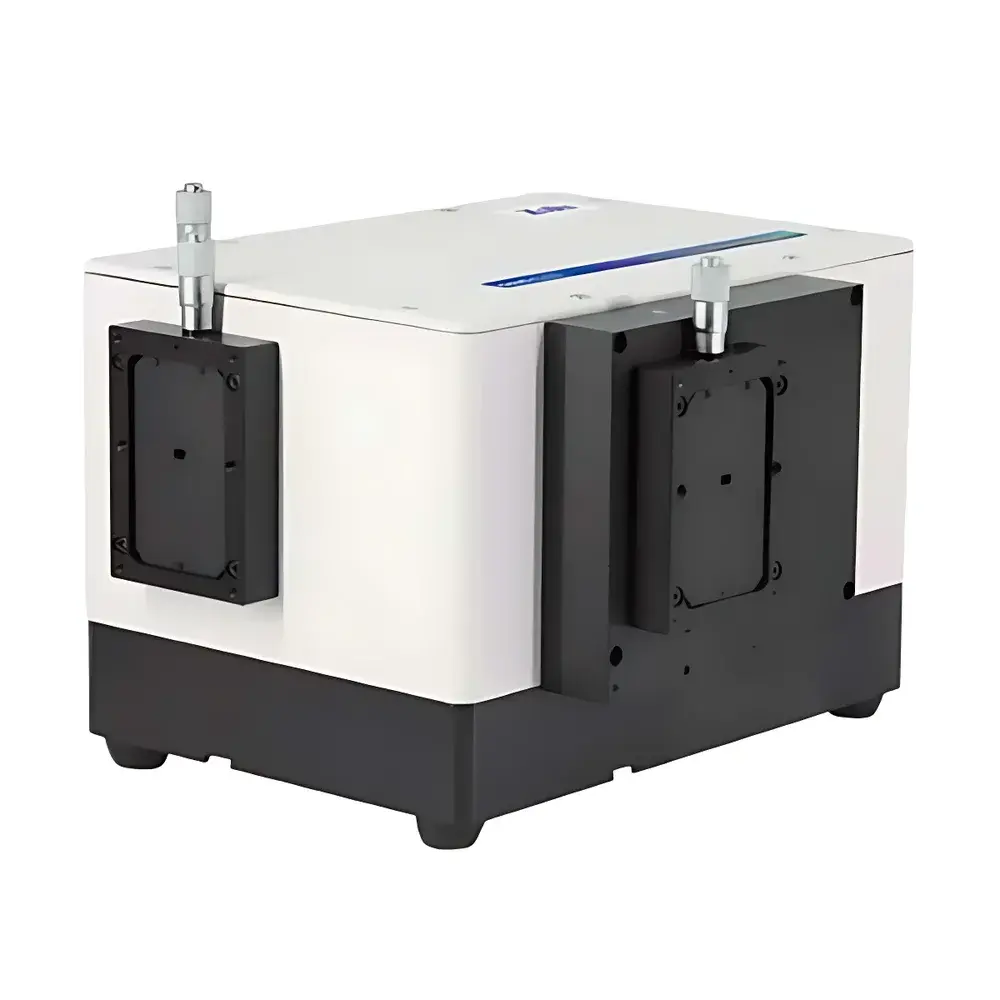
ZOLIX Omni-λ2002i Imaging-Corrected Grating Monochromator
| Brand | ZOLIX |
|---|---|
| Origin | Shanghai, China |
| Manufacturer Type | Direct Manufacturer |
| Regional Classification | Domestic (PRC) |
| Model | Omni-λ2002i |
| Application Systems | Transmission/Reflection Spectroscopy |
| Grating Configuration | Dual-grating turret |
| Stray Light Level | 5 × 10⁻⁵ |
| Focal Length | 200 mm |
| f-number | f/3.5 |
| Optical Design | Czerny–Turner with Toroidal Imaging Correction |
| Entrance/Exit | Side-mounted entrance, side-mounted CCD exit |
| Grating Size | 50 × 50 mm |
| Slit Width Range | 0.01–3 mm (manual, motorized optional) |
| Slit Height Options | 2 mm / 4 mm / 14 mm |
| 焦 Plane Dimensions | 30 mm (W) × 14 mm (H) |
| Optical Axis Height | 146 mm |
| Wavelength Accuracy | ±0.1 nm (@1200 g/mm, 435.83 nm) |
| Wavelength Repeatability | 0.05 nm (@1200 g/mm, 435.83 nm) |
| Minimum Scan Step | 0.005 nm (@2400 g/mm) |
| Spectral Resolution (PMT) | 0.08 nm (@2400 g/mm, 435.83 nm) |
| Spectral Resolution (15-µm-pixel CCD) | 0.106 nm (@2400 g/mm, 435.83 nm) |
| CCD Single-Capture Spectral Range | 42 nm (@2400 g/mm, 30-mm CCD) |
| Mechanical Scan Range | 0–19,200 nm (dependent on grating) |
| Stray Light Suppression Ratio | 5 × 10⁻⁵ |
| Power Requirement | 100 W peak @ 24 V DC |
| Standard Interface | USB 2.0 |
Overview
The ZOLIX Omni-λ2002i is an imaging-corrected, dual-grating monochromator engineered for high-fidelity spectral isolation across the ultraviolet, visible, and near-infrared (UV-VIS-NIR) spectrum — spanning 190 nm to 4800 nm depending on grating selection. Based on a Czerny–Turner optical architecture enhanced with toroidal mirror correction, it delivers diffraction-limited image quality at the focal plane, minimizing astigmatism and spectral distortion. This design enables true multi-channel detection — particularly critical for array-based detectors such as scientific-grade CCDs and CMOS sensors — where spatial fidelity directly governs wavelength calibration stability and photometric accuracy. Unlike conventional monochromators, the Omni-λ2002i maintains consistent line shape and intensity distribution across its full spectral range, supporting quantitative applications including absolute reflectance measurement, quantum efficiency characterization, and time-resolved spectroscopy when integrated into synchronized optical systems.
Key Features
- Imaging-corrected optical path using toroidal collimating and focusing mirrors, ensuring flat, undistorted spectral images at the detector plane
- Dual-grating turret mechanism allowing rapid, reproducible switching between two user-installed gratings without realignment or recalibration
- Stray light suppression ratio of 5 × 10⁻⁵ — achieved via optimized baffling, blackened internal surfaces, and precision-aligned optical mounts — essential for high-dynamic-range measurements (e.g., weak Raman signals adjacent to strong Rayleigh peaks)
- Side-mounted entrance and side-mounted CCD exit configuration, optimized for direct coupling to linear or area-array detectors without beam folding
- Focal plane dimensions of 30 mm (width) × 14 mm (height), accommodating standard 2/3″ and 1″ format scientific CCDs with mechanical adaptability for custom sensor integration
- Manual slit with 0.01–3 mm continuous adjustment; optional motorized slits provide programmable bandwidth control compatible with automated spectroscopic workflows
- Standard USB 2.0 interface for host communication; firmware supports command-line control (ASCII protocol) for integration into LabVIEW, Python, MATLAB, or custom OEM software stacks
Sample Compatibility & Compliance
The Omni-λ2002i operates as a core optical engine rather than a standalone instrument, requiring integration with external light sources (e.g., deuterium, tungsten-halogen, or laser diodes), sample interfaces (transmission cells, integrating spheres, or reflection stages), and detectors (PMTs, Si/InGaAs CCDs, or thermoelectrically cooled sCMOS). Its modular mechanical interface — including standardized flange mounts (CF-35 or custom-machined options), M4 and M6 threaded holes, and defined optical axis height (146 mm) — ensures compatibility with ISO-standard optical tables and OEM optomechanical subassemblies. While not certified to a specific regulatory framework as a finished medical or pharmaceutical device, its mechanical stability (<0.05 nm wavelength repeatability), thermal drift performance (<±0.02 nm/°C under controlled lab conditions), and traceable calibration methodology align with GLP-compliant spectroscopic system design practices. When paired with NIST-traceable calibration lamps (e.g., Hg/Ar or Ne), it supports ASTM E275, ISO 13406-2, and USP spectrophotometer verification protocols.
Software & Data Management
The monochromator is controlled via ASCII-based serial commands over USB 2.0, enabling deterministic, low-latency positioning of the grating and slit mechanisms. ZOLIX provides a Windows-compatible SDK with documented API calls for wavelength scanning, grating selection, slit actuation, and encoder feedback polling. No proprietary runtime or closed drivers are required — all functions operate through standard HID-compliant USB enumeration. For data integrity in regulated environments, users may implement audit-trail logging at the application layer (e.g., timestamped command logs with checksummed responses), satisfying foundational requirements of FDA 21 CFR Part 11 when combined with appropriate system-level controls. The absence of embedded operating systems or network interfaces eliminates cybersecurity attack vectors common in “smart” spectrometers, reinforcing suitability for secure laboratory networks and cleanroom-integrated platforms.
Applications
- Fluorescence excitation/emission mapping with narrowband selection and high stray-light rejection
- Raman spectroscopy — especially low-wavenumber (<200 cm⁻¹) and surface-enhanced (SERS) configurations requiring UV excitation and NIR detection
- Reflectance and transmittance quantification of thin films, coatings, and photovoltaic materials per ASTM E903 and ISO 9050
- Spectral responsivity calibration of photodetectors and imaging sensors (per CIE S 023/E:2013)
- OEM integration into compact spectrometers, process analyzers, and hyperspectral imaging engines where footprint, thermal stability, and detector compatibility are prioritized
- Time-resolved photoluminescence decay analysis when synchronized with pulsed lasers and gated ICCDs
FAQ
What grating options are supported, and how do I select the optimal one for my wavelength range?
The Omni-λ2002i accepts 50 × 50 mm ruled or holographic gratings from 75 to 2400 g/mm. Selection depends on required resolution, spectral coverage, and detector pixel pitch. For example, a 2400 g/mm grating delivers 0.08 nm resolution with a PMT but limits scan range to ~600 nm; a 150 g/mm grating extends coverage to 19,200 nm but reduces resolution to ~3.2 nm.
Is the instrument suitable for vacuum or purged operation?
The base model is air-path only. Optional vacuum-compatible versions (with Viton O-rings, stainless steel housing, and bake-out rated components) are available upon request — contact technical support for pressure rating and outgassing specifications.
Can I use this monochromator with a fiber-coupled source or detector?
Yes — standard SMA905 or FC/PC fiber adapters can be mounted to the entrance or exit ports using optional kinematic flanges. Beam divergence and NA matching must be validated for throughput optimization.
Does the system include wavelength calibration tools?
No factory calibration certificate is included. Users must perform initial calibration using standard emission lamps (e.g., Hg, Ne, or Ar) and reference spectra. ZOLIX provides calibration procedure documentation and polynomial fitting templates.
Are motorized slits or shutters supplied as standard equipment?
No — manual slits are standard. Motorized slits, filter wheels, and electronic shutters are optional accessories with separate part numbers and driver compatibility documentation.





