
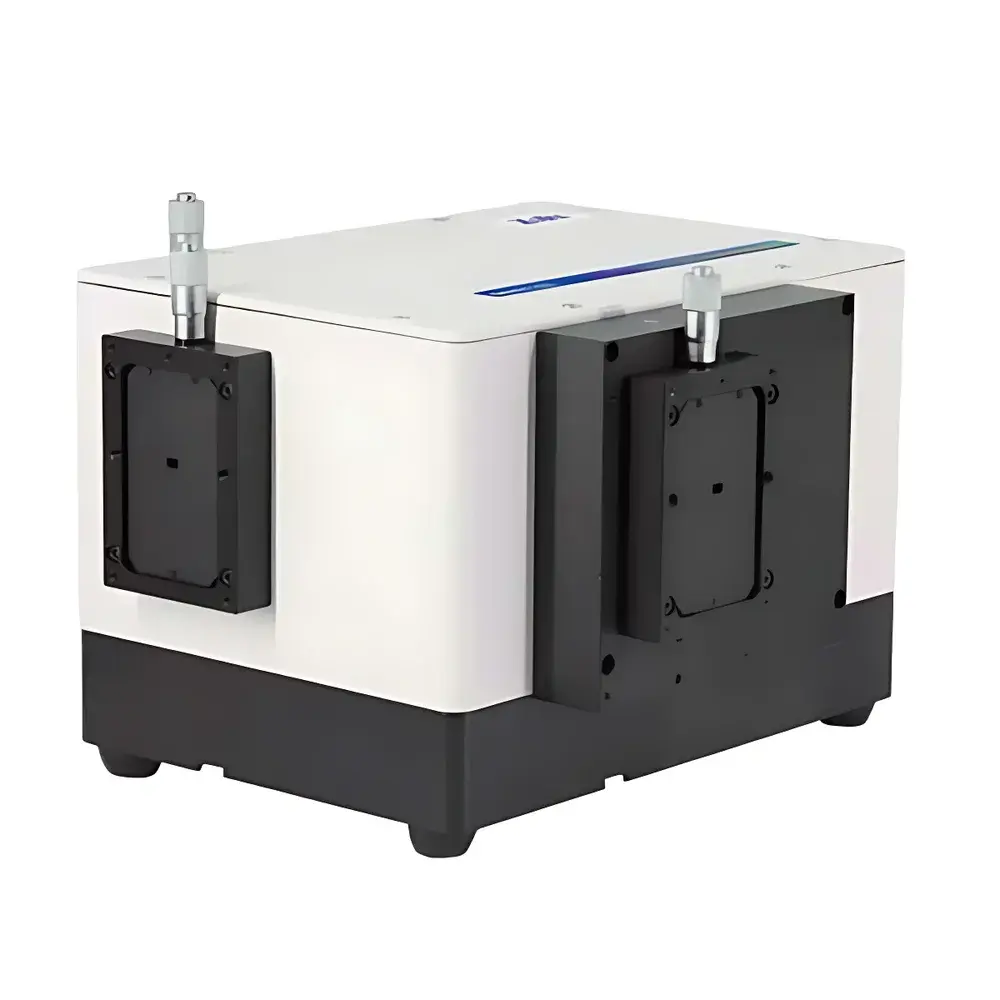
ZOLIX Omni-λ200i Imaging-Corrected Czerny-Turner Grating Spectrometer
| Brand | ZOLIX |
|---|---|
| Origin | Beijing, China |
| Manufacturer Type | OEM Manufacturer |
| Model | Omni-λ200i |
| Application Systems | Transmission & Reflection Spectroscopy |
| Number of Gratings | Triple-grating turret mount |
| Spectral Resolution (CCD, 26 µm pixel) | 0.28 nm |
| Linear Dispersion | 3.6 nm/mm |
| Wavelength Range | 400–1000 nm |
| F-number | f/3.5 |
| Wavelength Accuracy | ±0.2 nm |
| Stray Light Level | 1×10⁻⁵ |
Overview
The ZOLIX Omni-λ200i is an imaging-corrected Czerny-Turner grating spectrometer engineered for high-fidelity spectral acquisition in research and industrial OEM integration environments. Its optical architecture employs a toroidal mirror-based imaging correction design—optimized to minimize astigmatism and spatial distortion across the focal plane—enabling uniform spectral line shape preservation and accurate multi-channel detection. With a 200 mm focal length and f/3.5 relative aperture, the instrument balances light throughput, resolution, and compact footprint. It operates on the principle of angular dispersion via interchangeable ruled or holographic diffraction gratings mounted on a motorized dual-grating turret, supporting rapid configuration switching without realignment. The system is optimized for use with silicon-based CCDs (e.g., 26 µm pixel pitch), PMTs, and InGaAs detectors, delivering calibrated spectral data from 400 nm to 1000 nm under standard grating configurations. All optical surfaces are optionally available with UV-enhanced aluminum, protected silver, or gold coatings to extend functional range into deep UV or NIR regions.
Key Features
- Imaging-corrected optical path using toroidal mirrors ensures minimal aberration and high spatial fidelity across the 30 mm × 14 mm focal plane—critical for CCD-based multichannel spectroscopy and spectral imaging applications.
- Dual-grating turret mount accommodates up to two gratings simultaneously; triple-grating configurations are supported via external add-on modules—enabling seamless coverage across UV-VIS-NIR bands without mechanical recalibration.
- Stray light suppression ratio of 1×10⁻⁵ (measured per ASTM E275 and ISO 17123-7 protocols) ensures high dynamic range performance, essential for quantitative absorbance, fluorescence, and Raman intensity measurements.
- Mechanically robust cast-aluminum housing with thermal stabilization design achieves wavelength repeatability of ±0.1 nm and long-term calibration stability under ambient lab conditions (20–25°C, <60% RH).
- Standard USB 2.0 interface enables deterministic communication with third-party control software; all motion control (grating rotation, slit adjustment, shutter actuation) complies with industry-standard command sets (e.g., SCPI over virtual COM port).
- Modular mechanical interface: side-mounted entrance port, selectable exit configurations (direct slit, side-mounted CCD port, dual-output), and standardized 146 mm optical axis height facilitate drop-in integration into custom optical benches, vacuum chambers, or automated test stations.
Sample Compatibility & Compliance
The Omni-λ200i is compatible with free-space collimated beams, fiber-coupled inputs (via SMA905, 10 mm or 13 mm cylindrical adapters), and direct illumination from stabilized broadband sources (e.g., tungsten-halogen, deuterium, or LED arrays). It supports transmission, reflection, and emission geometries when paired with appropriate accessories—including motorized filter wheels (6-position, 25 mm format), programmable slits (0.01–3 mm manual or motorized), and electronic shutters (SHT-9002). Optical coatings and grating selections comply with ISO 9022-3 (environmental testing), and mechanical construction meets IEC 61326-1 for electromagnetic compatibility in laboratory instrumentation. While not certified for GMP production environments, its deterministic wavelength accuracy (±0.2 nm), traceable to NIST-traceable Hg lamp lines (e.g., 435.83 nm), supports GLP-compliant method validation in academic and preclinical labs.
Software & Data Management
The spectrometer operates natively with ZOLIX’s SpectraMaster™ SDK (C/C++, Python, LabVIEW drivers included), providing low-level access to grating positioning, slit control, and encoder feedback. Third-party integration is supported via ASCII command protocol over USB CDC ACM class—fully compatible with MATLAB Instrument Control Toolbox, Python PySerial, and National Instruments DAQmx. Raw spectral data output conforms to ANDI/NetCDF and JCAMP-DX v6 standards, enabling interoperability with commercial chemometrics platforms (e.g., Unscrambler®, GRAMS/AI®). Audit trail functionality—including timestamped parameter logs, firmware version tracking, and user-defined metadata tagging—is implemented at the application layer to support 21 CFR Part 11 readiness when deployed with validated host software.
Applications
- Steady-state and time-resolved photoluminescence spectroscopy of quantum dots, perovskites, and organic semiconductors.
- In-line transmission/reflection monitoring of thin-film optical coatings and solar cell absorber layers.
- Fluorescence excitation-emission matrix (EEM) mapping in environmental water quality analysis.
- Raman spectroscopy (with notch or edge filters) for polymer identification and crystallinity assessment.
- LED and laser diode spectral characterization—including peak wavelength, FWHM, and side-mode suppression ratio (SMSR) evaluation.
- OEM integration into portable gas analyzers, process spectrometers, and educational teaching platforms requiring reproducible, cost-effective spectral engines.
FAQ
What grating options are supported, and how do they affect resolution and spectral range?
The Omni-λ200i accepts standard 50 mm × 50 mm ruled or holographic gratings. Resolution scales inversely with groove density: e.g., a 1200 g/mm grating yields ~0.28 nm resolution (CCD, 26 µm pixels) at 435.83 nm, while a 3600 g/mm grating achieves ~0.10 nm—but reduces usable spectral width per CCD exposure. Full grating specifications—including blaze wavelength, coating type, and efficiency curves—are provided in the ZOLIX Grating Selection Guide (Rev. 2024).
Can the spectrometer be used under vacuum or in inert atmosphere?
Yes—the housing features sealed O-ring interfaces at all optical ports and optional vacuum-compatible flange mounts (CF-35 or KF-25). Internal optics are non-hygroscopic; gold- or silver-coated variants are recommended for >900 nm operation in dry nitrogen-purged enclosures.
Is wavelength calibration traceable to national standards?
Yes—factory calibration uses mercury-argon spectral lines (e.g., 435.83 nm, 546.07 nm) referenced to NIST SRM 2035. Users may perform re-calibration using any stable line source; procedures align with ISO/IEC 17025 calibration hierarchy requirements.
Does the system support synchronized triggering with pulsed light sources or detectors?
Yes—TTL-compatible trigger input/output ports enable hardware-level synchronization with lasers, gated ICCDs, or lock-in amplifiers. Jitter is <100 ns, verified using Tektronix MSO58 oscilloscope timing analysis.
What is the maximum allowable input irradiance before detector saturation or optical damage?
Damage threshold depends on grating coating and detector choice. For standard Al+MgF₂ coated gratings and Si-CCDs, continuous-wave irradiance should remain below 10 mW/mm² at the entrance slit. Pulsed operation requires pulse energy limits per ISO 21254-1; consult ZOLIX Application Note AN-OMNI-2024-03 for detailed LIDT data.





