
ZOLIX Omni-LIBS Integrated Laser-Induced Breakdown Spectroscopy System
| Brand | ZOLIX |
|---|---|
| Origin | Beijing, China |
| Manufacturer Type | Original Equipment Manufacturer (OEM) |
| Product Category | Domestic |
| Model | Omni-LIBS Integrated LIBS System |
| Pricing | Upon Request |
Overview
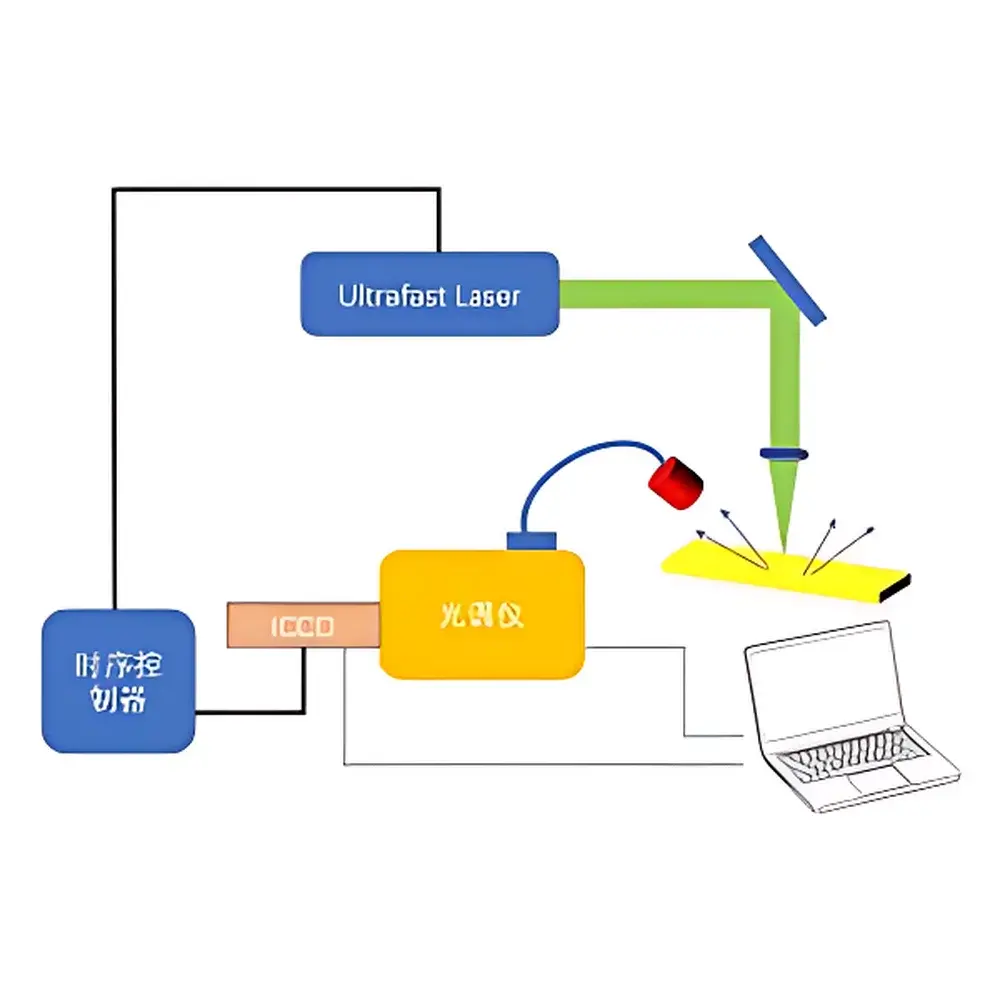
The ZOLIX Omni-LIBS Integrated Laser-Induced Breakdown Spectroscopy System is a turnkey analytical platform engineered for elemental analysis of solid, liquid, and powdered samples via laser-induced plasma emission. Based on the fundamental principle of atomic emission spectroscopy, the system employs a pulsed laser—typically operating at 1064 nm or 532 nm—to ablate a micro-volume of sample surface, generating a transient plasma plume (>5,000 K). As the plasma cools, excited atoms and ions decay to lower energy states, emitting characteristic photons across the UV–VIS–NIR spectral range (190–1000 nm). These emissions are collected, dispersed by a Czerny-Turner (C-T) monochromator, and resolved with sub-nanometer spectral fidelity using an intensified charge-coupled device (ICCD) or high-speed linear CCD detector. Unlike conventional lab-based spectroscopic methods requiring extensive sample preparation, LIBS enables direct, minimally destructive, in-situ, and multi-elemental detection—making it suitable for rapid screening, spatial mapping, and quantitative trace analysis in regulated and field-deployable environments.
Key Features
- Modular C-T spectrometer architecture with focal lengths of 200 mm, 320 mm, 500 mm, and 750 mm—optimized for flexibility between resolution, throughput, and portability
- High-throughput optical design supporting interchangeable gratings (e.g., 1200 grooves/mm), enabling configurable spectral resolution down to 0.03 nm (FWHM) at 750 mm focal length
- Native compatibility with ns-pulsed Nd:YAG lasers (Q-switched, 1–10 Hz repetition rate) and emerging fs-laser excitation sources for reduced thermal damage and improved ablation control
- Integrated time-gated ICCD detection with programmable delay (10 ns–10 ms) and gate width (2 ns–100 µs), synchronized via precision digital delay generator
- Multi-interface optical coupling: SMA905 fiber input (standard), free-space collimated input option, and dual-output ports for simultaneous PMT/CCD/ICCD integration
- Robust mechanical housing with kinematic mounts, temperature-stabilized optics bench, and vibration-damped baseplate for long-term measurement reproducibility
Sample Compatibility & Compliance
The Omni-LIBS system supports heterogeneous sample types without digestion or matrix-matching: metals, alloys, geological specimens, ceramics, biological tissues, pharmaceutical powders, and cultural heritage artifacts. Its non-contact, ambient-air operation eliminates vacuum requirements and enables real-time analysis under atmospheric or controlled gas environments (e.g., Ar, He). The system complies with core metrological principles outlined in ISO/IEC 17025 for calibration traceability of wavelength and intensity response. Spectral data acquisition protocols support audit-ready metadata logging—including laser energy (measured per-shot), gate timing, grating position, and detector gain—facilitating GLP/GMP-aligned workflows. While not pre-certified for FDA 21 CFR Part 11, the software architecture allows configuration of electronic signatures, user access tiers, and immutable audit trails required for regulated QC laboratories.
Software & Data Management
ZOLIX OmniControl™ software provides full instrument orchestration: laser triggering, delay/gate parameterization, spectrometer grating positioning, and detector acquisition control. Raw spectra are stored in vendor-neutral HDF5 format with embedded calibration coefficients (wavelength, pixel-to-energy mapping, dark current, flat-field correction). Quantitative analysis modules include peak identification (NIST Atomic Spectra Database v2023), background subtraction (asymmetric least-squares), multivariate curve resolution (MCR-ALS), and univariate calibration using internal standard normalization. Export options include CSV, ASCII, and MATLAB-compatible .mat files. All processing scripts are Python-based and open-source extensible via ZOLIX SDK (C/C++ and Python APIs included).
Applications
- Metallurgical QC: Rapid alloy grade verification (e.g., stainless steel 304 vs. 316), inclusion analysis, and coating thickness estimation via depth profiling
- Cultural heritage science: Non-invasive pigment identification in paintings, provenance studies of archaeological ceramics, and corrosion layer characterization
- Pharmaceutical QA: Elemental impurity screening per ICH Q3D guidelines; heavy metal detection (Pb, Cd, As, Hg) in herbal matrices such as Dangshen (Codonopsis pilosula)
- Environmental monitoring: Soil heavy metal mapping (Cr, Ni, Cu, Zn), fly ash composition analysis, and microplastic additive screening
- Geoscience: In-field mineral identification, rare earth element (REE) ratio quantification, and planetary analog studies under simulated Mars atmosphere
FAQ
What laser specifications are recommended for optimal LIBS performance with this system?
A Q-switched Nd:YAG laser with pulse duration ≤10 ns, energy stability ≤±1.5% RMS, and repetition rate 1–10 Hz is recommended. Wavelength options include 1064 nm (standard), 532 nm (for enhanced absorption in wide-bandgap materials), or harmonics up to 266 nm.
Can the system perform quantitative analysis without matrix-matched standards?
Yes—using calibration-free LIBS (CF-LIBS) algorithms based on Boltzmann plot and Saha–Eggert equations, though accuracy improves significantly with at least three certified reference materials (CRMs) per matrix type.
Is spectral calibration traceable to NIST standards?
Yes—each spectrometer undergoes factory calibration using Hg/Ar/Ne hollow cathode lamps; users receive a certificate listing calibrated wavelengths (±0.005 nm uncertainty) and linearity verification across the full spectral range.
How does the C-T design compare to echelle spectrometers for LIBS?
C-T systems offer higher optical throughput (>2× typical echelle), superior signal-to-noise for weak emissions, simpler alignment, and cost-effective resolution scalability—ideal for applications prioritizing sensitivity over ultra-broad simultaneous coverage.
Does ZOLIX provide application support for method development?
Yes—ZOLIX Application Scientists provide remote and on-site assistance for spectral acquisition optimization, calibration strategy design, and regulatory documentation support for ISO/IEC 17025 or GMP validation.





