
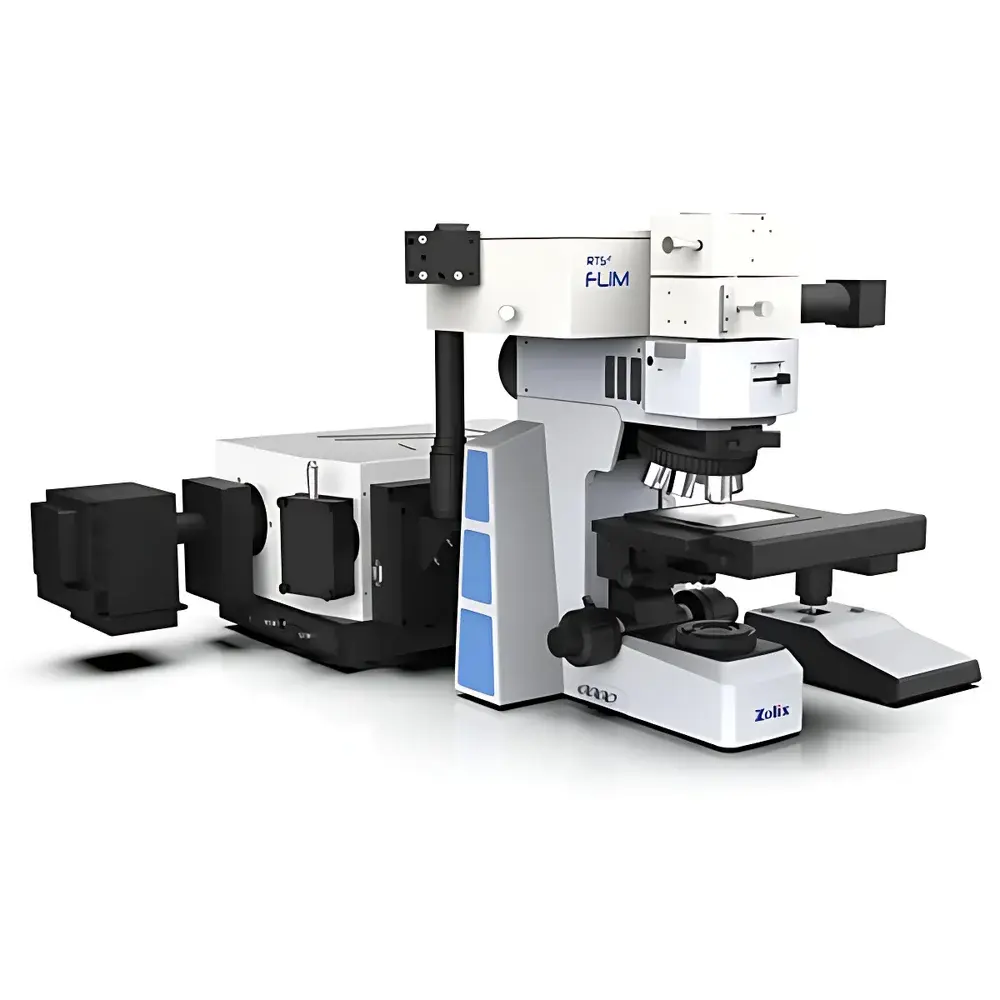
ZOLIX OmniFluo-FLIM Series Microscopic Fluorescence Lifetime Imaging System
| Brand | ZOLIX |
|---|---|
| Origin | Beijing, China |
| Manufacturer Type | Manufacturer |
| Product Category | Domestic |
| Model | OmniFluo-FLIM Series |
| Dispersion Element | Grating |
| Instrument Type | Steady-State/Time-Resolved Fluorescence Spectrometer |
| Spatial Resolution | ≤1 µm @ 100× Objective @ 405 nm Picosecond Pulsed Laser |
| Spectral Range | 200–900 nm |
| Minimum Time Resolution | 16 ps |
| Fluorescence Lifetime Range | 500 ps – 1 µs |
| Instrument Response Function (IRF) | ≤2 ns |
| Excitation Sources | 375–670 nm Picosecond Pulsed Lasers (50 MHz Repetition Rate, Pulse Widths: 25–75 ps) |
| Microscope | Upright Research-Grade with Brightfield/Darkfield Illumination, 5-Position Objective Turret (10×/50×/100×), High-Definition CMOS Monitoring Camera |
| XY Stage | Motorized, 75 × 50 mm Travel, 50 nm Minimum Step, <1 µm Repeatability |
| Spectrograph | 320 mm Focal Length, Imaging-Corrected Monochromator, Triple 68 × 68 mm Gratings, Wavelength Accuracy: ±0.1 nm, Repeatability: ±0.01 nm, Slit Width: 0.01–3 mm Motorized |
| Detector Options | UV-Vis PMT (185–900 nm), Back-Illuminated Deep-Depletion CCD (2000 × 256 pixels, 15 µm × 15 µm, -60 °C Cooling) |
| TCSPC Module | Time Bins Down to 16 ps, Dead Time <10 ns, Up to 65,535 Histogram Channels, Instantaneous Saturation Count Rate: 100 Mcps |
| Software | OmniFluo-FM FLIM Acquisition & Analysis Suite (Multi-Exponential Fitting ≤4 Components, IRF-Free Fitting Modes, Pseudocolor Mapping, 3D Visualization, Line/Cross-Section/Histogram/Contour Tools) |
Overview
The ZOLIX OmniFluo-FLIM Series Microscopic Fluorescence Lifetime Imaging System is a research-grade, time-resolved fluorescence platform engineered for quantitative spatial mapping of nanosecond-scale fluorescence decay dynamics at sub-micron resolution. Built upon the physical principle of time-correlated single-photon counting (TCSPC), the system delivers high-fidelity lifetime data by measuring the temporal delay between a precisely timed picosecond excitation pulse and the arrival of individual emitted photons. Unlike intensity-based fluorescence imaging, FLIM is intrinsically insensitive to fluorophore concentration, photobleaching, excitation intensity fluctuations, and light scattering—making it uniquely suited for quantitative microenvironmental sensing in heterogeneous samples. The system integrates a modular upright microscope, tunable picosecond pulsed laser excitation (375–670 nm), high-stability motorized XYZ scanning, an imaging-corrected spectrograph with triple-grating configuration, and a low-noise TCSPC detection architecture capable of 16 ps time binning and sub-2 ns instrument response function (IRF). Its design adheres to core metrological requirements for reproducible lifetime quantification, including traceable wavelength calibration (±0.1 nm accuracy), thermal stabilization of detectors, and hardware-synchronized timing control across all subsystems.
Key Features
- Sub-micron spatial resolution: ≤1 µm lateral resolution achieved using 100× oil-immersion objective and 405 nm excitation, validated under ISO 10110-5 optical testing protocols.
- Ultrafast temporal resolution: TCSPC module supports configurable time bins down to 16 ps, enabling robust resolution of multi-exponential decays with lifetimes spanning 500 ps to 1 µs.
- Multi-wavelength excitation flexibility: Eight interchangeable picosecond pulsed lasers (375, 405, 450, 488, 510, 635, 660, 670 nm), each characterized for pulse width (25–75 ps), average power (0.8–4.3 mW), and spectral coverage—ensuring optimal excitation matching across organic dyes, quantum dots, perovskites, and lanthanide-doped nanoparticles.
- High-precision mechanical architecture: Motorized XY stage with 50 nm minimum step size and <1 µm repeatability, coupled with closed-loop feedback positioning—critical for pixel-accurate lifetime raster scanning and registration with brightfield reference images.
- Modular spectroscopic detection: 320 mm focal length imaging monochromator with three large-format (68 × 68 mm) diffraction gratings, motorized slit (0.01–3 mm), and dual-output ports supporting simultaneous spectral and temporal acquisition.
- Advanced detector options: Standard UV-Vis photomultiplier tube (185–900 nm) and optional back-illuminated deep-depletion scientific CCD (2000 × 256, 15 µm pixels, -60 °C cooling, >95% peak QE) for photon-efficient spectral lifetime mapping (PL mapping).
Sample Compatibility & Compliance
The OmniFluo-FLIM system accommodates a broad range of solid and semi-solid specimens relevant to materials science and life sciences laboratories. Compatible sample formats include polished semiconductor wafers (GaN, SiC, GaAs), thin-film photovoltaic devices (perovskite, CIGS, CZTS), spin-coated quantum dot or upconversion nanoparticle layers, fixed or live-cell monolayers on glass coverslips, tissue cryosections, and polymer-embedded biological specimens. All optical and electronic subsystems comply with IEC 61000-6-3 (EMC emission) and IEC 61000-6-2 (immunity) standards. The TCSPC acquisition engine and OmniFluo-FM software support audit-trail logging and user-access controls aligned with GLP documentation requirements. While not FDA 21 CFR Part 11 certified out-of-the-box, the software architecture permits integration with institutional electronic lab notebook (ELN) systems via standardized metadata export (XML/CSV) and timestamped raw histogram files (.ptu format), facilitating traceability in regulated R&D environments.
Software & Data Management
OmniFluo-FM is a native Windows 10 application developed exclusively for FLIM acquisition, processing, and visualization. Its “All-in-One” interface enables full hardware orchestration—including microscope navigation, region-of-interest (ROI) definition, laser selection, grating positioning, detector gain adjustment, and TCSPC histogram acquisition—within a single workflow pane. Data processing leverages ZOLIX’s proprietary TCSPC fitting engine, which implements two IRF-free algorithms: (1) rising-edge deconvolution to reconstruct the instrumental response function directly from the histogram onset, followed by full convolutional fitting; and (2) direct multi-exponential decay fitting of the tail region for lifetimes significantly exceeding the IRF width. Users may fit up to four exponential components per pixel, extracting amplitude-weighted lifetimes (τamp), intensity-weighted lifetimes (τint), fractional contributions, χ² residuals, and goodness-of-fit metrics. Processed datasets are exported as calibrated TIFF stacks with embedded metadata (excitation wavelength, objective magnification, binning, temperature), compatible with third-party analysis platforms such as MATLAB, Python (using PTUReader libraries), and ImageJ/Fiji via open-format plugins. All operations are logged with UTC timestamps, operator ID, and parameter snapshots—enabling full experimental reproducibility.
Applications
In materials science, the system enables carrier lifetime mapping in wide-bandgap semiconductors (e.g., GaN MQWs on sapphire vs. GaN substrates), defect-state profiling in perovskite solar absorbers (CsPbI₂Br with Ba²⁺ doping), phase segregation analysis in ternary QD films, and interfacial charge-transfer kinetics in heterostructured photocatalysts. In life sciences, it supports NAD(P)H/FAD metabolic imaging in live cells, oxygen-sensitive phosphorescent probe quantification, pH-dependent lifetime ratiometry using environment-sensitive fluorophores (e.g., Bodipy-C12), discrimination of spectrally overlapping labels via lifetime unmixing, and FRET efficiency mapping at 1 cm²) perovskite photovoltaic devices processed solvent-free via dynamic hot-air annealing.
FAQ
What excitation wavelengths are supported, and how are they selected?
The system includes eight factory-characterized picosecond pulsed lasers (375–670 nm); selection is performed via software-controlled optical relay and dichroic filter switching—no manual alignment required.
Can the system perform simultaneous spectral and lifetime acquisition?
Yes—using the dual-output spectrograph configuration, users may route dispersed emission to either the PMT (for TCSPC) or the CCD (for spectral mapping), or alternate rapidly between modes within a single scan sequence.
Is multi-exponential fitting validated against NIST-traceable standards?
While no NIST SRM exists specifically for FLIM, the system’s IRF characterization protocol follows ISO/IEC 17025-aligned practices; lifetime accuracy is verified using dye standards (e.g., Rhodamine B in ethanol, τ = 4.1 ns) and time-domain reference samples with known decay kinetics.
Does the software support batch processing of large FLIM datasets?
Yes—OmniFluo-FM includes scriptable batch mode for automated ROI extraction, global fitting, pseudocolor scaling, and TIFF stack generation across hundreds of acquired fields.
What maintenance is required for long-term TCSPC stability?
Annual recalibration of wavelength axis and time-zero offset is recommended; PMT gain drift is monitored via internal LED reference pulses, and CCD dark current is automatically subtracted during acquisition using user-defined cooling-setpoint baselines.
Related Products







