
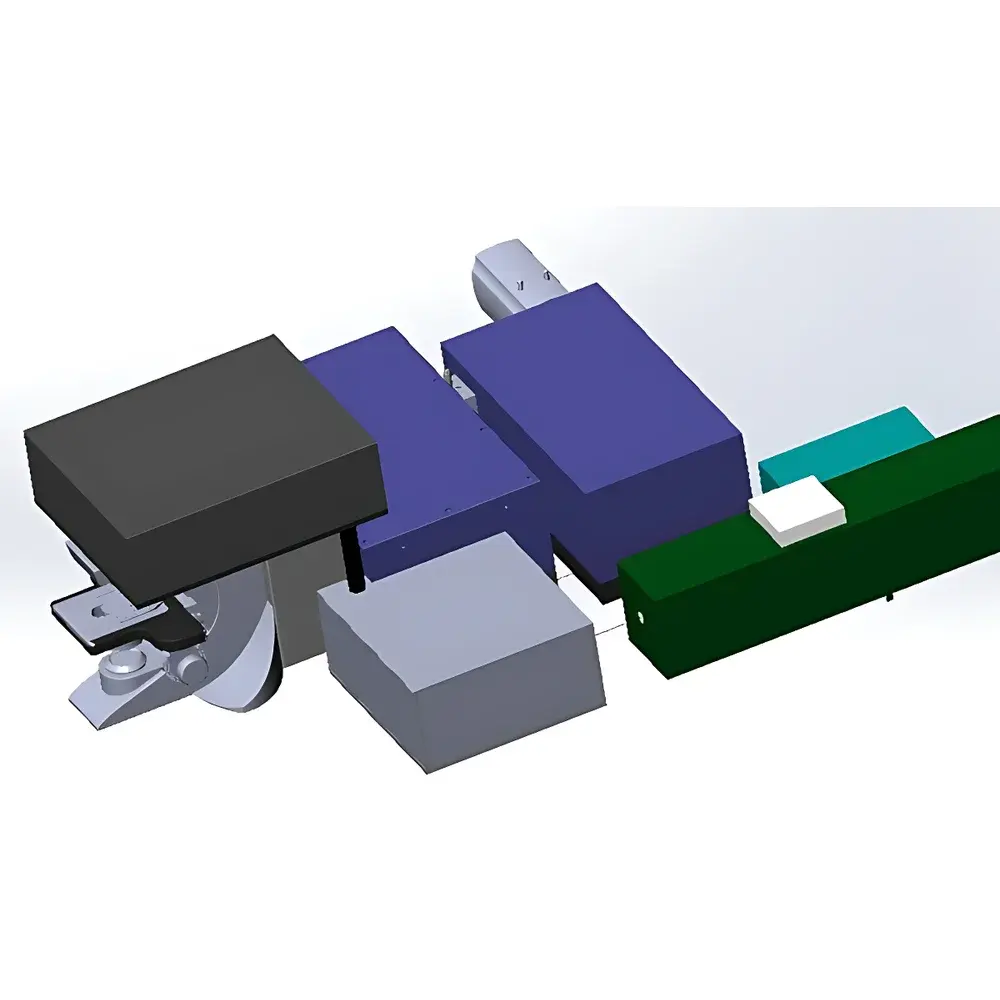
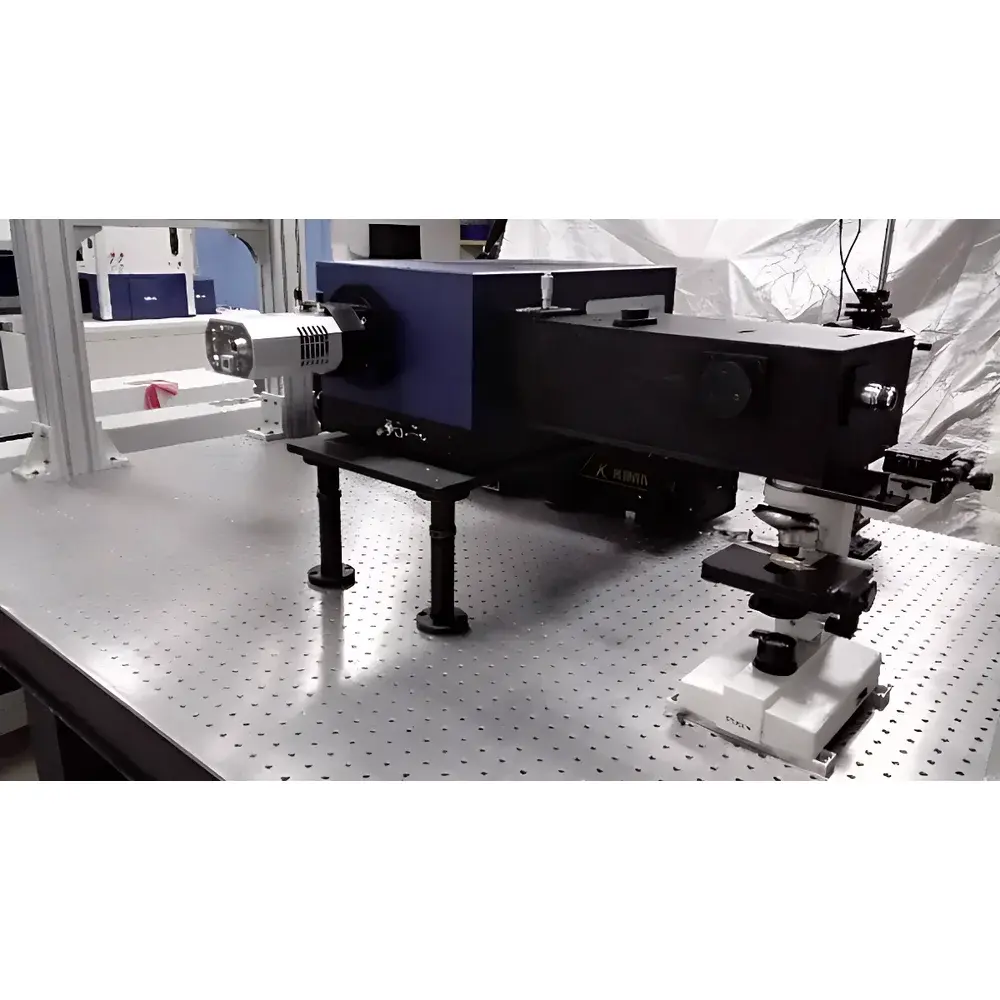
ZOLIX OmniPL-MicroS-A Vertical-Path Modular Micro-Photoluminescence Spectroscopy System
| Brand | ZOLIX |
|---|---|
| Origin | Beijing, China |
| Manufacturer Type | Direct Manufacturer |
| Regional Category | Domestic (China) |
| Model | OmniPL-MicroS-A (Vertical-Path Configuration) |
| Price Range | USD 14,000 – 28,000 |
| Dispersive Element | Filter-Based Spectral Selection |
| Spectral Bandpass (Slit) | 200–1600 nm |
| Spectral Resolution | 0.1 nm |
| Sensitivity | >100:1 (Signal-to-Noise Ratio) |
| Wavelength Accuracy | ±0.2 nm |
Overview
The ZOLIX OmniPL-MicroS-A Vertical-Path Modular Micro-Photoluminescence Spectroscopy System is an engineered platform for high-spatial-resolution photoluminescence (PL) characterization of solid-state materials at the microscale. Built upon a modular architecture integrating a research-grade upright microscope, a high-focal-length imaging spectrometer (Omni-λ500i, 500 mm focal length, f/6.5), and tunable excitation sources, the system operates on the principle of steady-state and time-resolved PL spectroscopy. It enables quantitative spectral acquisition across an extended wavelength range—from deep ultraviolet (200 nm) to near-infrared (1600 nm)—with sub-nanometer resolution and calibrated wavelength accuracy. The vertical optical path aligns with standard metallurgical or fluorescence microscope configurations, facilitating intuitive sample positioning, compatibility with ambient or controlled-environment stages (e.g., cryostats, electrical probe stations), and straightforward integration into existing cleanroom or materials characterization labs. Unlike integrated benchtop fluorimeters, this system supports full optical train customization—allowing users to select detector types (cooled CCD, InGaAs array, or single-channel PMT), grating densities, entrance/exit slits, and synchronization electronics (e.g., photon counting, lock-in amplification) per application-specific signal-to-noise and temporal requirements.
Key Features
- Modular vertical-path design based on a standard upright microscope body—enabling rapid reconfiguration for PL, Raman, or electroluminescence (EL) measurements
- Extended spectral coverage: 200–1600 nm, supported by interchangeable detectors (cooled Si-CCD: 200–1000 nm; thermoelectrically cooled InGaAs array: 800–1600 nm; side-on PMT: 200–870 nm)
- High spectral fidelity: ≤0.1 nm resolution (FWHM) and ±0.2 nm absolute wavelength accuracy—traceable to NIST-calibrated emission lines
- Standard 325 nm HeCd laser excitation (≥20 mW), with optional 405 nm, 532 nm, and 633 nm diode or gas lasers for resonant or non-resonant excitation
- Dedicated UV-optimized 20× objective (250–800 nm transmission) and integrated CCD monitoring path for real-time micro-area targeting
- Configurable detection electronics: DC-coupled PMT with HVC1800 high-voltage supply, DCS202PC single-photon counter (≥5 Mcps max count rate), or lock-in amplifier for low-light or modulated-excitation applications
- USB 2.0–controlled spectrometer with motorized slit (0.01–3 mm width), grating turret, and filter wheel interface—fully programmable via ZOLIX SpectraSoft suite
Sample Compatibility & Compliance
The OmniPL-MicroS-A accommodates rigid planar samples—including semiconductor wafers, thin films, 2D material flakes (e.g., MoS₂, WS₂), perovskite crystals, quantum dot arrays, and doped oxides (e.g., ZnO:Al)—mounted on standard microscope slides or metal stubs. Its vertical geometry permits direct coupling to commercial cryogenic stages (down to 10 K), vacuum-compatible sample chambers, and electrical probe stations for correlative PL/electrical transport studies. All optical components comply with ISO 10110 surface quality standards; spectral calibration follows ASTM E275 and ISO 17025 traceability protocols. The system’s firmware and data acquisition software support audit trails, user access control, and electronic signatures—meeting foundational requirements for GLP-compliant materials testing laboratories. While not pre-certified for FDA 21 CFR Part 11, its logging architecture is compatible with third-party validation packages for regulated QC environments.
Software & Data Management
SpectraSoft v4.x—the native acquisition and analysis platform—provides synchronized hardware control, real-time spectral preview, multi-curve overlay, peak deconvolution (Gaussian/Lorentzian fitting), intensity mapping (XY raster scanning), and batch processing for spectral libraries. Raw data is saved in vendor-neutral HDF5 format with embedded metadata (excitation wavelength, slit width, integration time, detector gain, calibration coefficients). Export options include CSV, ASCII, and JCAMP-DX for interoperability with Origin, Igor Pro, MATLAB, and Python-based analysis pipelines (e.g., SciPy, lmfit). The software supports automated wavelength calibration using Hg/Ar lamp spectra and includes built-in correction algorithms for detector quantum efficiency, grating blaze function, and stray light suppression. Audit logs record all parameter changes, acquisition timestamps, and user IDs—essential for reproducibility tracking and method validation.
Applications
- Micro-scale defect mapping in III–V and II–VI semiconductors (e.g., GaN dislocation luminescence, CdTe grain boundary recombination)
- Bandgap and exciton binding energy quantification in monolayer TMDs and heterostructures
- Quantum yield estimation and lifetime correlation in colloidal and core-shell quantum dots
- Phase segregation analysis in mixed-halide perovskites via spatially resolved PL peak shifts
- Thermal quenching behavior of phosphors (e.g., YAG:Ce³⁺) from 80 K to 400 K using cryostat-integrated operation
- Correlative PL–Raman–topography on the same micro-region using shared XYZ stage and optical path
FAQ
What excitation wavelengths are natively supported?
The system ships with a 325 nm HeCd laser (≥20 mW output). Optional laser modules—including 405 nm diode, 532 nm DPSS, and 633 nm HeNe—are mechanically and software-integrated via standardized beam delivery ports.
Can the system perform time-resolved PL measurements?
Yes—when configured with a pulsed laser source (e.g., picosecond diode laser) and time-correlated single-photon counting (TCSPC) module (DCS202PC), the system achieves sub-nanosecond temporal resolution. Full TCSPC histogram acquisition and decay fitting are supported in SpectraSoft.
Is NIR extension beyond 1000 nm included by default?
The base configuration covers 200–1000 nm using a Si-CCD. Extension to 1600 nm requires the optional TE-cooled InGaAs array detector and matching 800–1600 nm grating—both field-installable without optical realignment.
Does the vertical-path design limit compatibility with cryogenic systems?
No—vertical geometry is preferred for most closed-cycle cryostats (e.g., Janis ST-500, BlueFrog) due to simplified optical access through top-view windows and minimal thermal drift during cooldown.
How is wavelength calibration maintained over time?
SpectraSoft includes automated recalibration routines using internal Hg/Ar lamp references. Users may schedule daily or per-session calibrations; all calibration files are versioned and timestamped in the project database.




