
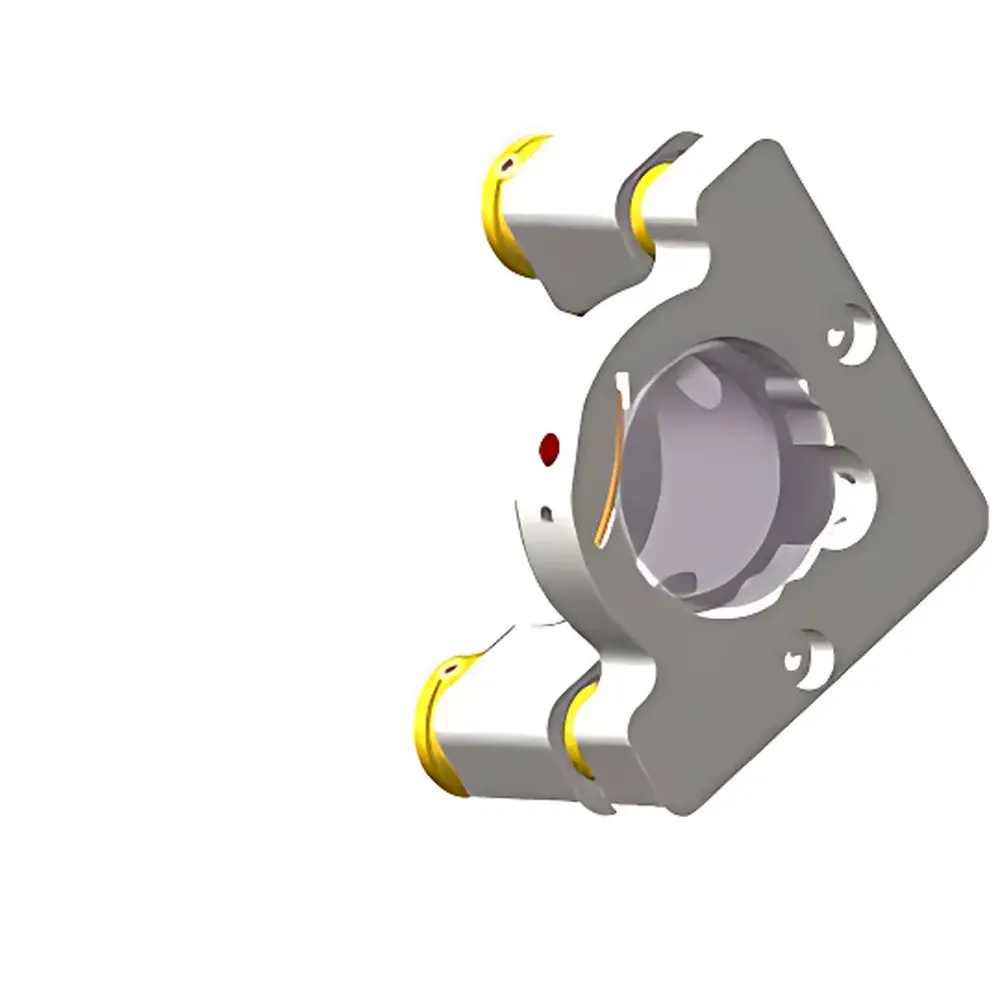
ZOLIX OMUS Series Ultra-Stable Optical Mounts
| Brand | ZOLIX |
|---|---|
| Origin | Beijing, China |
| Manufacturer Type | Direct Manufacturer |
| Product Line | OMUS Series |
| Material | 304 Stainless Steel |
| Vacuum Compatibility | Yes (with vacuum-grade lubricant) |
| Spring Configuration | Quad-spring design (except OMUS12.7) |
| Thread Specification | Fine-pitch precision-ground threads with integrated locking mechanism |
| Mounting Options | Dual clamping mode (spring-actuated blade + set-screw), removable blade |
| Locking System | Dual-stage — thread-locking collar + front/rear plate locking threads |
| Adjustment Interface | Rear hex socket for wrench or included ergonomic handwheel |
| Base Plate Thickness | 18 mm |
| Standard Mounting Holes | M4 and M6 compatible |
| Compliance | Designed for ISO/IEC 17025-aligned optical alignment workflows, compatible with UHV-compatible assembly protocols when specified |
Overview
The ZOLIX OMUS Series Ultra-Stable Optical Mounts are engineered for high-precision, long-term optical alignment in demanding research and industrial environments—including ultra-high vacuum (UHV) chambers, interferometric setups, laser cavity construction, and metrology-grade beam steering applications. These mounts operate on a mechanical principle of constrained elastic deformation and friction-controlled micro-adjustment: four symmetrically arranged stainless-steel tension springs provide uniform restoring force across the kinematic tilt axis, while fine-pitch, ground-thread actuators translate rotational input into sub-arcsecond angular displacement with minimal hysteresis. Constructed entirely from 304 stainless steel, the OMUS platform eliminates thermal drift-induced misalignment and ensures dimensional stability under thermal cycling (−20 °C to +60 °C). The absence of aluminum or plated components prevents outgassing in vacuum-rated configurations when paired with fluorinated grease (e.g., Krytox GPL 205 or similar ISO VG 15 vacuum lubricants).
Key Features
- Monolithic 304 stainless steel construction for superior rigidity, corrosion resistance, and vacuum compatibility (outgassing rate <1×10⁻⁹ Pa·m3/s·cm2 per ASTM E595 when properly conditioned)
- Quad-spring suspension architecture (standard on OMUS25.4, OMUS25.4-B, and larger variants) delivering balanced load distribution and reduced coupling between pitch/yaw axes
- Fine-pitch (0.25 mm lead), precision-ground stainless steel thread pairs with integrated mechanical lock collars—designed to suppress backlash and maintain positional integrity over >105 adjustment cycles
- Dual-mode mirror retention: spring-actuated flexure blade (prevents localized stress on optics) + secondary set-screw interface—blades are field-removable without tools for hybrid mounting flexibility
- Dual-stage locking system: primary thread-lock collar + secondary M3 locking screws on front and rear plates for redundancy during vibration-prone operation
- Rear hex socket (2.5 mm) enabling either standard 2 mm hex key or included ergonomic handwheel (120 mm effective radius) to achieve angular resolution ≤3 arcsec per full turn
- 18 mm thick rear base plate with dual-standard tapped holes (M4 and M6) for direct integration into optical tables, breadboards, or custom vacuum flanges
Sample Compatibility & Compliance
The OMUS Series accommodates round optics from Ø12.7 mm to Ø50.8 mm (depending on model), including fused silica, BK7, CaF2, and metallic-coated substrates (e.g., protected aluminum, dielectric HR mirrors). All contact surfaces are passivated per ASTM A967 and electropolished to Ra <0.4 µm to minimize particle generation in cleanroom or vacuum environments. Mounts comply with mechanical interface standards defined in ISO 10110-7 (optical element mounting tolerances) and support traceable alignment calibration per ISO/IEC 17025 when used with certified autocollimators or digital theodolites. For regulated environments (e.g., photonics manufacturing under ISO 13485 or semiconductor tooling qualifying to SEMI F20), optional documentation packages include material certifications (EN 10204 3.1), RoHS/REACH declarations, and vacuum bake-out validation reports.
Software & Data Management
While inherently manual and analog in operation, the OMUS Series is fully compatible with digital alignment workflows. Its repeatable mechanical response enables integration with motorized actuator retrofits (e.g., Thorlabs K10CR1-compatible stepper adapters) and closed-loop position feedback via capacitive or strain-gauge sensors. Mounting footprints align with industry-standard CAD libraries (STEP/IGES), facilitating parametric modeling in Zemax OpticStudio, CODE V, or SolidWorks for tolerance stack-up analysis. All models ship with a serialized calibration record documenting initial runout (<5 µm TIR at optic surface), thread torque specification (0.35–0.45 N·m), and recommended maintenance intervals (lubrication renewal every 12 months or after 200 hr in UHV service).
Applications
- Stabilized laser resonator alignment in DPSS and ultrafast amplifier systems
- Interferometer mirror positioning in gravitational wave detector prototype benches (e.g., LIGO-style test mass suspensions)
- Vacuum-compatible beam steering for synchrotron beamlines and EUV lithography R&D
- Long-duration optical coherence tomography (OCT) reference arm stabilization
- Cryogenic optical mounting where CTE mismatch must be minimized (e.g., SiC or Invar-based platforms)
- Calibration-grade alignment fixtures for NIST-traceable photonic sensor testing
FAQ
Can the OMUS mount be used in ultra-high vacuum (UHV) environments?
Yes—when assembled with vacuum-rated lubricants and baked per ISO 14644-1 Class 5 protocols, OMUS mounts meet UHV requirements (<1×10⁻¹⁰ mbar) for extended durations.
What is the maximum recommended optic weight for OMUS25.4-B?
For optimal stability and repeatability, the maximum supported mass is 120 g at center-of-gravity alignment; heavier optics require OMUS30.0 or larger variants.
Is the dual-clamping mechanism compatible with coated or fragile substrates like MgF2-AR coated fused silica?
Yes—the spring-blade mode applies distributed pressure (<0.15 MPa peak) and eliminates point-loading; set-screw-only mode is advised only for robust substrates ≥3 mm thickness.
Does ZOLIX provide mounting templates or CAD models?
Yes—native STEP, IGES, and Parasolid files are available upon request, including GD&T annotations per ASME Y14.5-2018.
How often should the thread mechanism be serviced?
In ambient lab conditions: every 18 months. In continuous UHV or high-vibration settings: every 6–12 months, with torque verification using a calibrated 0.5 N·m digital torque screwdriver.






