
ZOLIX Remote Raman Spectroscopy Solution
| Brand | ZOLIX |
|---|---|
| Origin | Beijing, China |
| Manufacturer Type | Authorized Distributor |
| Product Origin | Domestic (China) |
| Model | Remote Raman System |
| Pricing | Upon Request |
| Excitation Wavelengths | 405, 514, 532, 633, 670, 671, 785, 808 nm |
| Spectral Range | 100–4000 cm⁻¹ (laser-dependent) |
| Focal Length Options | 20–100 mm (probe), 1000 mm (telescope) |
| Spot Size | ~100 µm @ 100 µm core fiber |
| Working Distance | 20–100 mm (probe) |
| Numerical Aperture | 0.22 @ 40 mm focal length |
| Probe Dimensions | 2.25" L × 0.96" W × 0.58" H |
| Probe Housing Material | Hard-anodized aluminum or 316 stainless steel |
| Telescope Interface | FC/APC (laser), SMA (spectrometer) |
| Spectrometer Types | Czerny-Turner imaging-corrected (320 mm focal length, F/4.2) or VPH grating-based (85 mm focal length, F/1.8) |
| Spectral Resolution | <2 cm⁻¹ @ 1800 l/mm (CT), ~5 cm⁻¹ @ 1800 l/mm (VPH) |
| Detector Options | ICCD (1024×1024, 13 µm pixels, <2 ns gate width, 280–810 nm) or back-illuminated deep-depletion CCD (2000×256, 15 µm pixels, 200–1100 nm) |
| Laser Options | Pulsed Nd:YAG (532 nm, 290 mJ, 10 Hz) or CW diode (532/785 nm, 100 mW) |
| Optical Density of Notch Filters | OD >6 |
| Operating Temperature | 0–85 °C |
| Max Pressure Rating | 15 psi |
| Fiber Core | 100/100 µm standard (FC or SMA interface) |
Overview
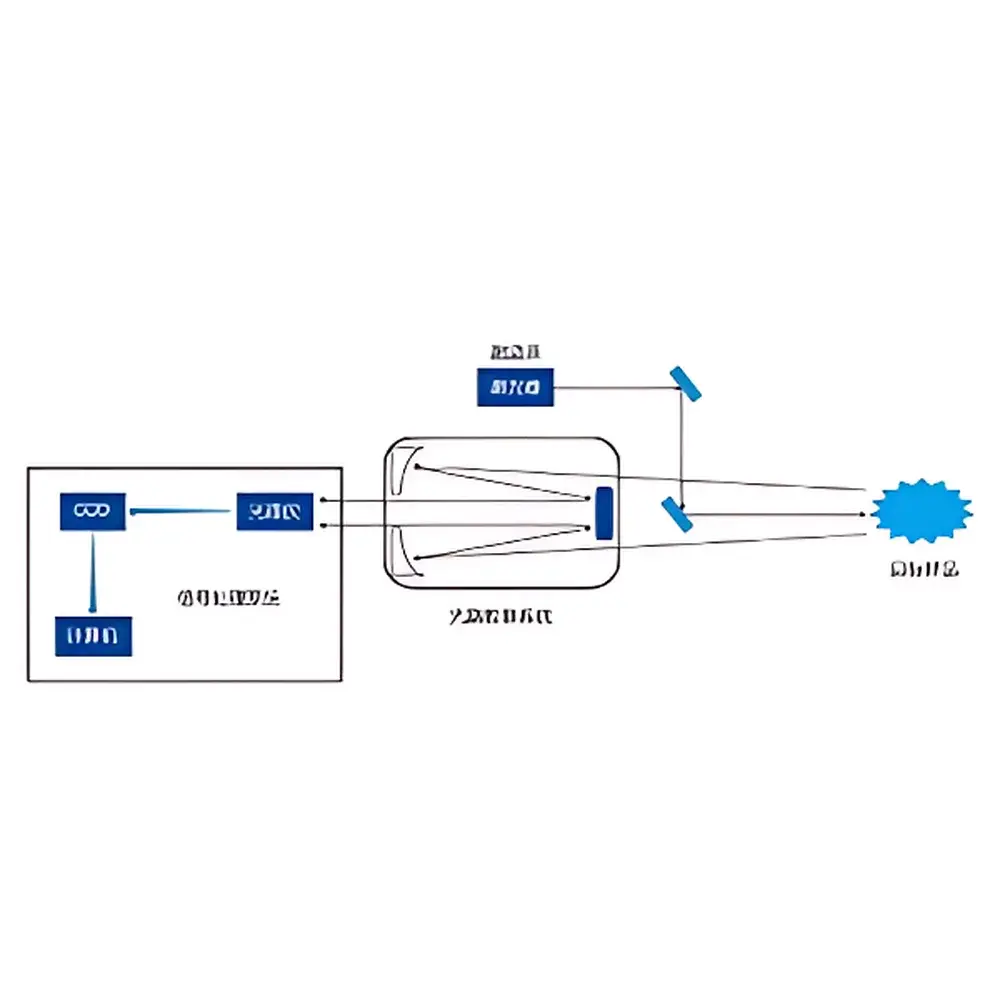
ZOLIX Remote Raman Spectroscopy Solutions are engineered for standoff molecular identification and structural characterization at distances ranging from millimeters to tens of meters. Based on inelastic scattering of monochromatic light—primarily from pulsed or continuous-wave lasers—the system captures vibrational Raman shifts (typically 100–4000 cm⁻¹) to deliver non-contact, non-destructive chemical fingerprinting. Unlike conventional benchtop Raman systems, remote configurations integrate high-energy excitation sources, large-aperture collection optics (e.g., Cassegrain telescopes), high-throughput spectrometers, and time-gated detection to suppress ambient background and long-lived fluorescence—critical for field-deployable operation under uncontrolled lighting or atmospheric conditions. The architecture adheres to fundamental principles of resonance Raman enhancement and coherent anti-Stokes Raman scattering (CARS)-informed signal optimization, enabling reliable discrimination of crystalline phases, polymorphs, oxidation states, and molecular conformations without physical sampling.
Key Features
- Modular optical design supporting configurable standoff distances: 0–100 mm (fiber-coupled probe), 0.2–1 m (micro-Raman with extended working distance objectives), and up to 66 m (telescope-based pulsed system per ASTM E2532-22 guidelines for remote spectroscopic sensing)
- Dual-laser platform compatibility: Pulsed 532 nm Nd:YAG (290 mJ, 10 Hz) for time-resolved gated detection; CW 532/785 nm diodes for high-sensitivity near-infrared measurements with reduced fluorescence interference
- Interchangeable spectrometer modules: High-resolution Czerny-Turner imaging spectrometer (320 mm focal length, F/4.2, <2 cm⁻¹ resolution with 1800 l/mm grating) or high-throughput volume-phase holographic (VPH) spectrometer (85 mm focal length, F/1.8, optimized for weak signal capture)
- Time-gated ICCD detector (<2 ns minimum gate width, 280–810 nm response) for background rejection in daylight or nuclear facility environments; optional deep-depletion back-illuminated CCD (200–1100 nm) for CW applications requiring high quantum efficiency
- Ruggedized probe housing in 316 stainless steel or hard-anodized aluminum (IP65-rated), rated for 0–85 °C operation and 15 psi pressure—suitable for integration into robotic platforms, UAV-mounted payloads, or hot-cell monitoring systems
- OD >6 ultra-steep-edge laser line rejection filters ensure >99.9999% suppression of Rayleigh scatter, preserving dynamic range for low-intensity Raman bands
Sample Compatibility & Compliance
The ZOLIX Remote Raman System is validated for analysis of solids, powders, liquids, gases, and thin films—including hazardous, radioactive, or thermally unstable materials where contact is prohibited. It supports regulatory-compliant workflows under ISO/IEC 17025:2017 for testing laboratories and aligns with FDA 21 CFR Part 11 requirements when paired with ZOLIX SpectraSuite™ software featuring electronic audit trails, user access controls, and data integrity logging. Applications include IAEA-defined nuclear material verification (e.g., uranium oxide phase identification), EPA Method 8021B-adapted organic contaminant screening, and ASTM D7979-21 for polymer additive quantification in industrial settings. Probe and telescope variants meet MIL-STD-810G shock/vibration specifications for mobile deployment.
Software & Data Management
ZOLIX SpectraSuite™ v5.2 provides full instrument control, real-time spectral acquisition, automated cosmic ray removal, multivariate curve resolution (MCR), and library-matching against NIST, SDBS, and custom-built spectral databases (e.g., mineralogical, explosive, radiological). Raw data is stored in vendor-neutral HDF5 format with embedded metadata (excitation wavelength, integration time, grating position, temperature, GPS coordinates if equipped). The software supports GLP/GMP-compliant reporting templates, CSV export for LIMS integration, and Python API access for automated QA/QC scripting. All spectral processing adheres to ISO 18355:2016 for chemometric validation, including limit-of-detection (LOD) calculation per IUPAC recommendations.
Applications
- Planetary Surface Exploration: Validated in Mars-simulated environments (per NASA JPL analog protocols) for mineralogical mapping—distinguishing carbonates (calcite, aragonite), sulfates (gypsum, anhydrite), and hydrated oxides via characteristic ν₁(CO₃²⁻), ν₁(SO₄²⁻), and δ(OH) modes at standoff distances ≥10 m
- Nuclear Facility Monitoring: Integrated onto remotely operated vehicles (ROVs) for identification of radioactive contaminants (e.g., uranyl nitrate hydrates, CsI particulates) at 1 m standoff—leveraging time-gated detection to overcome gamma-induced scintillation noise
- In Situ Materials Synthesis: Real-time monitoring of CVD diamond growth (detecting sp³/sp² ratio, stress-induced peak shifts, defect-related D-band intensity) and graphene domain evolution on liquid copper substrates (G/2D intensity ratio, linewidth analysis)
- Hazardous Substance Detection: Field-deployable identification of explosives (TNT, RDX), chemical warfare agents (sarin simulants), and toxic industrial chemicals (ammonia, chlorine) in open-air or confined-space scenarios per NATO AEP-88 standards
- Environmental Forensics: Quantitative analysis of microplastic polymer types (PET, PP, PE) and adsorbed pollutants (PAHs, PCBs) in soil/water matrices using spatially resolved mapping with motorized XYZ stages
FAQ
What is the maximum reliable standoff distance for quantitative mineral identification?
Under clear atmospheric conditions with a 1000 mm Cassegrain telescope and 532 nm pulsed excitation, quantitative phase identification (e.g., distinguishing calcite from dolomite) is achievable up to 66 m, as verified per ASTM E2532-22 Annex A2.
Can the system operate in direct sunlight?
Yes—time-gated ICCD detection with sub-2 ns shutter control enables daytime operation by rejecting solar continuum and skyglow; typical SNR >15:1 for 1 s integration on white marble at 10 m standoff.
Is the system compliant with FDA 21 CFR Part 11 for pharmaceutical use?
When deployed with SpectraSuite™ v5.2 in validated configuration (electronic signatures, audit trail, role-based permissions), it meets Part 11 requirements for raw material identity testing per USP .
What spectral calibration standards are supported?
NIST-traceable neon and mercury-argon lamps; optional onboard LED-based wavelength reference for drift correction during extended field campaigns.
How is laser safety managed for outdoor deployment?
All configurations comply with IEC 60825-1:2014 Class 4 laser safety requirements; integrated beam path interlocks, visible aiming beams, and remote shutter control ensure ALARA compliance during operation.




