
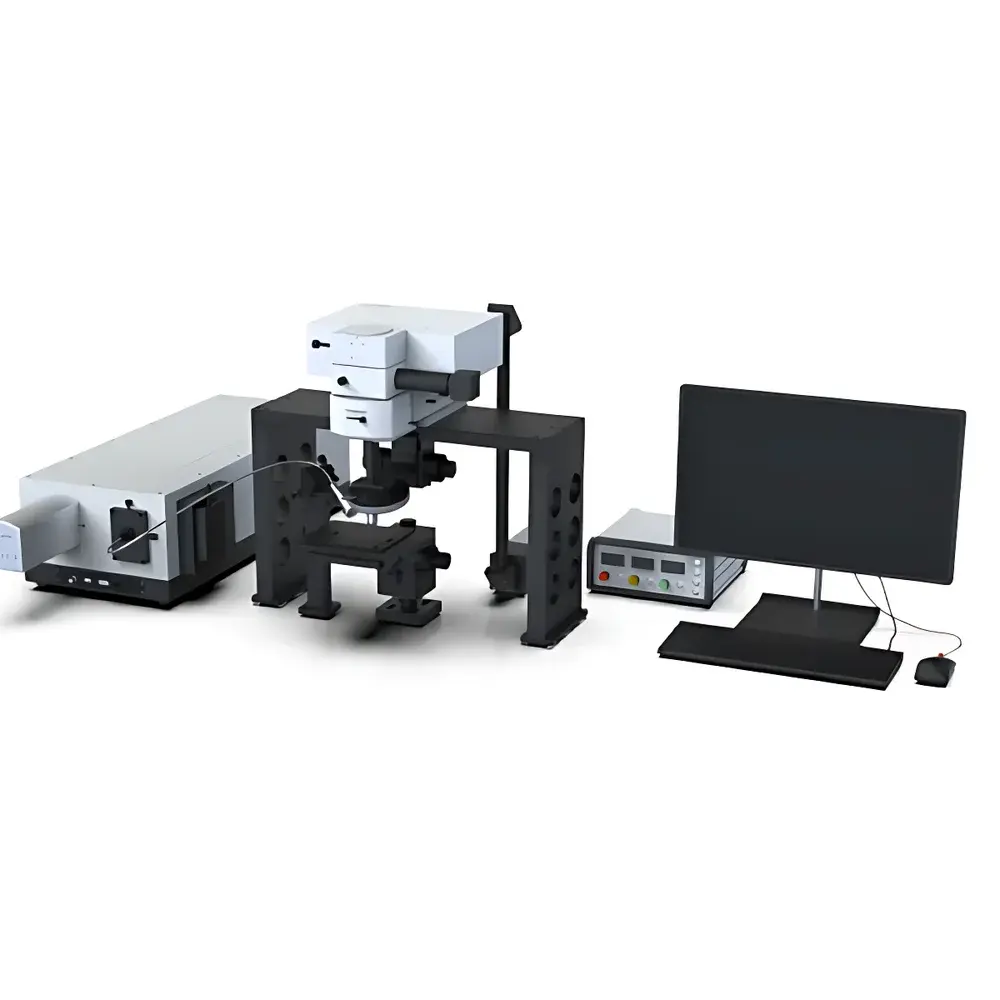
ZOLIX RTS-LIBS Combined Raman and Laser-Induced Breakdown Spectroscopy System
| Brand | ZOLIX |
|---|---|
| Origin | Beijing, China |
| Manufacturer Type | Direct Manufacturer |
| Product Origin | Domestic (China) |
| Model | RTS-LIBS |
| Pricing | Upon Request |
| Spectral Range | 200–850 nm (customizable bands available) |
| Spectral Resolution | <0.05 nm @ 1200 g/mm grating |
| Spatial Resolution | Lateral: <500 nm @ 532 nm excitation laser |
| Axial | <2 µm @ 50 µm pinhole, 532 nm |
Overview
The ZOLIX RTS-LIBS Combined Raman and Laser-Induced Breakdown Spectroscopy System is an integrated dual-modal analytical platform engineered for simultaneous acquisition of molecular vibrational signatures and elemental atomic emission spectra from the same micro-volume of sample. It combines confocal Raman spectroscopy—based on inelastic scattering of monochromatic light—with laser-induced breakdown spectroscopy (LIBS), which relies on plasma generation via nanosecond pulsed laser ablation and subsequent time-gated detection of atomic/ionic line emissions. This hybrid architecture enables correlative analysis at the micron scale: Raman spectroscopy delivers fingerprint-level identification of chemical bonds, functional groups, crystallinity, and phase composition, while LIBS provides quantitative or semi-quantitative elemental composition—including trace metals and light elements (e.g., Li, Be, B, C, N, O)—without requiring matrix-matched standards. The system is fundamentally designed for non-contact, in situ, and minimally destructive interrogation, making it suitable for heterogeneous, layered, or irreplaceable samples where spatially resolved chemical mapping is critical.
Key Features
- Co-registered optical path design ensuring precise spatial overlap (<1 µm alignment tolerance) between Raman excitation focus and LIBS plasma generation zone
- Dual-laser excitation architecture: continuous-wave (CW) 532 nm laser for Raman; Q-switched nanosecond Nd:YAG laser (1064 nm fundamental, frequency-doubled to 532 nm optional) for LIBS ablation
- High-throughput Czerny-Turner spectrometer with long focal length (≥750 mm) and interchangeable 1200 g/mm and 2400 g/mm gratings for optimized resolution/sensitivity trade-off
- Dual-detector configuration: deep-cooled scientific CCD (−70 °C operating temperature) for high-sensitivity Raman acquisition; gated Intensified CCD (ICCD) with sub-nanosecond shutter width for time-resolved LIBS and transient Raman signal capture
- Motorized XYZ translation stage with 100 nm step resolution and closed-loop feedback for automated raster scanning and hyperspectral data cube generation
- Integrated spectral calibration using Hg-Ne and Ar emission lamps with real-time wavelength correction algorithms
Sample Compatibility & Compliance
The RTS-LIBS system supports solid, powder, liquid, and thin-film samples without mandatory preprocessing—enabling direct analysis of archaeological artifacts, geological specimens, pharmaceutical tablets, battery electrode cross-sections, and forensic residues. Its non-vacuum operation and ambient-air-compatible LIBS mode eliminate the need for inert gas purging in many applications. All optical and electronic subsystems comply with IEC 61000-6-3 (EMC emission) and IEC 61000-6-2 (immunity) standards. Software workflows support audit trails, user access control, and electronic signature functionality aligned with FDA 21 CFR Part 11 requirements for regulated environments. Data export formats include ASCII, HDF5, and JCAMP-DX, ensuring interoperability with third-party chemometric platforms (e.g., MATLAB, Python scikit-learn, Unscrambler) and laboratory information management systems (LIMS).
Software & Data Management
ZOLIX SpectrumStudio v4.x provides unified control of both modalities through a modular GUI with synchronized acquisition timing, real-time spectral preview, and multi-dimensional data visualization (2D intensity maps, 3D spectral stacks, PCA score plots). The software embeds automated baseline correction (Asymmetric Least Squares), cosmic-ray removal, peak deconvolution (Voigt fitting), and spectral library matching against internal databases (e.g., RRUFF, ICDD PDF-4+, NIST LIBS Atlas). For quantitative LIBS analysis, it implements internal standard normalization and partial least squares regression (PLSR) calibration modules. All raw and processed data are stored with embedded metadata (laser energy, gate delay, integration time, grating position, environmental conditions), supporting full traceability and GLP/GMP-compliant reporting.
Applications
- Cultural heritage science: stratigraphic analysis of pigment layers in paintings, identification of corrosion products on metal artifacts, differentiation of natural vs. synthetic dyes
- Geoscience and planetary analog studies: rapid field-deployable mineral phase + elemental association mapping (e.g., hematite + Fe/Mn ratio correlation)
- Pharmaceutical QA/QC: co-localized detection of active pharmaceutical ingredient (API) polymorphic form (Raman) and elemental impurities (LIBS) per ICH Q2(R2) and USP /
- Environmental monitoring: speciation of heavy metals in soil particulates (e.g., Cr(III) vs. Cr(VI) inferred from Raman bands + total Cr quantification via LIBS)
- Security and defense: standoff detection of explosive residues (e.g., RDX, PETN Raman fingerprints) coupled with nitrogen/oxygen stoichiometry confirmation via LIBS
FAQ
What is the minimum detectable concentration for trace elements using LIBS mode?
Detection limits are matrix-dependent and typically range from 10–100 ppm for most metals in solid matrices under optimized gating and signal averaging. Limits improve significantly with double-pulse LIBS configurations (not standard but optionally integrable).
Can the system perform depth profiling?
Yes—sequential LIBS ablation combined with Raman acquisition after each pulse enables controlled layer-by-layer analysis with axial resolution down to ~1 µm per shot, validated on multilayer thin-film devices and coated historical glass.
Is vacuum or inert gas required for LIBS operation?
No. Ambient-air LIBS is fully supported. Optional argon purge chamber is available for enhanced signal-to-noise ratio in low-Z element analysis (e.g., C, N, O, F).
How is spectral calibration maintained over long-term operation?
Automated daily calibration using built-in Hg-Ne/Ar lamp sources, with software-driven wavelength drift compensation based on reference peak positions across the full 200–850 nm range.
Does the system support external triggering for synchronization with other instruments?
Yes—TTL-compatible trigger I/O ports enable hardware synchronization with external lasers, stages, or data acquisition systems for multi-instrument experiments.




