
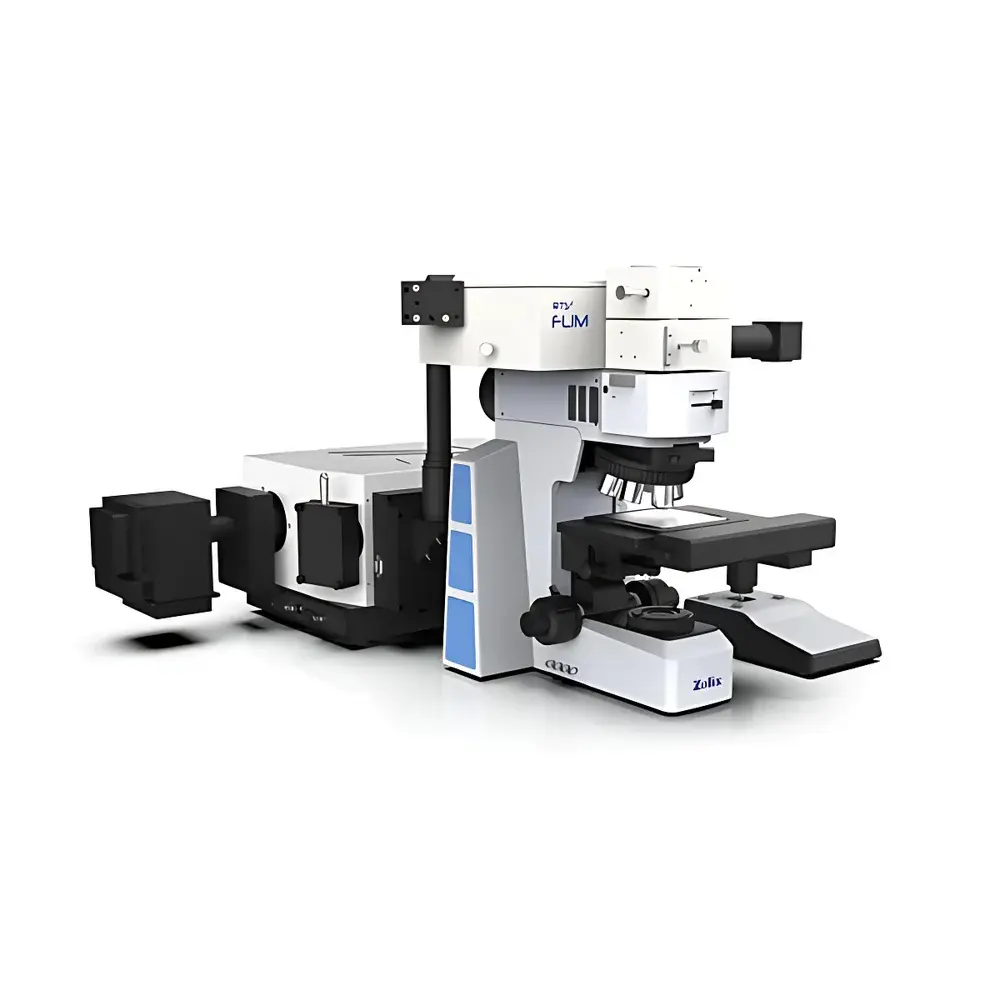
ZOLIX RTS2-FLIM Microscopic Fluorescence Lifetime Imaging System
| Brand | ZOLIX |
|---|---|
| Origin | Beijing, China |
| Manufacturer Type | OEM Manufacturer |
| Product Origin | Domestic (China) |
| Model | RTS2-FLIM |
| Dispersion Element | Grating |
| Instrument Type | Steady-State Fluorescence Spectrometer |
| Spatial Resolution | ≤1 µm @ 100× objective, 405 nm excitation |
| Excitation Source | Picosecond Pulsed Lasers (375–670 nm), 50 MHz repetition rate |
| Time Resolution | 16 ps |
| Fluorescence Lifetime Range | 500 ps – 1 µs |
| Instrument Response Function (IRF) | ≤2 ns |
| Spectral Range | 200–900 nm |
| Microscope Configuration | Upright research-grade microscope with epi-illumination, halogen lamp (12 V / 100 W), 5-position objective turret (10×/50×/100×), high-definition CMOS monitor camera |
| Scanning Stage | Motorized XY stage (75 × 50 mm travel, 50 nm step size, <1 µm repeatability) |
| Spectrograph | 320 mm focal length, imaging-corrected monochromator, dual input ports, CCD & slit outputs, three 68 × 68 mm gratings, wavelength accuracy ±0.1 nm, repeatability ±0.01 nm, scan step 0.0025 nm |
| Detector Options | UV-VIS PMT (185–900 nm), back-illuminated deep-depletion scientific CCD (2000 × 256 pixels, 15 µm × 15 µm, -60 °C cooling, QE >95%) |
| TCSPC Module | Time binning down to 16 ps, dead time <10 ns, up to 65,535 time channels, instantaneous saturation count rate 100 Mcps |
| Software | OmniFluo-FM — integrated FLIM acquisition, multi-exponential decay fitting (≤4 components), IRF-aware convolutional fitting, pseudo-color mapping, histogram/contour/3D visualization, GLP-compliant data logging |
Overview
The ZOLIX RTS2-FLIM Microscopic Fluorescence Lifetime Imaging System is a fully integrated, confocal-capable platform engineered for quantitative, spatially resolved fluorescence lifetime measurements at the sub-micron scale. It combines time-correlated single-photon counting (TCSPC) with high-precision motorized scanning microscopy and modular picosecond pulsed laser excitation to deliver robust nanosecond-to-microsecond lifetime quantification across biological, photonic, and semiconductor samples. Unlike intensity-based fluorescence imaging, FLIM provides intrinsic contrast independent of fluorophore concentration, photobleaching, or excitation intensity—making it uniquely suited for quantitative microenvironmental sensing (e.g., pH, O₂, ion concentration), FRET efficiency mapping, and defect-state characterization in wide-bandgap materials. The system operates on the physical principle that fluorescence lifetime—the average residence time of an excited electron in the S₁ singlet state before radiative decay—is modulated by molecular conformation, local polarity, quenching interactions, and non-radiative pathways. By resolving the temporal profile of photon arrival relative to a precisely timed excitation pulse (via TCSPC), the RTS2-FLIM extracts decay kinetics with picosecond timing fidelity and sub-µm spatial registration.
Key Features
- Ultra-high temporal resolution: 16 ps minimum time binning, enabling accurate resolution of multi-exponential decays with lifetimes spanning 500 ps to 1 µs.
- Multi-wavelength picosecond excitation: Eight interchangeable pulsed lasers (375–670 nm), each optimized for pulse width (25–75 ps), average power (0.8–4.3 mW), and spectral coverage (400–950 nm), supporting broad fluorophore and material compatibility.
- Sub-diffraction spatial resolution: ≤1 µm lateral resolution achieved using 100× oil-immersion objectives and 405 nm excitation, validated under ISO 19012-1 optical testing protocols.
- Instrument Response Function (IRF) characterization: Measured IRF ≤2 ns; software supports both experimental IRF import and IRF-free fitting algorithms—including rising-edge deconvolution and late-decay direct exponential fitting—for rigorous, model-aware lifetime extraction.
- Modular spectrograph architecture: 320 mm focal length imaging monochromator with triple large-format gratings (68 × 68 mm), <0.01 nm wavelength repeatability, and dual-output configuration (slit + CCD) for simultaneous spectral and lifetime acquisition.
- GLP-ready data management: OmniFluo-FM software enforces audit-trail logging, user-access controls, electronic signatures, and raw-data immutability—aligned with FDA 21 CFR Part 11 and ISO/IEC 17025 requirements for regulated laboratories.
Sample Compatibility & Compliance
The RTS2-FLIM accommodates diverse sample formats including live cells on glass-bottom dishes, thin-film semiconductor wafers (GaN, SiC, perovskites), quantum dot dispersions, tissue sections, and microLED arrays. Its open optical design permits integration with environmental chambers (temperature, CO₂, humidity control) and electrochemical cells. All optical components comply with RoHS Directive 2011/65/EU and CE marking standards for laboratory instrumentation. For pharmaceutical and clinical research applications, the system supports IQ/OQ/PQ validation documentation packages and adheres to ASTM E2919-22 (Standard Guide for Fluorescence Lifetime Measurements) and ISO 12866:2020 (Optics and photonics — Fluorescence lifetime measurement methods). Hardware calibration certificates (wavelength, timing, spatial) are traceable to NIST standards via accredited third-party metrology labs.
Software & Data Management
OmniFluo-FM is a purpose-built, Windows 10-native application delivering unified control over microscope navigation, laser triggering, stage scanning, TCSPC acquisition, and advanced decay analysis. The software implements a deterministic, multi-threaded acquisition engine capable of real-time histogram accumulation at >10 Mcps sustained count rates. Decay fitting employs a Levenberg–Marquardt algorithm with χ² minimization and Akaike Information Criterion (AIC)-driven model selection for 1–4 exponential components. Each fitted pixel generates metadata including amplitude-weighted lifetime (⟨τ⟩_amp), intensity-weighted lifetime (⟨τ⟩_int), fractional contributions, reduced χ², and residual RMS error—exportable as HDF5 or CSV for MATLAB/Python post-processing. All datasets retain full provenance: timestamp, instrument configuration hash, laser power logs, stage coordinates, and operator ID. Audit trails record every parameter change, file export, and fitting iteration, satisfying GLP/GMP data integrity requirements.
Applications
In materials science, the RTS2-FLIM enables carrier lifetime mapping of GaN-based HEMTs, defect-state profiling in CsPbI₂Br perovskite photovoltaics, and phase segregation analysis in CIGS/CZTS absorber layers. In life sciences, it supports NAD(P)H/FAD metabolic imaging in live neurons, oxygen-sensitive phosphorescent probe quantification in tumor spheroids, and FRET-based conformational dynamics of membrane receptors labeled with Alexa Fluor or mCherry variants. The system has been deployed in peer-reviewed studies for distinguishing autofluorescence from exogenous probes in HeLa cells, quantifying gold-nanoparticle–induced quenching gradients in GFP-tagged membranes, and correlating PL decay heterogeneity with grain-boundary density in MBE-grown MQWs on GaN substrates.
FAQ
What is the minimum detectable lifetime and how is it determined?
The system reliably resolves lifetimes ≥500 ps, limited by the measured IRF width (≤2 ns) and timing jitter of the detector-laser synchronization chain. Shorter lifetimes require IRF deconvolution and are subject to fitting uncertainty governed by photon statistics and signal-to-noise ratio.
Can the RTS2-FLIM perform simultaneous spectral and lifetime acquisition?
Yes—via the dual-output spectrograph configuration, users can route dispersed emission either to the TCSPC detector (for lifetime-resolved spectra) or to the scientific CCD (for rapid PL mapping), with automated wavelength-synchronized scanning.
Is the system compatible with third-party objectives or custom sample stages?
The upright microscope features standardized RMS-threaded nosepiece and XYZ translation mounts, enabling integration of Nikon, Olympus, or Zeiss infinity-corrected objectives and vacuum-compatible or cryogenic sample holders.
How does the software handle multi-exponential decay fitting in heterogeneous samples?
OmniFluo-FM applies pixel-wise global fitting with shared instrumental parameters (IRF, dispersion), allowing robust separation of co-localized species—e.g., free vs. bound NADH—without requiring prior spectral unmixing.
Does the system support regulatory compliance for QC/QA in pharmaceutical manufacturing?
Yes—OmniFluo-FM includes 21 CFR Part 11-compliant user authentication, electronic signatures, and immutable audit logs. Optional IQ/OQ documentation and GxP validation support are available through ZOLIX’s Regulatory Affairs division.





