
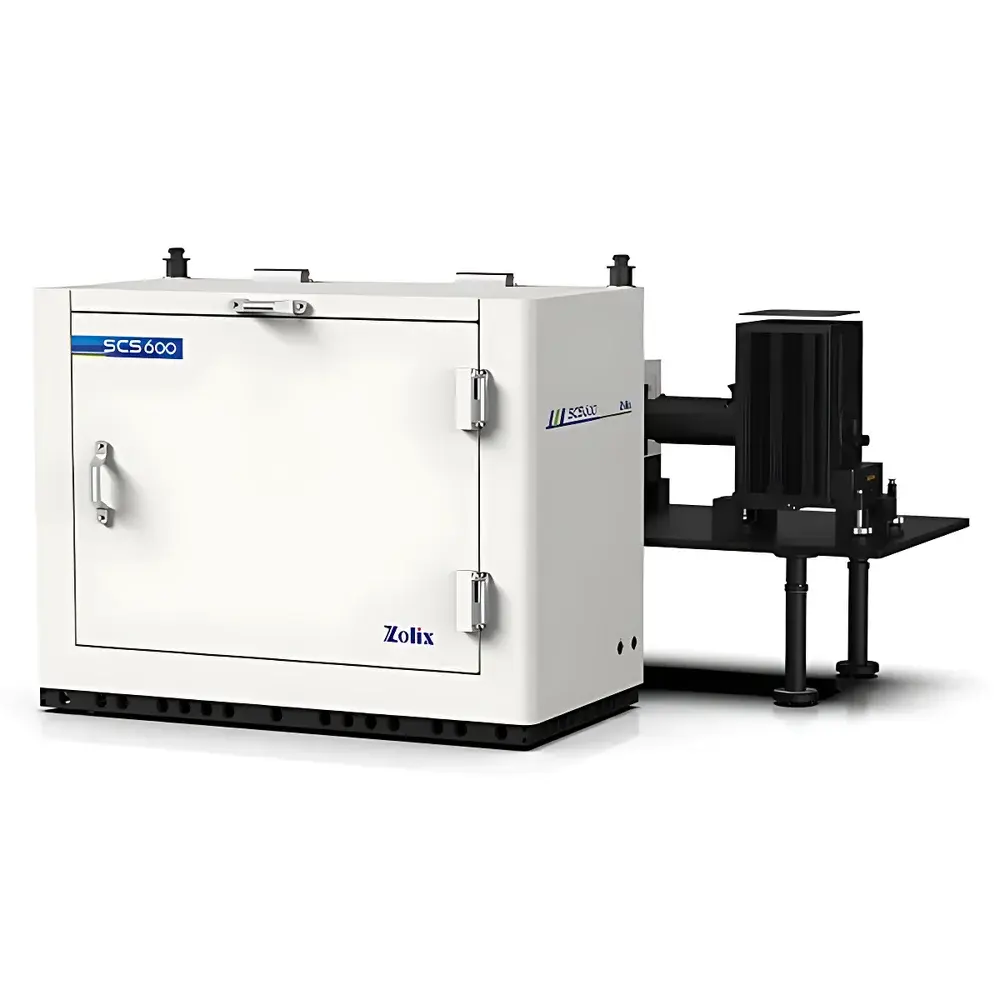
ZOLIX SCS600 Series Quantum Efficiency Measurement System for Photovoltaic Devices
| Brand | ZOLIX |
|---|---|
| Origin | Beijing, China |
| Manufacturer | ZOLIX Optics |
| Product Type | Domestic |
| Model | SCS600 Series |
| Price | Contact for Quote |
Overview
The ZOLIX SCS600 Series Quantum Efficiency Measurement System is a second-generation, high-precision photovoltaic characterization platform engineered for absolute external quantum efficiency (EQE), internal quantum efficiency (IQE), incident photon-to-electron conversion efficiency (IPCE), and spectral responsivity (SR) measurements across a broad wavelength range—from 250 nm to 1700 nm (extendable to 2500 nm with optional dual-source configuration). Built upon a reflection-based optical architecture, the system eliminates chromatic aberration inherent in transmissive optics—ensuring diffraction-limited beam quality, consistent spot size (≤Φ1 mm), and spatially uniform illumination across the full spectral range. This design is critical for accurate, repeatable measurements on small-area devices, micro-patterned cells, and multi-junction solar cells where localized irradiance errors directly propagate into spectral response uncertainty. The system employs a calibrated substitution method, relying on high-stability primary light sources (150 W xenon lamp and/or tungsten-halogen lamp) with output stability exceeding 99% over 1 hour, and integrates traceable NIST-traceable reference detectors per spectral band. It supports both DC and AC photocurrent acquisition, enabling simultaneous bias-light and bias-voltage operation—essential for isolating carrier collection dynamics under realistic operating conditions.
Key Features
- Full-spectrum EQE/IQE/IPCE and spectral responsivity mapping from 250 nm to 1700 nm (200–2500 nm with dual-source SCS600-XT configuration)
- Reflection-optics path eliminating chromatic aberration—maintaining ≤Φ1 mm monochromatic spot size across entire range
- Dual-source capability: Xenon lamp (optimized UV–VIS) + tungsten-halogen lamp (enhanced NIR), compensating for spectral gaps (e.g., 800–1000 nm xenon dip)
- Integrated CCD-based real-time beam monitoring with live sample positioning feedback and motorized XYZ sample stage
- High-fidelity current measurement using Keithley 2612B / 2636B source measure units (SMUs) supporting four-quadrant operation, sub-pA resolution, and programmable voltage/current biasing
- Modular hardware architecture: Optional glovebox-compatible IPCE-PVK adapter (2 m fiber-coupled, dual-side access, built-in CCD, 380 × 290 × 400 mm footprint)
- Customizable monochromatic LED bias light modules (365–980 nm, ±10 nm bandwidth, 1–100% intensity control, <1% RMS stability)
- Software-controlled automated scanning, data normalization, JSC integration (AM1.5G-weighted), and IQE correction via reflectance/transmittance input
Sample Compatibility & Compliance
The SCS600 accommodates standard PV device formats—including rigid wafers (up to 156 mm × 156 mm), flexible thin-film substrates, perovskite mini-modules, organic photovoltaic (OPV) cells, and III–V multi-junction stacks—within its enlarged dual-door (top + front) sample chamber. Its modular design enables seamless integration with inert-atmosphere gloveboxes (IPCE-PVK kit), vacuum chambers, and temperature-controlled stages (−40 °C to +120 °C, optional). All optical components meet ISO 9001 manufacturing standards; detector calibrations are traceable to NIST SRM 2069 (silicon photodiode) and SRM 2068 (InGaAs). The system supports GLP-compliant data integrity through audit-trail-enabled software logging, user-access controls, and electronic signatures—fully aligned with FDA 21 CFR Part 11 requirements when deployed in regulated R&D or QC environments.
Software & Data Management
ZOLIX QEMaster v3.x provides a unified GUI for instrument control, spectral scan definition, bias parameter scripting (voltage, light bias wavelength/intensity), and real-time data visualization. Raw photocurrent, reference diode signal, and calculated EQE/IPCE curves are stored in HDF5 format with embedded metadata (wavelength, slit width, integration time, SMU settings, calibration IDs). Batch processing includes AM1.5G-weighted JSC derivation, IQE deconvolution using user-supplied R/T spectra, and statistical reporting (mean, std dev, CV%) across multiple scans. Export options include CSV, MATLAB .mat, and industry-standard PV-DAQ-compatible XML. Remote operation via TCP/IP and Python API (PyZOLIX) enables integration into automated test benches and LIMS workflows.
Applications
- Routine EQE validation of Si, CIGS, CdTe, perovskite, and OPV cells during process development and production QA
- Multi-junction cell characterization: Section-by-section IPCE analysis using spectrally selective bias illumination to forward-bias individual subcells
- Light-beam-induced current (LBIC) mapping for spatial defect localization and shunt resistance profiling
- Stability assessment under sequential spectral stress (e.g., UV degradation kinetics via 365 nm bias)
- Optical loss analysis via combined EQE + reflectance/transmittance modeling
- Calibration transfer between lab-scale systems and production-line IV testers
FAQ
What wavelength ranges does the base SCS600 support, and how is extension to 2500 nm achieved?
The standard SCS600-XE and SCS600-TH models cover 250–1700 nm. The SCS600-XT dual-source configuration adds extended NIR coverage up to 2500 nm using synchronized xenon and tungsten-halogen lamps with optimized grating and InSb/extended-InGaAs detectors.
Is the system compatible with nitrogen- or argon-filled gloveboxes?
Yes—the IPCE-PVK accessory provides fiber-optic coupling (2 m UV-grade silica fiber), sealed feedthroughs, and internal CCD monitoring, enabling full functionality inside Class 1000 gloveboxes without compromising optical alignment.
How is detector linearity and saturation managed during high-intensity monochromatic illumination?
Each spectral band uses a dedicated, factory-calibrated reference detector (Si, Ge, or InGaAs) operated below 80% of its saturation limit. Real-time signal monitoring triggers automatic integration time adjustment to maintain linear response across all wavelengths.
Can the system perform time-resolved photocurrent measurements?
While primarily optimized for steady-state EQE, the integrated Keithley SMUs support pulsed I–V and transient photocurrent acquisition (down to 10 µs resolution) when paired with optional lock-in amplification or fast digitizers.
Does ZOLIX provide application support for custom cell architectures (e.g., tandem perovskite–Si)?
Yes—ZOLIX offers application engineering services including custom bias-light sequencing protocols, multi-subcell deconvolution algorithms, and joint method development with academic and industrial partners under NDA.





