
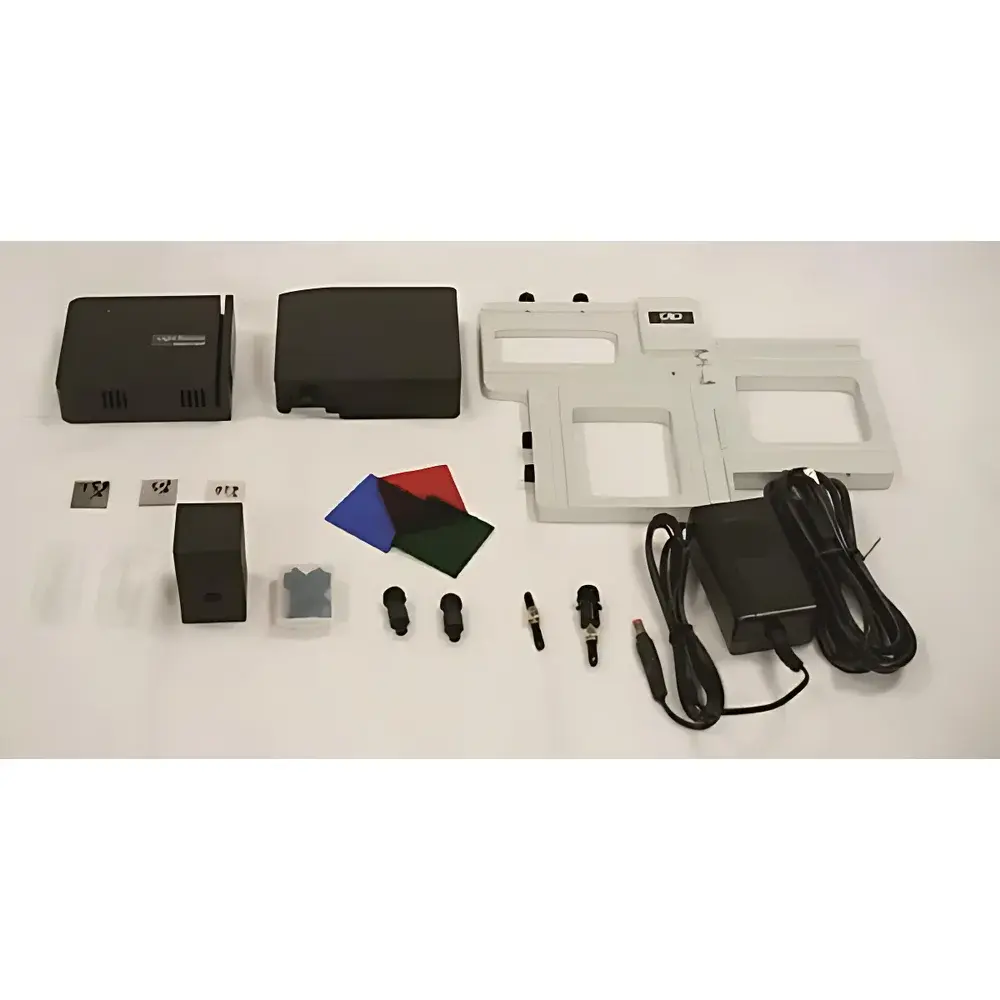
ZOLIX SGM1040-VNIR Spectroscopy Measurement Toolkit
| Brand | ZOLIX |
|---|---|
| Origin | Beijing, China |
| Manufacturer Type | Original Equipment Manufacturer (OEM) |
| Product Category | Domestic |
| Model | SGM1040-VNIR |
| Price Range | USD 70,000 – 112,000 |
| Wavelength Range | 350–1020 nm |
| Slit Width | 25 µm |
| Optical Resolution (FWHM) | 1.3 nm |
| Detector | Sony ILX554B linear CCD, 2048 pixels |
| Integration Time | 1 ms – 65 s |
| Dynamic Range | 1800:1 |
| Signal-to-Noise Ratio | 200:1 |
| Wavelength Repeatability | ±0.05 nm (100 consecutive measurements, Hg-Ar lamp) |
| Wavelength Accuracy | ±0.3 nm |
| Thermal Drift | <0.04 nm/°C |
| Data Interface | USB 2.0 @ 480 Mbps |
| Fiber Connector | SMA 905 |
| Dimensions | 86 × 110 × 31.4 mm |
Overview
The ZOLIX SGM1040-VNIR Spectroscopy Measurement Toolkit is a fully integrated, portable benchtop system engineered for quantitative spectral analysis in the visible and near-infrared (VNIR) range (350–1020 nm). Built upon a high-stability miniature spectrometer core—featuring a Sony ILX554B 2048-pixel linear CCD sensor, thermally compensated optical path, and precision 25 µm entrance slit—the toolkit implements standard spectroscopic measurement principles grounded in Beer–Lambert law-based absorbance quantification and Fresnel-based transmittance modeling. Its architecture supports both relative and calibrated absolute spectral radiometry, enabling traceable photometric and colorimetric characterization. Designed explicitly for pedagogical rigor and field-deployable robustness, the system complies with ISO/IEC 17025-aligned operational constraints for teaching laboratories and quality control environments where reproducibility under variable ambient conditions is critical.
Key Features
- Optically optimized VNIR spectrometer (350–1020 nm) with 1.3 nm FWHM resolution and <0.04 nm/°C thermal wavelength drift coefficient
- Integrated balanced broadband tungsten-halogen light source with stable spectral output across 380–1000 nm, certified per CIE Illuminant A reference conditions
- Multi-exposure acquisition engine enabling precise dynamic range extension without saturation or clipping artifacts
- Onboard ARM-based CPU and embedded memory supporting real-time color parameter calculation (CIE XYZ, L*a*b*, CCT, CRI)
- Ruggedized mechanical design validated for shock (MIL-STD-810G), vibration (IEC 60068-2-64), and humidity (IEC 60068-2-30) compliance
- Modular accessory ecosystem including quartz and PMMA cuvettes, calibrated ND filters (15%, 50%, 75%), RGB reference films, collimating optics, and SMA905-compatible fiber coupling
- Compact footprint (86 × 110 × 31.4 mm) and full system integration into an IP67-rated waterproof transport case for classroom mobility and field deployment
Sample Compatibility & Compliance
The SGM1040-VNIR accommodates standard 10 mm pathlength square cuvettes (quartz and optical-grade plastic), thin-film samples mounted on custom holders, and solid-state color filters via its adjustable sample stage. All optical components meet ISO 10110 surface quality specifications (scratch-dig 60-40), and the spectrometer’s wavelength calibration is traceable to NIST-traceable Hg-Ar emission lines. The system supports GLP-compliant operation through audit-trail-enabled software logging, user-access-level controls, and timestamped spectral data export conforming to ASTM E131-22 (Standard Terminology Relating to Molecular Spectroscopy). It is suitable for instructional use under ANSI/ASSP Z535.4 safety labeling standards and meets electromagnetic compatibility requirements per FCC Part 15 Subpart B and CE EN 61326-1.
Software & Data Management
The included ZOLIX SpectraView Pro software provides a deterministic, scriptable interface compliant with IEEE 1159-2019 spectral data exchange conventions. It supports batch processing of absorbance/transmittance spectra, automated baseline correction using polynomial and rubber-band algorithms, and generation of calibration curves per ISO 8655-6 (volumetric apparatus validation). Raw spectral data is exported in ASCII (.txt) and HDF5 (.h5) formats, ensuring interoperability with MATLAB, Python (NumPy/Pandas), and LabVIEW environments. Audit trails record operator ID, instrument configuration, environmental metadata (temperature/humidity if external sensors are connected), and processing history—fully satisfying FDA 21 CFR Part 11 requirements for electronic records and signatures when deployed in regulated academic or industrial QC workflows.
Applications
- Educational spectral characterization: lamp spectral power distribution (SPD) analysis, correlated color temperature (CCT) determination, and chromaticity coordinate mapping using CIE 1931 xy diagram
- Quantitative transmission spectroscopy: spectral transmittance profiling of optical filters, polymer films, and liquid dye solutions; identification via spectral library matching (e.g., NIST SRD 139)
- UV-Vis absorption assays: construction of Beer’s law calibration curves for concentration determination in biochemical assays (e.g., protein quantification at 280 nm, nucleic acid at 260 nm)
- Industrial process monitoring: real-time color consistency verification in paint, textile, and display manufacturing per ISO 11664-4 (CIE colorimetry)
- Environmental education modules: solar spectral irradiance simulation, atmospheric scattering demonstration, and water turbidity correlation studies
FAQ
Is the SGM1040-VNIR spectrometer calibrated at the factory? How often does recalibration require?
Yes, each unit undergoes full wavelength and radiometric calibration against NIST-traceable Hg-Ar and tungsten-halogen standards prior to shipment. Recalibration is recommended annually or after any mechanical impact exceeding 50 g, per ISO/IEC 17025 Clause 6.6.
Can the system operate without a PC connection?
No—the onboard CPU handles signal processing and color calculations, but spectral acquisition, visualization, and data export require the host PC running SpectraView Pro via USB 2.0.
What is the minimum detectable absorbance and its uncertainty?
At 550 nm with 1 s integration and 10× averaging, the system achieves an absorbance detection limit of 0.005 AU (±0.002 AU, k=2), determined per ISO 11929:2019 for ionizing radiation measurement uncertainty propagation.
Are third-party cuvettes or fiber optics compatible?
Yes—any standard 10 mm square cuvette with optical path alignment and SMA905-terminated fibers with NA ≤ 0.22 are mechanically and optically compatible.
Does the toolkit support GMP/GLP documentation workflows?
Yes—SpectraView Pro includes configurable electronic signature fields, version-controlled method templates, and immutable raw-data archiving aligned with Annex 11 and ALCOA+ data integrity principles.
Related Products



