
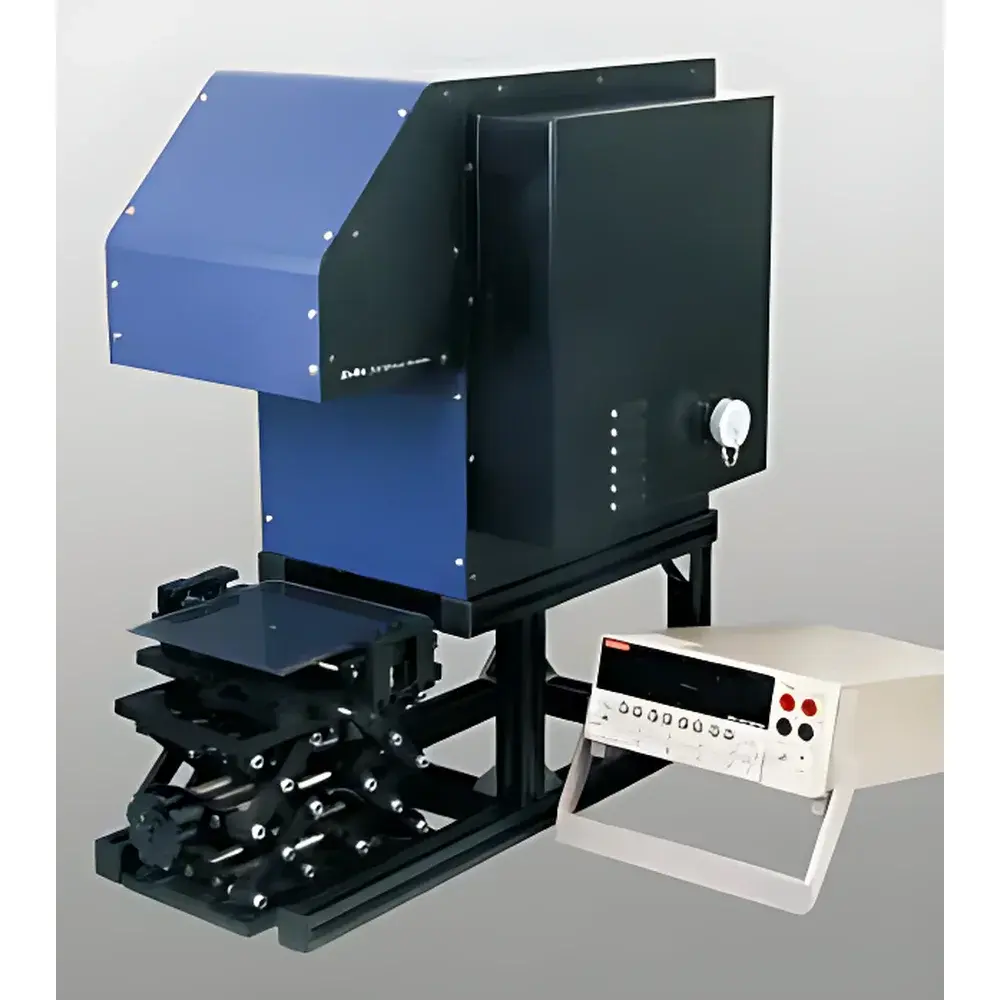
ZOLIX SolarIV 100 Photovoltaic I-V Characterization System
| Brand | ZOLIX |
|---|---|
| Origin | Beijing, China |
| Manufacturer Type | Original Equipment Manufacturer (OEM) |
| Product Origin | Domestic (PRC) |
| Model | SolarIV 100 |
| Automation Level | Semi-Automatic |
| Compliance | IEC 60904-1, IEC 60904-9 (Class AAA/ABA Simulators), ISO/IEC 17025-aligned testing workflow |
Overview
The ZOLIX SolarIV 100 Photovoltaic I-V Characterization System is a semi-automated, laboratory-grade instrument engineered for precise current–voltage (I-V) curve acquisition and quantitative photovoltaic parameter extraction under both illuminated and dark conditions. Based on the fundamental principle of controlled source-measure unit (SMU)-driven bias sweep combined with calibrated solar simulation, the system enables traceable measurement of key device metrics—including open-circuit voltage (Voc), short-circuit current (Isc), short-circuit current density (Jsc), maximum power point voltage (Vmpp) and current (Impp), fill factor (FF), and power conversion efficiency (η)—in accordance with internationally recognized photovoltaic characterization standards. The system integrates a high-stability light source, a precision SMU, reference cell calibration, and thermally stabilized sample positioning to minimize measurement uncertainty arising from spectral mismatch, spatial non-uniformity, and thermal drift.
Key Features
- Comprehensive I-V characterization under standard test conditions (STC: 1000 W/m², AM1.5G spectrum, 25°C cell temperature)
- Simultaneous acquisition of illuminated and dark I-V curves for diode parameter modeling (e.g., series/shunt resistance, ideality factor)
- Integrated AAA- or ABA-class solar simulator (model-dependent), compliant with IEC 60904-9 spectral match, temporal stability, and spatial uniformity requirements
- Low-shadow probe design minimizing active-area occlusion and ensuring representative current collection
- Built-in certified silicon reference cell (QE-B1) with NIST-traceable calibration certificate for irradiance normalization
- Dedicated motorized or manual sample stage (IV-F3/F4) with XYZ adjustment and optional temperature control interface
- Preconfigured Keithley SMU (2400/2420/2440 series) operating in four-quadrant sourcing and measuring mode with sub-picoampere current resolution
Sample Compatibility & Compliance
The SolarIV 100 supports rigid and flexible photovoltaic devices up to 200 × 200 mm active area, including crystalline silicon (c-Si), thin-film (CIGS, CdTe, a-Si), perovskite, organic PV (OPV), and multi-junction cells. All measurement protocols adhere to IEC 60904-1 (photovoltaic current–voltage characteristics) and IEC 60904-9 (classification of solar simulators). Reference cell calibration follows IEC 60904-2 and is traceable to national metrology institutes. The system architecture supports GLP-compliant operation through audit-ready software logging, user access controls, and electronic signature capability—facilitating alignment with ISO/IEC 17025 accreditation requirements for testing laboratories.
Software & Data Management
The proprietary IV-Software provides a Windows-based graphical user interface with real-time curve plotting, multi-sweep averaging, and automated parameter calculation per IEC 61215 and IEC 61646. It supports configurable sweep parameters (voltage step size, delay time, compliance limits), temperature compensation input, and irradiance correction using reference cell feedback. Raw data export is available in ASCII, Excel (.xlsx), and XML formats for third-party analysis (e.g., MATLAB, Python, PVsyst). Full-report generation includes annotated I-V plots, tabulated results, measurement metadata (date/time, operator ID, ambient conditions), and pass/fail flags against user-defined specification limits. All software modules are designed to meet FDA 21 CFR Part 11 requirements for electronic records and signatures when deployed in regulated R&D or QC environments.
Applications
- Routine performance screening of lab-scale and pilot-line solar cells during material development and process optimization
- Quality assurance testing of commercial PV modules prior to encapsulation or field deployment
- Stability assessment via repeated I-V measurements under controlled thermal and illumination stress (e.g., ISOS-L-1, ISOS-D-1 protocols)
- Failure analysis through dark I-V analysis to extract recombination mechanisms and contact quality metrics
- Educational use in university photovoltaics laboratories for hands-on training in device physics and metrology principles
- Calibration transfer between reference cells and production-line flash testers
FAQ
What standards does the SolarIV 100 comply with for photovoltaic testing?
The system implements measurement procedures aligned with IEC 60904-1 (I-V characterization), IEC 60904-9 (solar simulator classification), and IEC 60904-2 (reference cell requirements). Optional configuration supports ASTM E1036 and JIS C 8912 compliance.
Can the system measure temperature-dependent I-V characteristics?
Yes—when integrated with an external temperature-controlled stage or environmental chamber (via analog/digital I/O interface), the software logs temperature-synchronized sweeps and applies temperature correction algorithms per IEC 60891.
Is remote operation or automation scripting supported?
The IV-Software exposes COM/ActiveX and TCP/IP APIs for integration into LabVIEW, Python, or custom MES/QMS platforms, enabling unattended batch testing and statistical process control (SPC) workflows.
How is spectral mismatch corrected during efficiency calculation?
Correction is performed using the measured external quantum efficiency (EQE) spectrum of the DUT and the relative spectral irradiance distribution of the simulator, as defined in IEC 60904-7.
What documentation is provided for regulatory audits?
Each system ships with a Factory Acceptance Test (FAT) report, calibration certificates for the reference cell and SMU, software validation summary (IQ/OQ), and a traceable metrology chain document supporting ISO/IEC 17025 implementation.







