
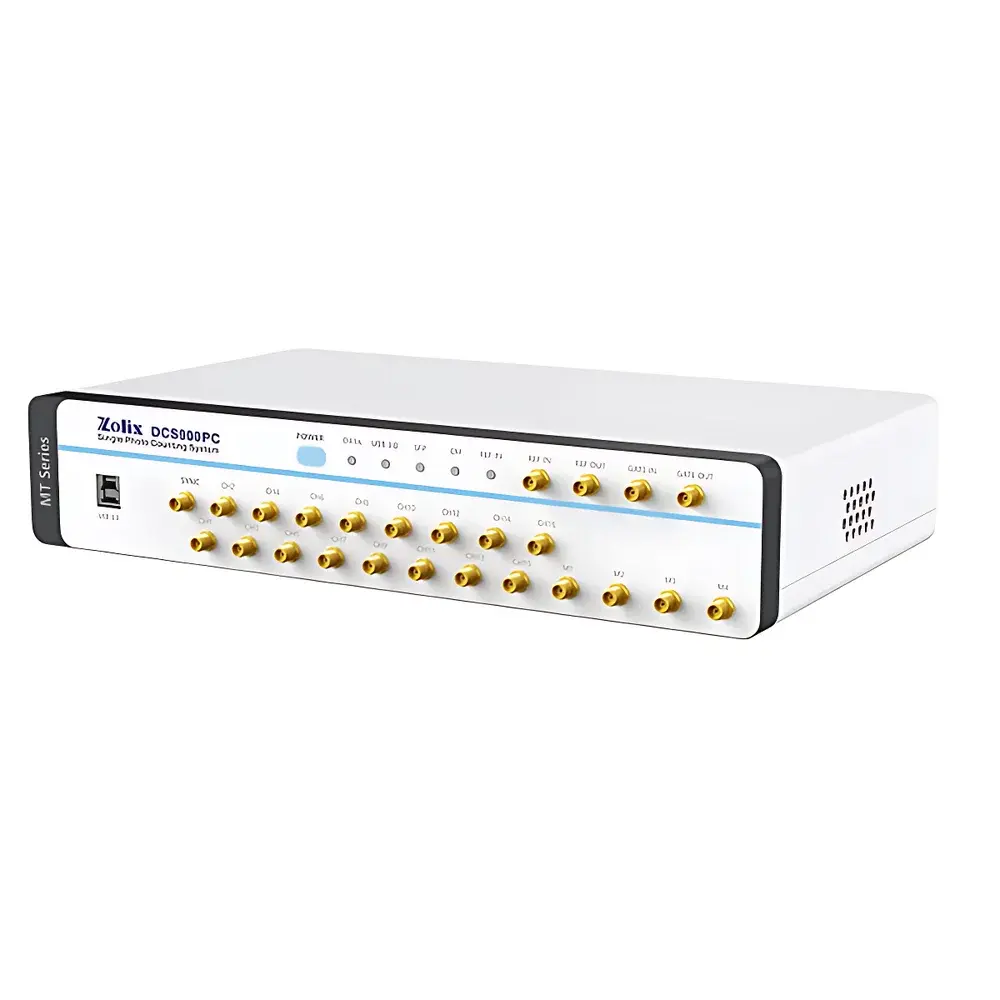
ZOLIX TCSPC Plus Advanced Time-Correlated Single Photon Counting System
| Brand | ZOLIX |
|---|---|
| Origin | Beijing, China |
| Manufacturer Type | Original Equipment Manufacturer (OEM) |
| Product Category | Domestic |
| Model | TCSPC Plus |
| Instrument Type | Steady-State & Time-Resolved Fluorescence Spectrometer |
| Time Resolution | 2 / 4 / … / 33,554,432 ps |
| Time Channels | 65,535 |
| Dead Time | 2 ns |
| Timing Jitter | <10 ps |
| Maximum Instantaneous Count Rate | 500 Mcps |
| PMT Detector | R928P (Spectral Range: 185–900 nm |
Overview
The ZOLIX TCSPC Plus is a high-performance time-correlated single photon counting (TCSPC) data acquisition system engineered for precision time-resolved fluorescence spectroscopy. Based on the fundamental principle of start-stop timing—where a laser excitation pulse serves as the START signal and the first detected photon from the sample triggers the STOP signal—the system reconstructs fluorescence decay profiles with picosecond-level temporal fidelity. Unlike analog or gated detection methods, TCSPC operates in the time domain with inherent single-photon sensitivity, exceptional signal-to-noise ratio (SNR), and statistical accuracy governed by Poisson counting statistics. The TCSPC Plus integrates seamlessly with the OmniFluo990 steady-state/time-resolved fluorescence spectrometer and the OmniFluo-FLIM fluorescence lifetime imaging microscope, enabling quantitative lifetime measurements down to 100 ps when paired with picosecond pulsed lasers. Its architecture supports both bulk solution-phase kinetics and spatially resolved FLIM applications, making it suitable for probing ultrafast intramolecular processes—including electron transfer, energy migration, conformational relaxation, and solvation dynamics—in chemical, biological, and materials science laboratories.
Key Features
- Ultra-high time resolution: Configurable from 2 ps to 33,554,432 ps across 65,535 time channels, allowing flexible trade-offs between temporal density and dynamic range.
- Low dead time of 2 ns ensures minimal pulse pile-up even at high count rates, preserving decay fidelity under moderate excitation conditions.
- Timing jitter <10 ps guarantees sub-picosecond timing precision, critical for resolving multi-exponential decays with closely spaced lifetimes.
- Maximum instantaneous count rate of 500 Mcps accommodates demanding applications such as high-repetition-rate laser excitation (e.g., 10 MHz supercontinuum sources) without saturation-induced distortion.
- Native compatibility with R928P photomultiplier tubes (185–900 nm spectral response; rise time ≤2.2 ns; dark count ≤100 cps at –10 °C), optimized for UV–Vis fluorescence detection.
- Firmware- and software-upgradable design supports future enhancements in histogramming algorithms, real-time deconvolution, and hardware synchronization protocols.
Sample Compatibility & Compliance
The TCSPC Plus is compatible with standard cuvette-based samples, microvolume cells, thin-film substrates, and biological specimens mounted on glass slides or coverslips. It supports aqueous, organic, and mixed-solvent systems—including temperature-controlled environments (–20 °C to +80 °C with optional accessories). Data acquisition and analysis workflows comply with GLP and GMP documentation requirements when used in regulated environments. While not certified per se, the system’s deterministic timing architecture, audit-trail-capable software logging (via Omni-Win), and traceable calibration procedures align with ISO/IEC 17025 principles for analytical instrument validation. Lifetime fitting routines implement standard nonlinear least-squares (NLLS) algorithms with χ² minimization and residual analysis, supporting ASTM E2847-21 guidelines for fluorescence lifetime measurement uncertainty estimation.
Software & Data Management
Controlled exclusively via ZOLIX’s Omni-Win platform, the TCSPC Plus provides a unified interface for hardware configuration, real-time histogram visualization, background subtraction, instrument response function (IRF) measurement, and multi-exponential decay fitting. Raw histograms are stored in vendor-neutral binary formats (e.g., .sdt) with embedded metadata—including laser repetition rate, detector gain, dwell time, and environmental sensor readings (if enabled). Export options include ASCII (CSV/TXT), MATLAB (.mat), and HDF5 for interoperability with Python (NumPy, SciPy), Igor Pro, and OriginLab. All processing steps—including IRF convolution, scatter correction, and global analysis across multiple wavelengths or positions—are fully scriptable and reproducible. Audit trails record user actions, parameter changes, and fitting iterations—supporting 21 CFR Part 11 compliance when deployed with appropriate IT infrastructure and electronic signature controls.
Applications
- Quantitative determination of fluorescence lifetimes in molecular standards (e.g., Erythrosin B in water: measured τ = 88 ps vs. reference 89 ± 3 ps).
- Discrimination of fluorophore species with overlapping spectra but distinct lifetimes—enabling multiplexed sensing without spectral unmixing.
- Probing protein folding intermediates, ligand-binding kinetics, and Förster resonance energy transfer (FRET) efficiency in live-cell FLIM.
- Characterizing charge recombination dynamics in perovskite solar cell materials and triplet-state lifetimes in OLED emitters.
- Validation of time-domain optical tomography models through calibrated lifetime phantoms.
- Method development for pharmaceutical stability studies where photodegradation pathways manifest as lifetime shifts.
FAQ
What is the minimum measurable fluorescence lifetime with the TCSPC Plus?
The practical lower limit is ~100 ps when using picosecond excitation sources and optimized IRF deconvolution. In benchmark tests with Erythrosin B (τ ≈ 88 ps), the system delivers results consistent with international reference values.
Can the TCSPC Plus be integrated with third-party lasers or detectors?
Yes—standard TTL-compatible START/STOP I/O interfaces support synchronization with external picosecond lasers (e.g., Ti:sapphire, fiber, or diode-pumped solid-state) and most fast PMTs, MCP-PMTs, or SPAD arrays with NIM or LVDS output.
Is firmware upgrade supported in-field?
Yes—ZOLIX provides periodic firmware updates via secure download; upgrades retain full backward compatibility with existing Omni-Win versions and histogram file formats.
Does the system support global lifetime analysis across emission wavelengths?
Yes—Omni-Win enables simultaneous fitting of decay curves acquired at multiple emission bands, constraining shared lifetime components while allowing amplitude variations—ideal for anisotropy-resolved or wavelength-dependent quenching studies.
What calibration standards are recommended for routine verification?
ZOLIX recommends traceable standards including Erythrosin B (aqueous, τ ≈ 89 ps), Rhodamine B (ethanol, τ ≈ 1.6 ns), and Coumarin 153 (acetonitrile, τ ≈ 4.9 ns), all referenced in the international interlaboratory study published in Analytical Chemistry (2007, 79, 2137).





