
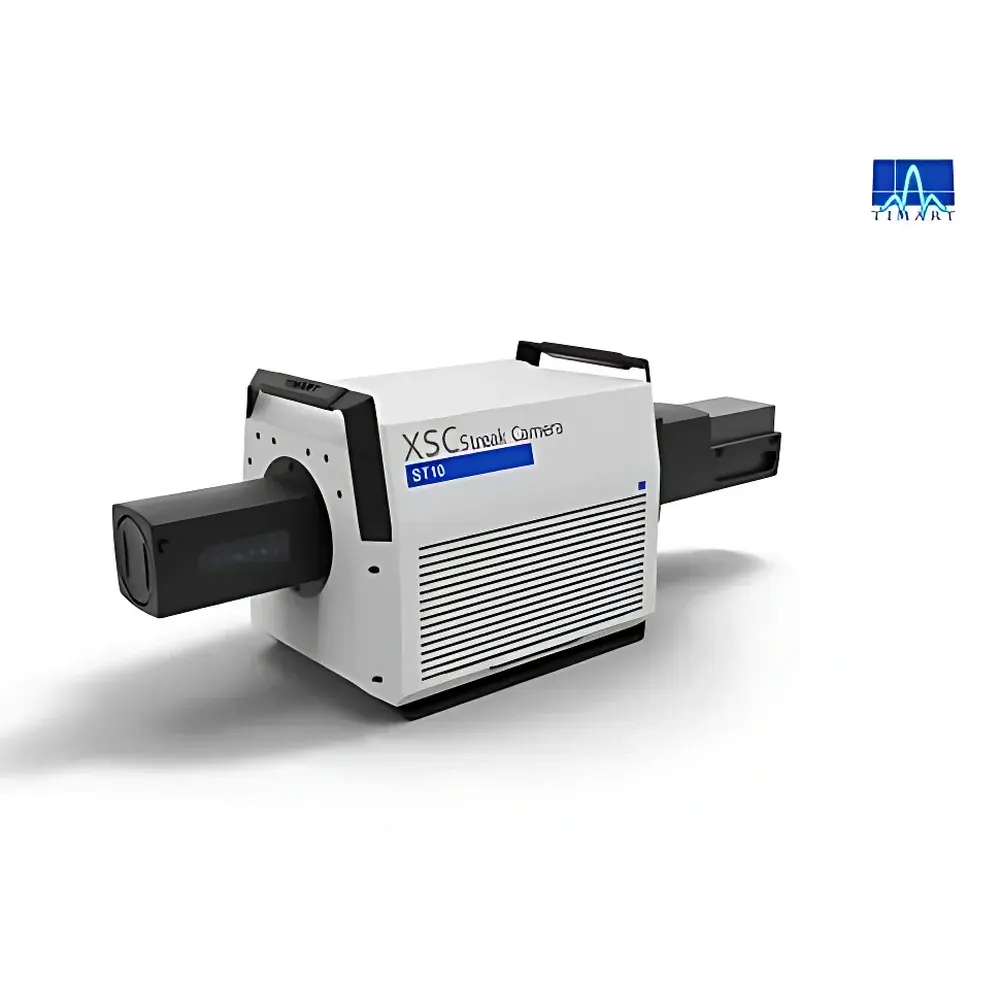
ZOLIX TIMART Series Universal Streak Camera
| Brand | ZOLIX |
|---|---|
| Origin | Beijing, China |
| Manufacturer Type | OEM Manufacturer |
| Regional Category | Domestic (China) |
| Model | TIMART |
| Price Range | USD 110,000 – 138,000 |
Overview
The ZOLIX TIMART Series Universal Streak Camera is a high-performance, dual-mode ultrafast optical diagnostic instrument engineered for simultaneous picosecond temporal and micrometer spatial resolution. Based on the principle of electro-optic deflection in a synchro-scan or single-shot streak tube, it converts time-varying light intensity distributions into spatially encoded images on a photocathode–fluorescent screen–camera detection chain. This enables direct measurement of intensity–time–space correlations in transient optical events—such as laser-induced plasma decay, fluorescence lifetime dynamics, or fast discharge luminescence—without requiring repetitive averaging. Designed by the Xi’an Institute of Optics and Precision Mechanics, Chinese Academy of Sciences, and manufactured by ZOLIX (Beijing), the TIMART platform bridges the gap between specialized ultrafast facilities and general-purpose university and industrial laboratories. Its architecture supports both high-repetition-rate synchronous scanning (up to 300 MHz) and single-trigger acquisition (≥1 kHz), making it uniquely adaptable across diverse experimental paradigms—from time-resolved photoluminescence spectroscopy of perovskite semiconductors to Thomson scattering diagnostics in pulsed plasma sources.
Key Features
- Ultrafast temporal resolution: ≤2 ps (typical), with minimum achievable resolution down to 400 fs in optimized configurations
- Wide spectral response: UV–NIR coverage (200–900 nm) via interchangeable photocathodes (S20, BB, S25) and phosphor screens (P20, P43, P46, P47)
- Dual operational modes: Software-controlled switching between synchro-scan (40–300 MHz) and single-shot/low-repetition trigger mode (≤1 kHz), eliminating hardware reconfiguration
- High spatial fidelity: Up to 50 line pairs/mm spatial resolution; optical slit width adjustable from 0–3 mm with 10–20 µm precision
- Enhanced signal detection: Dual-stage microchannel plate (MCP) intensifiers delivering gain up to 3×10⁵; fiber-optic faceplate coupling improves quantum efficiency by >20× versus lens-coupled systems
- Scientific-grade readout: Cooled back-illuminated sCMOS or CCD sensors (2048×2048 to 4096×4096), 16-bit digitization, dynamic range >10,000:1, and deep-well capacity ≥60,000 e⁻
- Robust mechanical design: EMI-shielded housing compliant with laboratory electromagnetic compatibility standards; optional water-cooling for stable long-term operation at –20 °C sensor temperature
Sample Compatibility & Compliance
The TIMART series interfaces seamlessly with standard optical diagnostics platforms—including confocal microscopes, monochromators, spectrometers (e.g., Omni-λ series), and fiber-coupled sample chambers—via modular relay optics and standardized flange mounts (CF, SM, or FC/PC). It supports vacuum-compatible configurations for plasma and laser-ablation experiments. All electronic control subsystems comply with IEC 61000-6-3 (EMI emission) and IEC 61000-6-2 (immunity) requirements. Firmware and software adhere to GLP-aligned data integrity principles: full audit trail logging, user-access controls, and timestamped metadata embedding (ISO/IEC 17025 traceability framework). While not FDA 21 CFR Part 11 certified out-of-the-box, the system architecture permits validation-ready deployment in regulated environments upon customer-defined qualification protocols.
Software & Data Management
TIMART is operated through a unified, Python-based GUI that integrates real-time camera control, streak tube parameter tuning (scan speed, delay, gain), and synchronized acquisition with external devices (pulse generators, spectrometers, shutters). The native software suite includes:
- StreakView Pro: For raw image correction (dark current subtraction, flat-field normalization), time-axis calibration, and intensity–time profile extraction
- SpectraStreak Toolkit: Enables joint spectral–temporal reconstruction when coupled with grating spectrometers—supporting wavelength calibration via Hg/Ne lamp references and dispersion modeling
- Batch Processing Engine: Supports automated analysis pipelines for fluorescence lifetime decay fitting (multi-exponential deconvolution), transient absorption kinetics, and ASE pulse duration quantification
- Data export formats: HDF5 (with embedded metadata), TIFF (16-bit), CSV, and MATLAB .mat—ensuring interoperability with Igor Pro, OriginLab, and Python (NumPy/SciPy) workflows
Applications
The TIMART camera serves as a core diagnostic tool in fundamental and applied ultrafast science:
- Time-resolved photoluminescence (TRPL) of perovskite nanocrystals (e.g., CsPbBr₃, Cs₄PbBr₆), resolving multi-component decay kinetics on sub-ns to µs scales
- Ultrafast plasma diagnostics: Full-spectrum time-gated imaging of laser-induced air breakdown, including continuum and line-emission evolution
- ASE (amplified spontaneous emission) lifetime mapping in organic semiconductor thin films under femtosecond excitation
- Transient absorption spectroscopy: Monitoring excited-state population dynamics in photoactive molecular systems
- Flash radiography and wire explosion studies under controlled gas pressure environments
- Quantum device characterization: Time-domain response measurement of single-photon avalanche diodes (SPADs) and superconducting nanowire detectors
- LIDAR and Thomson scattering: High-bandwidth photon arrival timing for plasma electron density profiling
FAQ
What is the minimum detectable pulse duration?
The system achieves ≤2 ps temporal resolution under optimal conditions (e.g., narrow slit, high MCP gain, low-noise readout); the theoretical limit is 400 fs depending on photocathode response and deflection electronics bandwidth.
Can TIMART be integrated with third-party spectrometers?
Yes—standard C-mount or SMA fiber interfaces enable coupling with commercial spectrometers (e.g., Acton, Princeton Instruments, Horiba). ZOLIX provides optical alignment templates and dispersion compensation scripts for common grating configurations.
Is remote operation supported?
Full Ethernet and USB 3.0 connectivity allow headless operation, scripting via Python API, and integration into LabVIEW or MATLAB automation frameworks.
What maintenance is required for long-term stability?
No routine vacuum servicing is needed—the streak tubes are sealed and rated for >10,000 hours MTBF. Annual calibration of time-axis linearity and spectral registration is recommended for quantitative applications.
Does the system support synchronization with femtosecond laser oscillators?
Yes—integrated RF input accepts TTL or sine-wave triggers from laser sync outputs (e.g., Coherent Chameleon, Spectra-Physics Mai Tai), with jitter <10 ps RMS when using low-skew BNC cabling.





