
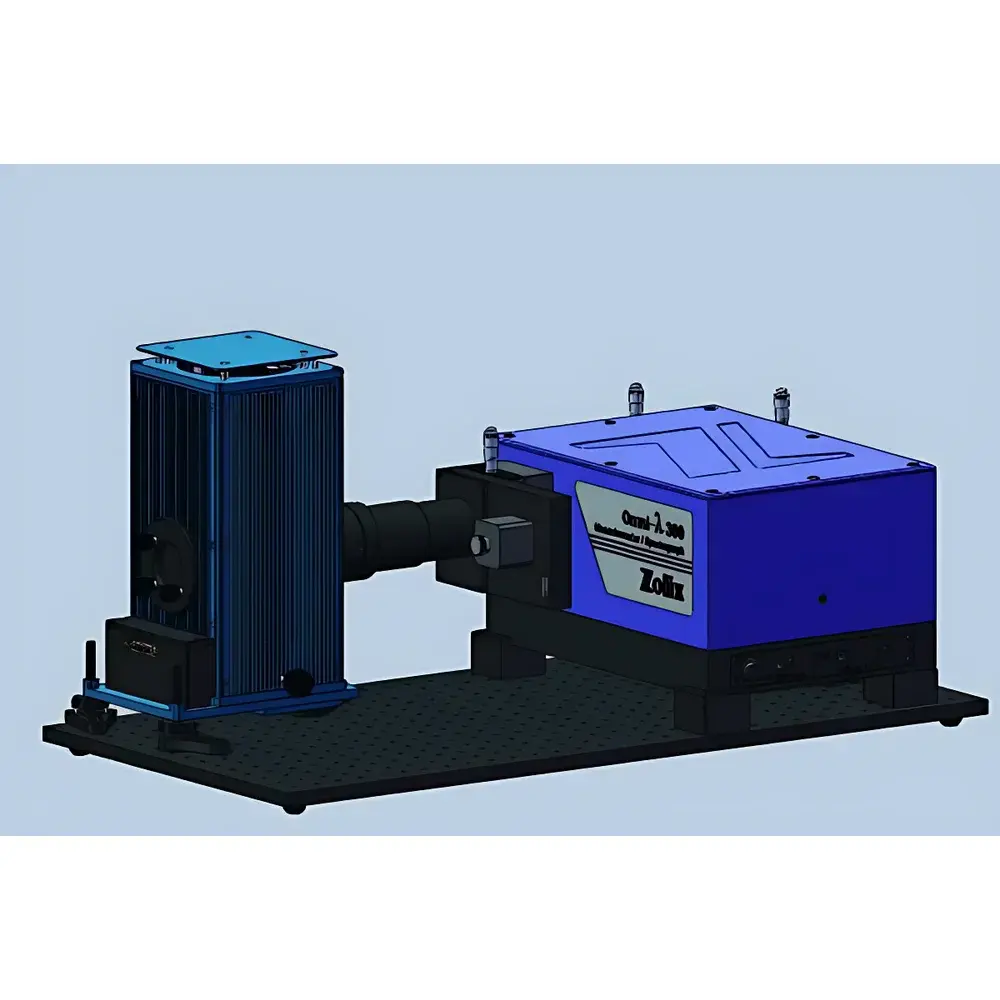
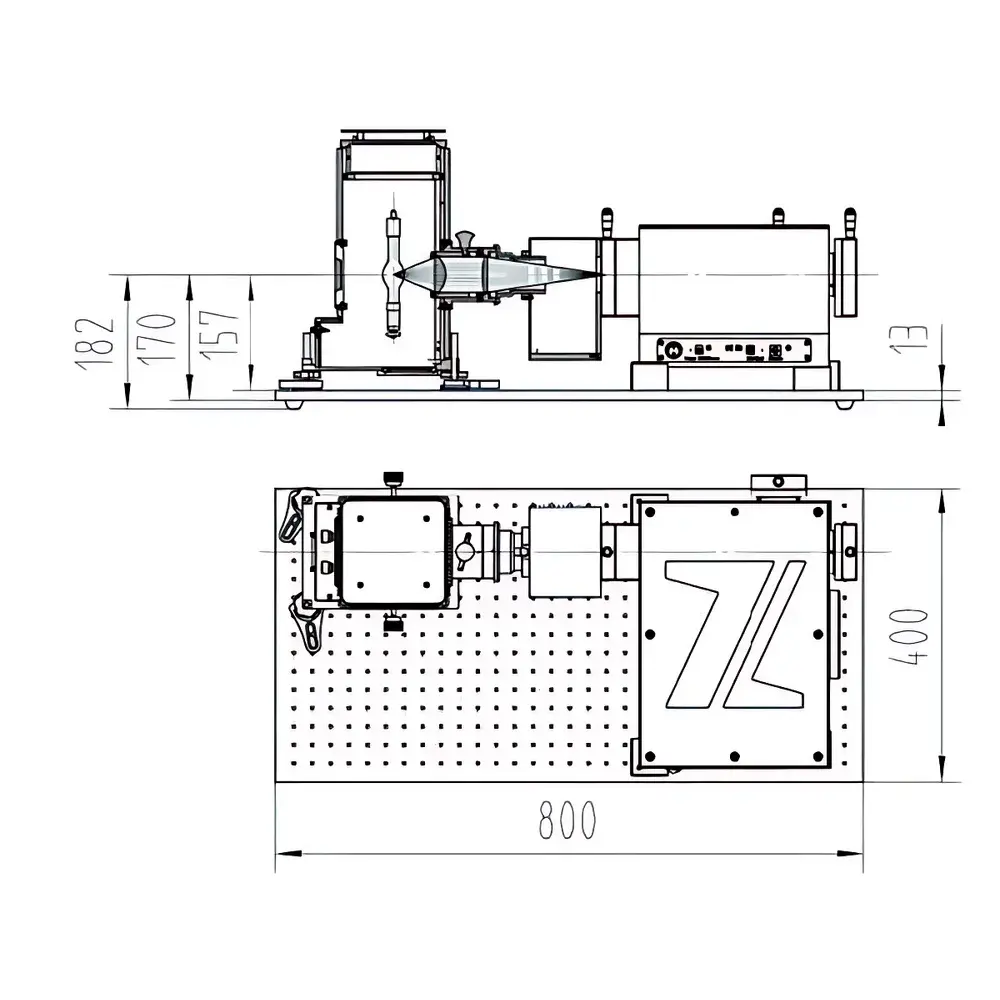
ZOLIX TLS3-X150A/X500A/T250A Tunable Monochromatic Light Source
| Brand | ZOLIX |
|---|---|
| Origin | Beijing, China |
| Manufacturer Type | Direct Manufacturer |
| Light Source Type | Xenon Lamp (X150A/X500A) / Tungsten-Halogen Lamp (T250A) |
| Illumination Mode | External Illumination |
| Spectral Range | 200–2500 nm (dependent on lamp and grating selection) |
| Grating Options | 1200 g/mm (200–600 nm), 600 g/mm (330–1000 nm), 300 g/mm (800–2500 nm) |
| Slit Width Options | 0.5–4.5 mm |
| Spectral Bandwidth (FWHM) | 1.35–36.5 nm (varies with grating and slit width) |
| Output Coupling | Direct interface to spectrometer slit or optional accessories (collimator, integrating sphere, diffuser) |
Overview
The ZOLIX TLS3-X150A/X500A/T250A Tunable Monochromatic Light Source is a modular, research-grade optical system engineered for precise spectral control in laboratory and industrial metrology applications. Built around a high-stability Czerny-Turner monochromator platform (Omni-300 series), it integrates interchangeable broadband lamps — GLORIA-X150A (150 W xenon arc), GLORIA-X500A (500 W xenon arc), or GLORIA-T250A (250 W tungsten-halogen) — enabling continuous spectral coverage from deep ultraviolet (200 nm) through visible to mid-infrared (2500 nm). The system operates on the principle of wavelength-selective dispersion via ruled or holographic diffraction gratings, followed by spatial filtering at adjustable entrance/exit slits. Its external illumination architecture ensures minimal thermal load on samples while maintaining high radiometric stability (<±0.5% RMS over 1 hour, typical), making it suitable for quantitative photometric and quantum efficiency measurements requiring traceable spectral irradiance.
Key Features
- Modular lamp interchangeability: Seamless integration of 150 W and 500 W xenon arc lamps for UV–VIS stability and high photon flux, or 250 W tungsten-halogen for NIR continuity and low-noise thermal emission.
- Precision monochromator core: Omni-300 optical bench with kinematic grating mount, supporting three standard gratings (1200, 600, and 300 grooves/mm) optimized for resolution–throughput trade-offs across spectral regions.
- Adjustable spectral bandwidth: Slit widths from 0.5 mm to 4.5 mm yield FWHM values ranging from 1.35 nm (UV, narrow slit, high-groove grating) to 36.5 nm (NIR, wide slit, low-groove grating), calibrated per NIST-traceable procedures.
- Integrated system architecture: Pre-aligned baseplate assembly includes power supply, monochromator, filter wheel (for order-sorting and harmonic suppression), circular variable slits, and USB/Ethernet-enabled control firmware.
- Direct spectrometer coupling: Standard SMA905 or fiber-optic interfaces allow plug-and-play connection to commercial CCD/CMOS array spectrometers or lock-in detection systems without realignment.
Sample Compatibility & Compliance
The TLS3 series supports diverse sample geometries and measurement configurations via optional accessories certified for optical metrology integrity. The TLS-A5 off-axis parabolic collimator delivers <1.2° divergence over 3–25 mm beam diameters, minimizing wavefront aberration for reflectance/transmittance calibration. The OL-Difref-VNIR diffuse reflectance accessory features BaSO₄-coated integrating cavity (≥98% reflectance, 350–1700 nm), dual detector ports, and compliance with ASTM E275 and ISO 13468 for bidirectional reflectance distribution function (BRDF) studies. The OL-IS2P-200A2 integrating sphere (200 mm diameter) enables uniform irradiance generation (±1.5% spatial non-uniformity) for QE testing of photovoltaic devices per IEC 60904-8 and JIS C 8912 standards. All electrical subsystems conform to IEC 61010-1 safety requirements; firmware supports audit trail logging aligned with GLP/GMP documentation practices.
Software & Data Management
ZOLIX LightMaster™ v4.2 software provides cross-platform (Windows/Linux) instrument control, spectral scan automation, and radiometric calibration import. It supports programmable wavelength stepping (minimum 0.01 nm increment), dwell time adjustment per point, and real-time intensity normalization against reference diode signals. Data export formats include CSV, HDF5, and XML-compliant spectral irradiance files compliant with ASTM E275 and CIE S 014-2/E:2020 metadata schemas. For regulated environments, optional 21 CFR Part 11 mode enables electronic signatures, role-based access control, and immutable audit logs — fully compatible with LIMS integration via OPC UA or RESTful API endpoints.
Applications
- Quantum efficiency characterization of solar cells and photodetectors across AM1.5G-relevant spectral bands.
- Fluorescence excitation profiling for material photophysics and biosensor development.
- Calibration of spectral radiometers, imaging sensors, and hyperspectral cameras using NIST-traceable line sources.
- Photochemical reaction kinetics studies under controlled monochromatic irradiance (e.g., photocatalysis, polymer degradation).
- Optical thin-film and coating reflectance/transmittance mapping in UV–NIR regimes.
FAQ
What lamp options are supported, and how do they affect spectral output?
The TLS3-X150A and TLS3-X500A use air-cooled xenon arc lamps optimized for stable UV–VIS output (200–1000 nm); the TLS3-T250A employs a tungsten-halogen lamp for enhanced NIR continuity (up to 2500 nm) with lower UV intensity.
Can the system be used for absolute irradiance measurements?
Yes — when paired with a NIST-calibrated reference detector (e.g., Hamamatsu S1337 series) and LightMaster™ calibration module, the system achieves ±3% uncertainty in absolute spectral irradiance (250–1100 nm) per ISO/IEC 17025-accredited protocols.
Is remote operation supported for integration into automated test benches?
All models support TCP/IP and USB CDC virtual COM port protocols; full SCPI command set enables seamless integration with LabVIEW, Python (PyVISA), or MATLAB-based test sequencers.
How is stray light suppressed across spectral orders?
The integrated filter wheel automatically engages order-sorting filters (UV, VIS, NIR) synchronized with grating selection; additional notch and bandpass filters can be manually installed for demanding applications such as Raman excitation.
What maintenance is required for long-term wavelength accuracy?
Annual grating alignment verification and slit calibration using He–Ne laser reference lines (632.8 nm) and mercury-argon emission standards are recommended; ZOLIX provides factory recalibration services with ISO 17025-certified reports.





