
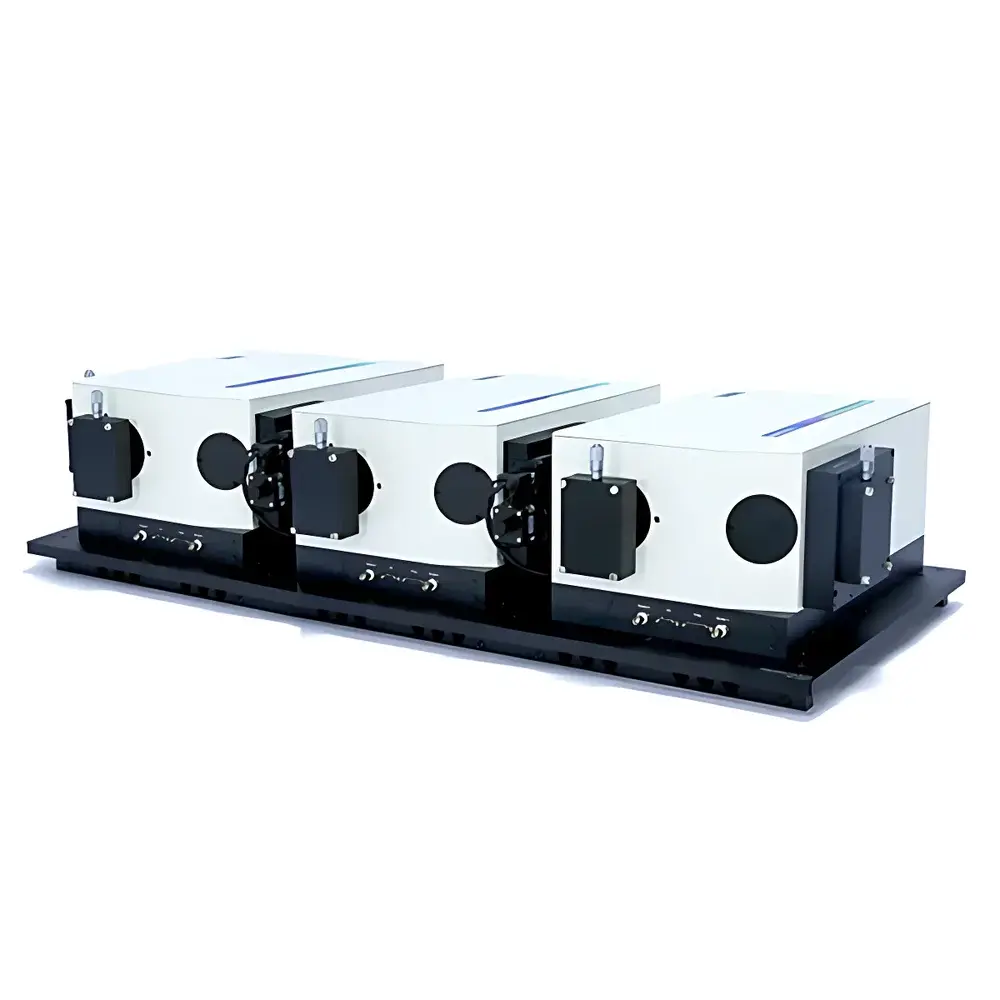
ZOLIX Triplex Grating Spectrometer Monochromator
| Brand | ZOLIX |
|---|---|
| Origin | Beijing, China |
| Manufacturer Type | Original Equipment Manufacturer (OEM) |
| Product Origin | Domestic (China) |
| Model | Triplex |
| Application System | Universal |
| Spectral Resolution | 3 cm⁻¹ |
| Spectral Range | 200–800 nm |
| Wavenumber Range (relative, @ 325 nm excitation) | 50–18,000 cm⁻¹ |
| Repeatability | ±5 cm⁻¹ |
| Single-Capture Imaging Range | 700 cm⁻¹ |
Overview
The ZOLIX Triplex Grating Spectrometer Monochromator is a high-performance, triple-stage grating-based optical spectrometer engineered for ultra-low stray light and high spectral resolution in demanding Raman spectroscopy applications. Based on the modular “SpectraKing” series of 500 mm focal-length monochromators, the Triplex configuration implements a cascaded dispersion architecture: the first two stages operate in subtractive (anti-parallel) dispersion mode to suppress stray light by >4 orders of magnitude, while the third stage operates in additive (in-phase) dispersion mode to maximize resolving power. This hybrid optical design preserves throughput while achieving a nominal spectral resolution of 3 cm⁻¹ at 325 nm excitation—critical for distinguishing narrow vibrational modes in resonance Raman experiments. The instrument is fundamentally a vacuum-compatible, motorized scanning spectrometer with fully synchronized grating rotation, wavelength calibration traceable to NIST-traceable emission lines, and mechanical stability compliant with ISO 10110-7 for optical surface alignment repeatability.
Key Features
- Triple-stage cascaded monochromator architecture: two subtractive stages + one additive stage for simultaneous stray-light suppression (<0.001% at 500 nm) and high resolution (3 cm⁻¹)
- Three independently motorized 500 mm focal-length monochromator units, each equipped with a triple-grating turret (deep-UV, mid-UV, and visible gratings)
- Imported ruled and holographic gratings with peak reflectivity up to ~70% across 200–800 nm; optimized blaze angles per spectral region
- Side-entry/dual-output port configuration on Stages I & II; dual-input/dual-output configuration on Stage III for flexible detector integration (CCD array, PMT, InGaAs, or Si APD)
- Integrated wavelength calibration using internal Hg/Ne/Ar lamp reference lines with automated spectral line recognition and polynomial fitting (R² > 0.9999)
- Motorized slit drives (10–3000 µm width), precision collimator alignment, and thermal drift compensation via aluminum-invar hybrid optical bench
Sample Compatibility & Compliance
The Triplex spectrometer supports both free-space and fiber-coupled excitation configurations, compatible with continuous-wave (CW) and pulsed lasers (e.g., HeCd 325 nm, Kr⁺ 406.7 nm, Nd:YAG 532 nm). Its deep-UV grating option enables resonance Raman studies of biological chromophores (e.g., heme, flavins, nucleic acid bases) and wide-bandgap semiconductors (e.g., ZnO, GaN). The system meets mechanical and electromagnetic compatibility requirements per IEC 61326-1:2023 (industrial environment), and its optical housing conforms to ISO 14644-1 Class 8 cleanroom handling protocols. While not certified for GMP production environments, its hardware-level audit trail logging, user-accessible calibration history, and firmware versioning support GLP-compliant laboratory documentation per ISO/IEC 17025:2017 Annex A.
Software & Data Management
Control and acquisition are managed via ZOLIX SpectraMaster™ v4.2 software (Windows 10/11 x64), supporting real-time spectral preview, multi-channel synchronization (detector trigger, laser shutter, filter wheel), and batch acquisition with metadata embedding (excitation wavelength, grating ID, slit width, integration time). Raw data export adheres to ANDI/MSNetCDF format for cross-platform interoperability with OriginLab, MATLAB, and Python (via scipy.io.netcdf). All calibration parameters, grating selection logs, and motor position timestamps are stored in encrypted SQLite3 databases with SHA-256 hash integrity verification—enabling full traceability for FDA 21 CFR Part 11–aligned workflows when paired with validated user authentication modules.
Applications
- Ultraviolet Resonance Raman (UVRR) spectroscopy of proteins, nucleic acids, and metalloenzymes
- Low-frequency Raman studies (<100 cm⁻¹) of phonon modes in 2D materials (graphene, MoS₂, h-BN)
- Time-resolved Raman with gated ICCD detection in pump-probe configurations
- Photoluminescence excitation (PLE) mapping across semiconductor heterostructures
- High-resolution emission spectroscopy of rare-earth-doped phosphors and quantum dots
- Standoff detection systems requiring high rejection of Rayleigh scatter in ambient light conditions
FAQ
Can the Triplex operate as a single-stage or dual-stage monochromator?
Yes—the optical train allows mechanical bypass of individual stages, enabling standalone use of any one or two monochromators without recalibration.
Is vacuum operation supported?
The main optical chamber is vacuum-compatible (10⁻⁵ mbar rating); optional differential pumping ports are available for UV-VIS extension below 190 nm.
What detector interfaces are natively supported?
Standard IEEE-1394b (FireWire) for CCD arrays; analog BNC and TTL trigger I/O for PMTs; optional PCIe digitizer integration for high-speed transient capture.
Does the system include wavelength calibration standards?
Yes—a factory-installed Hg/Ne/Ar hollow-cathode lamp with automated shutter and spectral line library is included; NIST-traceable certificate provided with delivery.
How is spectral resolution verified and maintained?
Resolution is verified using the 546.07 nm Hg line FWHM method per ISO 14644-14; long-term stability is ensured by in-situ grating encoder feedback and periodic auto-alignment routines.





