
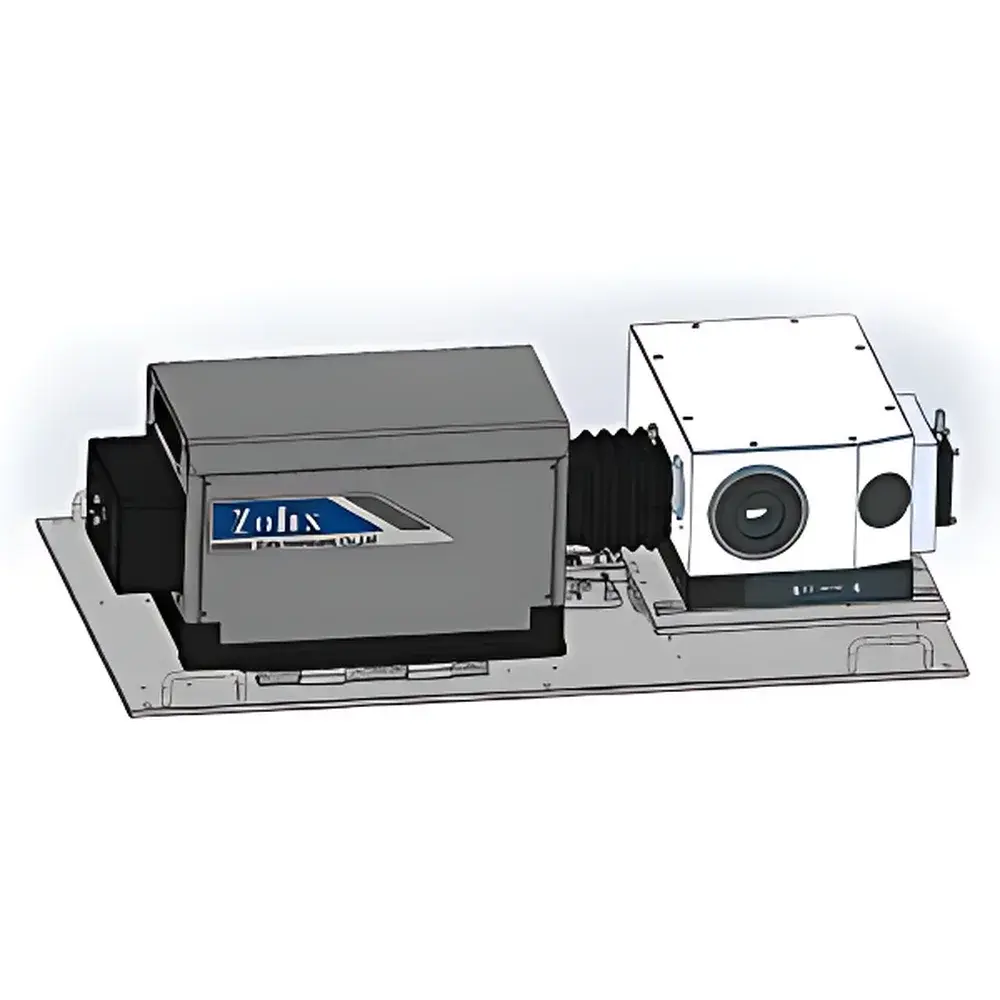
ZOLIX Ultrafast Time-Resolved Spectroscopy System
| Brand | ZOLIX |
|---|---|
| Origin | Beijing, China |
| Manufacturer Type | Authorized Distributor |
| Product Category | Domestic |
| Model | Ultrafast Time-Resolved Spectroscopy System |
| Pricing | Upon Request |
| Spectral Range | 200–900 nm (UV-VIS-NIR) |
| Temporal Resolution | ≤5 ps |
| Lifetime Measurement Range | 50 ps – 100 µs |
| Spectral Resolution | <0.1 nm |
| Single-Shot Spectral Coverage | ≥200 nm |
| Operation Modes | Steady-State Spectra, Transient Absorption Imaging, Time-Resolved Fluorescence Decay, Striped Streak Camera-Based Detection |
| Core Components | Imaging Spectrograph, Streak Camera Detector, Precision Coupling Optics, Integrated Control & Data Processing Software |
Overview
The ZOLIX Ultrafast Time-Resolved Spectroscopy System is a high-performance, modular instrumentation platform engineered for sub-picosecond temporal resolution and broad spectral coverage across the ultraviolet, visible, and near-infrared (200–900 nm) domains. It operates on the principle of optical streak imaging—where ultrafast photonic events are converted into spatially resolved intensity distributions on a phosphor screen via time-dependent electron deflection in a high-voltage electrostatic field. This enables direct mapping of the temporal axis onto the spatial coordinate of the detector plane with ≤5 ps instrument response function (IRF), making it suitable for investigating non-equilibrium carrier dynamics, femtosecond-scale photoinduced processes, and transient luminescence phenomena in advanced optoelectronic materials.
The system integrates a precision imaging spectrograph (with selectable focal lengths from 200 mm to 750 mm and grating configurations up to 1200 l/mm), a gated streak camera with thermoelectrically cooled sCMOS readout, and a fully synchronized optical coupling architecture. Its design supports both single-shot and multi-scan acquisition modes, accommodating pump-probe, fluorescence upconversion, and wide-field transient absorption geometries. The platform conforms to fundamental requirements for time-resolved photophysics research under controlled laboratory environments and is compatible with cryogenic stages, confocal microscopes, and external ultrafast laser sources (e.g., Ti:sapphire oscillators/amplifiers, OPA systems).
Key Features
- Sub-5 ps instrumental time resolution validated with autocorrelation and fluorescence lifetime standards
- Simultaneous acquisition of full transient spectra (≥200 nm per shot) with <0.1 nm spectral resolution using optimized 1200 l/mm gratings
- Modular spectrograph options: Omni-λ2002i (F/3.5, 0.3 nm res.), Omni-λ3004i (F/4.2, 0.1 nm), Omni-λ5004i (F/6.5, 0.08 nm), Omni-λ7504i (F/9.7, 0.05 nm)
- Flexible input coupling: fiber port, standard fluorescence cuvette holder, lens-based collection, or confocal microscope interface
- Dual-stage image intensifier with P43 phosphor and gated MCP for signal amplification and temporal gating
- Integrated control software supporting real-time parameter adjustment, delay-line synchronization, and hardware-triggered acquisition
- Thermoelectrically cooled sCMOS sensor with 16-bit digitization, low read noise (80 dB dynamic range
Sample Compatibility & Compliance
The system accommodates solid-state thin films (e.g., perovskite photovoltaics, 2D TMDCs), liquid-phase colloidal quantum dots, organic semiconductor blends, and gas-phase plasma emissions. Sample interfaces include standard cuvettes, vacuum-compatible sample chambers, cryostat-mounted holders (4–300 K), and probe station integration for in-situ electrical biasing. All optical paths comply with ISO 10110 surface quality standards; mechanical components meet RoHS directives. Data acquisition workflows support audit-trail logging and metadata embedding per GLP/GMP-aligned documentation practices. While not FDA 21 CFR Part 11 certified out-of-the-box, the software architecture permits configuration for regulated environments through user-defined electronic signatures and access controls.
Software & Data Management
The proprietary Omni-SpectraTR software provides unified control of spectrograph motorization, streak camera gate timing, delay stage positioning, and detector exposure. It supports batch-mode acquisition, spectral calibration via Hg/Ne lamp references, and lifetime decay fitting using nonlinear least-squares algorithms (Levenberg-Marquardt) with mono-/bi-/tri-exponential models. Export formats include HDF5 (with embedded timestamps and instrument metadata), ASCII, and MATLAB-compatible .mat files. Image processing includes background subtraction, dispersion correction, spatial binning, and kinetic trace extraction along user-defined spectral windows. Optional plugins enable correlation with TCSPC datasets (via RTS2/FLIM modules) and transient absorption kinetics modeling (TAM900 integration).
Applications
- Ultrafast photoluminescence decay in metal-halide perovskites and quantum-confined nanostructures
- Carrier thermalization, trapping, and recombination dynamics in semiconductor heterojunctions
- Time-resolved Raman spectroscopy of coherent phonon generation in chalcogenides
- Transient absorption imaging of exciton diffusion and charge separation in OPV active layers
- Plasma emission kinetics in pulsed discharge devices and laser-induced breakdown spectroscopy (LIBS)
- Fluorescence lifetime mapping in biological tissue phantoms under fs-pulse excitation
- Characterization of scintillator afterglow and radiation damage kinetics in fast neutron detectors
- Synchronization with free-electron laser (FEL) pulses for XUV-pump/VIS-probe experiments
FAQ
What laser repetition rates are supported?
The system accepts single-shot to 1 kHz pulse trains; higher repetition rates require pulse picking or cavity-dumping synchronization.
Can the system be upgraded for mid-IR detection?
Yes—by integrating a ZnSe-coated grating and InSb-based streak tube (optional retrofit, requires optical redesign).
Is vacuum compatibility available for the streak camera module?
Standard configuration operates at 10⁻⁵ mbar; UHV-compatible versions (10⁻⁹ mbar) are available upon request.
How is spectral calibration performed?
Using built-in Hg/Ne spectral lamp reference with automated peak detection and polynomial fitting (3rd–5th order).
Does the software support third-party data import (e.g., from TCSPC instruments)?
Yes—CSV and binary formats from Becker & Hickl, PicoQuant, and Horiba systems can be imported and co-plotted with streak data.






