
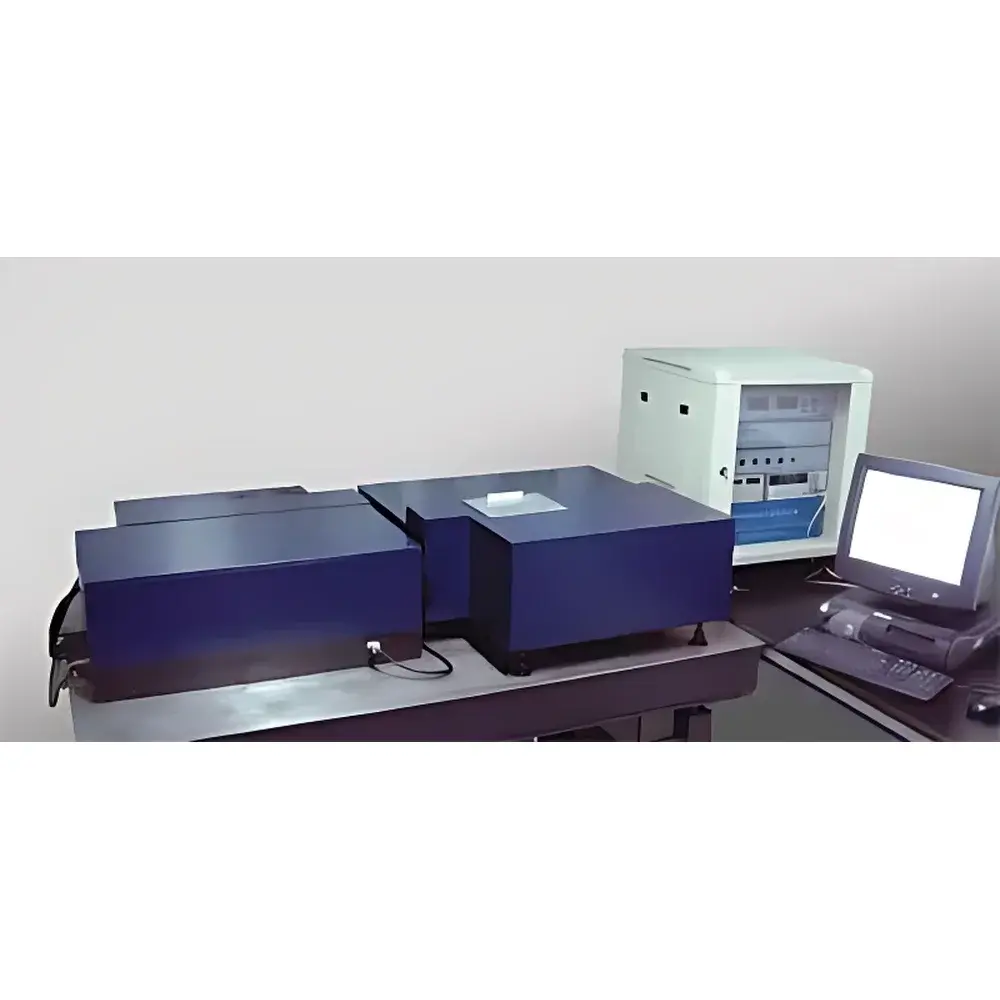
ZOLIX ZW UV-Vis Spectrophotometer Calibration Standard System
| Brand | ZOLIX |
|---|---|
| Origin | Beijing, China |
| Manufacturer Type | Manufacturer |
| Product Origin | Domestic (China) |
| Model | ZW |
| Pricing | Upon Request |
Overview
The ZOLIX ZW UV-Vis Spectrophotometer Calibration Standard System is a primary reference instrument engineered for national metrological traceability in optical density and spectral transmittance measurements. Designed and developed in collaboration with the National Institute of Metrology (NIM), China, this system serves as a national standard for calibrating routine UV-Vis spectrophotometers used in regulatory laboratories, pharmaceutical QC, materials science, and reference material certification. It operates on a single-beam optical architecture with collimated illumination geometry—samples are mounted vertically within a parallel light path to enable high-fidelity transmittance (T%) measurement across the full 200–850 nm spectral range. The core optical design integrates dual monochromators with 750 mm focal length and large-format 110 mm × 110 mm ruled gratings, delivering exceptional wavelength resolution, low stray light (< 5 × 10⁻⁹), and high photon throughput via high-numerical-aperture (NA) non-spherical optics. Wavelength accuracy is maintained at ±0.05 nm with repeatability better than ±0.005 nm—meeting stringent requirements for ISO/IEC 17025-accredited calibration labs.
Key Features
- Dual-monochromator optical train with 750 mm focal length and two independent 110 mm × 110 mm blazed gratings for ultra-low stray light and enhanced spectral purity
- Automated wavelength scanning with precision stepper-motor-driven grating rotation and real-time encoder feedback
- Integrated multi-source lamp compartment: deuterium lamp (UV), tungsten-halogen lamp (VIS), mercury calibration lamp (wavelength reference), and alignment laser (beam path optimization)
- Motorized sample stage with programmable insertion/ejection into the collimated beam path—enabling repeatable positioning and minimizing mechanical drift
- Configurable optical elements: Glan-Thompson polarizers (for polarization-dependent transmittance verification), dual-aperture linearity check module, motorized variable iris (adjustable beam diameter), and vacuum-compatible shutter for dark-signal subtraction
- Non-spherical mirror optics throughout the beam path to minimize aberrations and improve spot homogeneity and imaging fidelity
Sample Compatibility & Compliance
The ZW system is optimized for flat, rigid, optically homogeneous reference standards—including certified neutral density filters, NIST-traceable transmittance reference plates, and optical density calibration slides. Sample dimensions up to Ø50 mm or 25 mm × 25 mm are accommodated with precision kinematic mounting. All optical and mechanical subsystems conform to ISO 6944 (spectrophotometer performance testing), ISO 9022-3 (optical instruments—environmental testing), and support compliance with GLP and GMP documentation requirements. Data acquisition and parameter logging meet audit-trail criteria compatible with FDA 21 CFR Part 11 when deployed with validated software configurations. The system’s uncertainty budget for transmittance measurement is rigorously characterized and documented per ISO/IEC Guide 98-3 (GUM), yielding expanded relative uncertainty (k=2) ≤ 0.05% T across the operational range.
Software & Data Management
The ZW system is controlled via a modular, Windows-based software suite comprising three tightly integrated modules: (1) Spectrometer Control Engine (SCE) for monochromator positioning, lamp selection, shutter actuation, and detector gain management; (2) Filter Wheel Manager (FWM) for synchronized filter selection during multi-wavelength or order-sorting sequences; and (3) Data Acquisition & Analysis Platform (DAAP), which acquires raw photodiode signals, applies calibrated responsivity corrections, computes T%, logs metadata (wavelength, slit width, integration time, lamp status, ambient temperature), and exports results in CSV, XML, and PDF formats. All measurement parameters—including calibration coefficients, lamp usage hours, and positional encoder logs—are automatically timestamped and archived. DAAP supports batch processing, statistical reporting (mean, SD, CV%), and direct printing of calibration certificates compliant with ISO/IEC 17025 Annex A.2.
Applications
- Primary calibration of UV-Vis spectrophotometers in national metrology institutes and accredited calibration laboratories
- Verification and validation of optical density standards (e.g., SRM 2031, SRM 2065) used in pharmaceutical dissolution testing and photometric assay development
- Stray light characterization and linearity assessment of commercial spectrophotometers per ASTM E275 and ISO 6223
- Development and certification of custom reference materials requiring sub-0.1% T uncertainty
- Research in optical thin-film metrology, where precise transmittance spectra under defined polarization states are required
- Supporting interlaboratory comparison studies organized under APMP or BIPM frameworks
FAQ
What is the primary metrological role of the ZW system?
It functions as a national-level reference standard for spectral transmittance, providing traceability to SI units through direct comparison with primary radiometric standards.
Can the ZW system measure reflectance or absorbance directly?
No—it is configured exclusively for absolute transmittance (T%) measurement in transmission geometry; reflectance requires auxiliary integrating sphere accessories not included in the base configuration.
Is the software compliant with FDA 21 CFR Part 11 for regulated environments?
Yes—the DAAP module supports electronic signatures, audit trails, and user-access controls when installed on validated Windows OS platforms meeting IQ/OQ/PQ requirements.
What maintenance intervals are recommended for lamp sources and gratings?
Deuterium lamps require replacement every 1,000–1,200 operating hours; tungsten-halogen lamps every 2,000 hours; grating cleaning and alignment verification are recommended annually or after mechanical shock events.
Does the system support external trigger synchronization with third-party detectors or data loggers?
Yes—via TTL-compatible digital I/O ports (BNC), enabling hardware-triggered acquisition and external event logging in time-resolved applications.





