
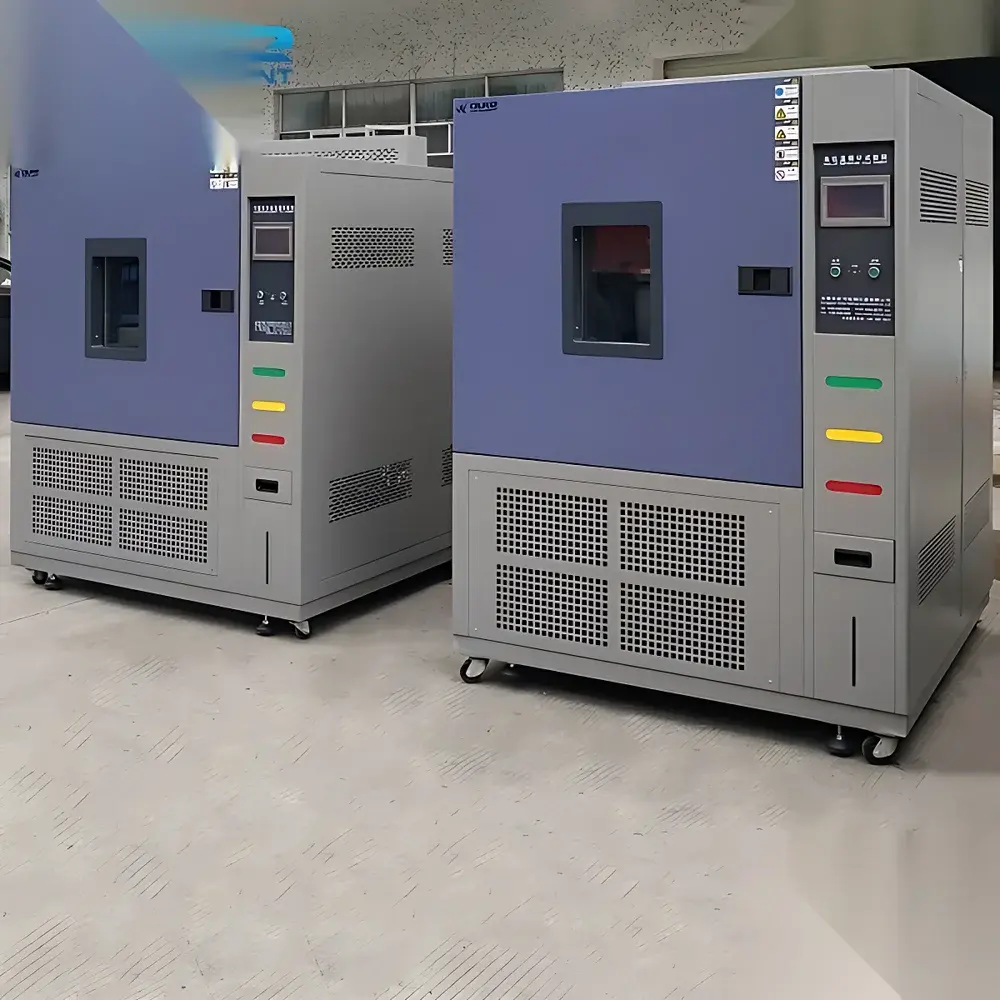
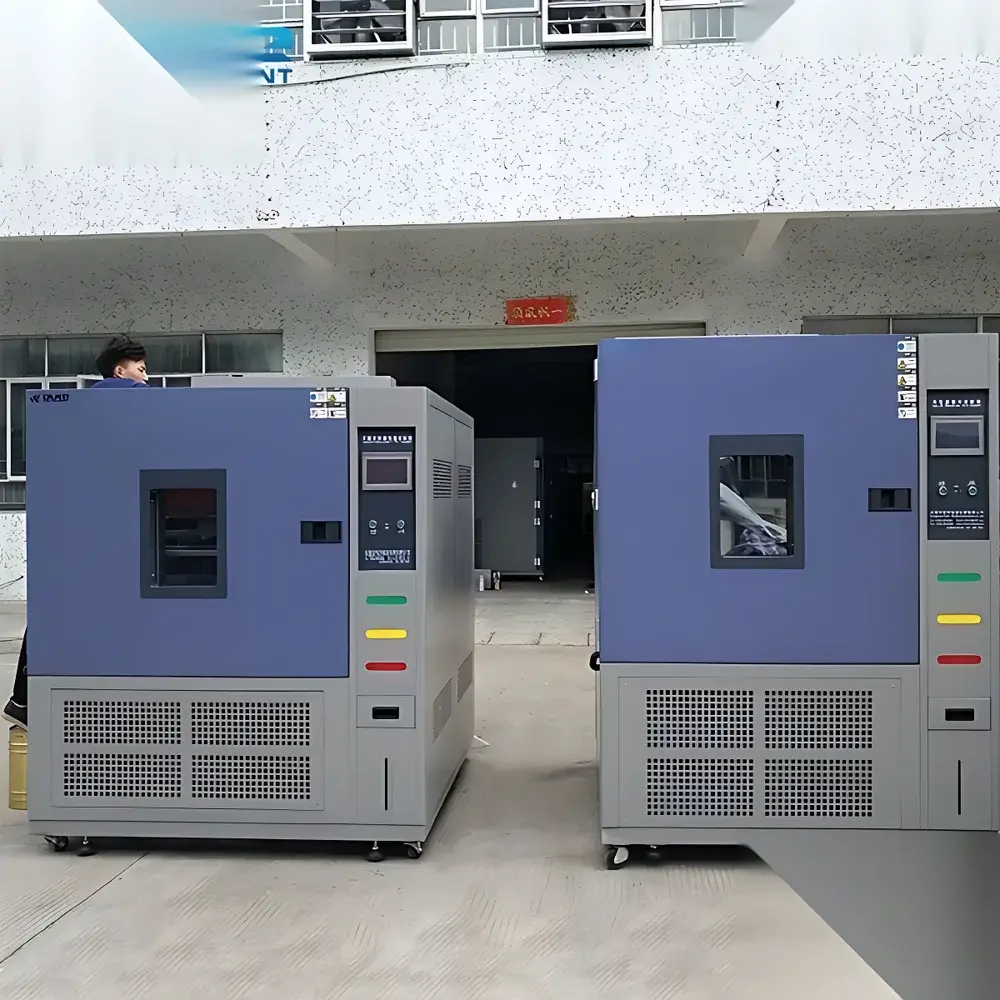
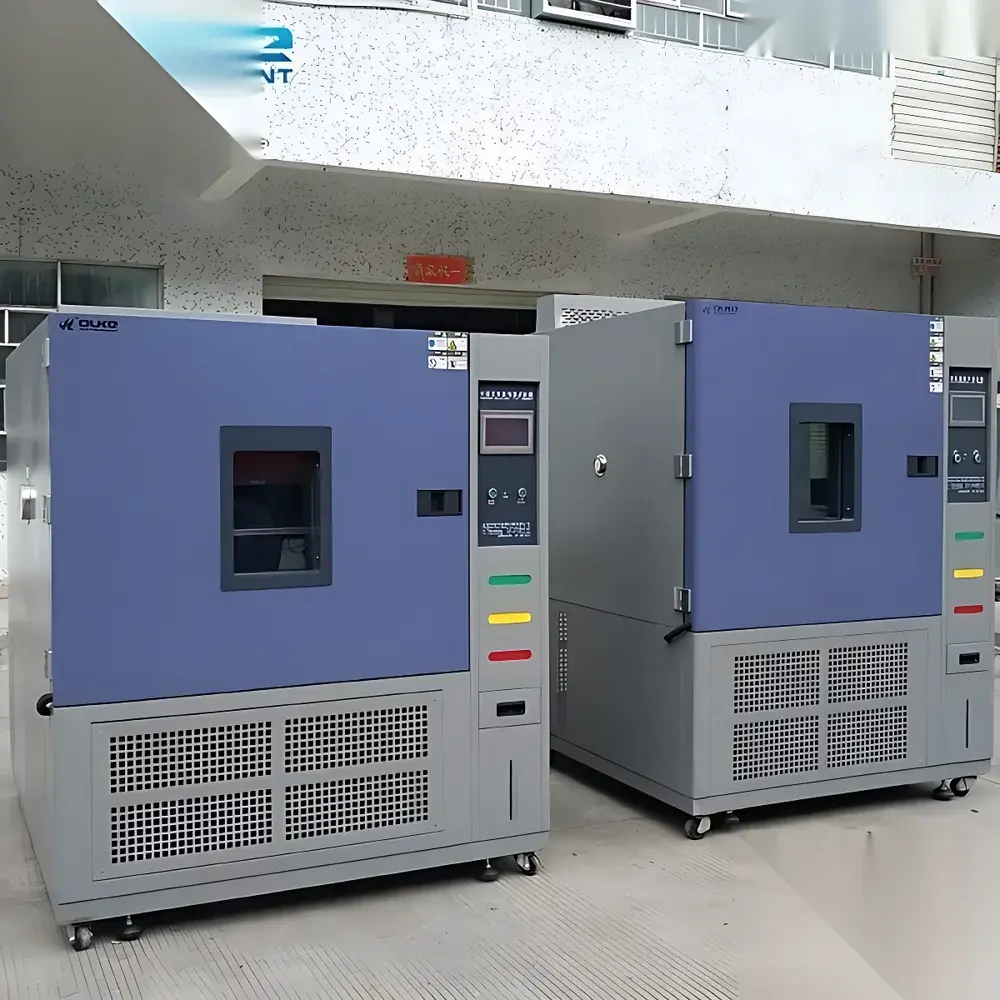
Three-Zone Temperature and Humidity Controlled Environmental Test Chamber
| Brand | OEM / Custom-Built |
|---|---|
| Origin | Imported |
| Manufacturer Type | Authorized Distributor |
| Temperature Range | –40 °C to +150 °C (optional down to –120 °C) |
| Humidity Range | 30–98% RH (optional 5–98% RH) |
| Temperature Resolution | 0.01 °C |
| Humidity Resolution | 0.1% RH |
| Temp. Uniformity | ±0.5 °C |
| Temp. Deviation | ≤±2 °C |
| Humidity Deviation | ≤±2.5% RH |
| Heating Rate | 2.0–3.0 °C/min |
| Cooling Rate | 0.7–1.0 °C/min |
| Control System | TEMI880 Color LCD Touchscreen Programmable Controller |
| Power Supply | 380 V ±5%, 50 Hz, 3P+N+G |
| Inner Chamber Material | SUS304 Stainless Steel |
| Compliance | GB/T 5170.2, GB/T 5170.5, GB 2423.1, GB 2423.2, GB 2423.22, GB 10589, GB 10592, GB 11158 |
Overview
The Three-Zone Temperature and Humidity Controlled Environmental Test Chamber is an engineered environmental simulation system designed for precise, repeatable, and traceable evaluation of material and component behavior under controlled thermal and hygrothermal stress conditions. Unlike single- or dual-zone chambers, this tri-compartment architecture enables independent control of pre-conditioning, transition, and test zones—facilitating rigorous temperature cycling, humidity ramping, and dwell protocols per IEC 60068-2 and MIL-STD-810H methodologies. The chamber operates on a forced-air convection principle with multi-stage refrigeration (cascade system for sub-zero operation), PID-controlled electric heating, and steam-based humidification with dehumidification via cooling coil and desiccant-assisted drying. Its core function is to replicate real-world environmental exposure profiles—including rapid thermal transients, sustained high-humidity aging, and combined temperature/humidity stress—to assess reliability, dimensional stability, seal integrity, coating adhesion, and electrical insulation performance across electronics, automotive components, polymers, pharmaceutical packaging, and aerospace assemblies.
Key Features
- Tri-zone modular design enabling simultaneous conditioning, transition, and testing—reducing cycle time and eliminating cross-contamination between thermal states.
- Cascade refrigeration system with environmentally compliant R404A/R23 mixed refrigerants, certified for stable operation down to –120 °C (optional configuration).
- TEMI880 programmable controller featuring 7-inch color TFT-LCD touchscreen, USB data export, real-time trend graphing, and up to 100 programmable test profiles with 999 segments per profile.
- SUS304 stainless steel interior chamber (fully welded, electropolished finish) and corrosion-resistant exterior (SUS304 or powder-coated A3 steel), ensuring long-term structural integrity and cleanroom-compatible hygiene.
- Integrated water-cooled condenser requiring inlet water at 10–28 °C and 0.1–0.3 MPa pressure—optimized for consistent cooling performance in ambient temperatures up to 35 °C.
- Compliance-ready hardware architecture: RS485 Modbus RTU interface, optional Ethernet/IP support, and audit-trail-capable event logging aligned with GLP/GMP documentation requirements.
Sample Compatibility & Compliance
The chamber accommodates samples up to 1,500 mm (W) × 1,200 mm (D) × 1,800 mm (H), with customizable internal dimensions available upon request. It supports standard test specimens including PCB assemblies, lithium-ion battery modules, medical device housings, optical lenses, and elastomeric gaskets. All performance specifications—including temperature uniformity (±0.5 °C), humidity deviation (≤±2.5% RH), and ramp rates—are verified per GB/T 5170.2 (temperature) and GB/T 5170.5 (humidity), equivalent to ISO 16750-4 and ASTM E145-22 calibration procedures. The system meets the essential safety and electromagnetic compatibility requirements of IEC 61000-6-2/6-3 and is CE-marked for use within EU regulatory frameworks. Optional IQ/OQ documentation packages are available to support FDA 21 CFR Part 11–compliant validation in regulated manufacturing environments.
Software & Data Management
The TEMI880 controller provides native data logging at user-selectable intervals (1s to 60min), storing ≥10,000 hours of timestamped temperature/humidity readings with automatic overwriting protection. Export formats include CSV and Excel-compatible .xls files via USB flash drive. Remote monitoring and alarm notification (via email/SMS through optional gateway module) enable unattended operation. For enterprise integration, the chamber supports OPC UA server functionality (add-on) and SCADA-compatible Modbus TCP communication. All logged data includes operator ID, profile name, segment number, and deviation flags—ensuring full traceability required under ISO/IEC 17025 and GxP quality systems. Calibration certificates (NIST-traceable sensors) and uncertainty budgets are provided with each unit shipment.
Applications
- Accelerated life testing of electronic enclosures under cyclic humidity ingress (e.g., IPC-9701 compliance verification).
- Thermal shock evaluation of solder joints and BGA interconnects using multi-zone step-and-soak profiles.
- Stability testing of sterile barrier systems (ISO 11607) under 40 °C/75% RH and 25 °C/60% RH conditions.
- Material coefficient of thermal expansion (CTE) characterization via controlled linear ramping with in-situ strain gauge interfacing.
- Validation of HVAC filter media performance under high-humidity loading per ISO 16890.
- Automotive component qualification per GMW14872, Ford CETP 00.00-L-467, and VW 80101 climatic endurance protocols.
FAQ
What does “three-zone” mean in this context?
It refers to physically separate compartments: one for pre-conditioning (e.g., low-temperature soak), one for rapid transition (thermal shock zone), and one for stabilized test exposure—enabling true thermal shock testing without mechanical movement of samples.
Can this chamber meet MIL-STD-810G Method 502.6 (low temperature) and Method 507.5 (humidity)?
Yes—when configured with –55 °C minimum capability and 5–98% RH range, it satisfies the environmental profile execution requirements; final compliance depends on site-specific validation per MIL-HDBK-340.
Is the humidity system capable of condensation control during rapid cooldown?
Yes—the integrated dew-point monitoring and dynamic dehumidification logic prevent uncontrolled condensation during ramp-down phases, critical for moisture-sensitive optoelectronic assemblies.
How is temperature uniformity validated across the working volume?
Per GB/T 5170.2, nine calibrated PT100 sensors are placed in a 3×3 grid at center height; uniformity is reported as maximum deviation from setpoint across all points during steady-state operation.
Does the system support automated reporting for ISO/IEC 17025 accreditation?
Yes—audit logs, calibration records, and raw test data exports comply with Clause 7.7 (Results Reporting) and Annex A.2 (Measurement Uncertainty) when used with documented SOPs and trained personnel.



