
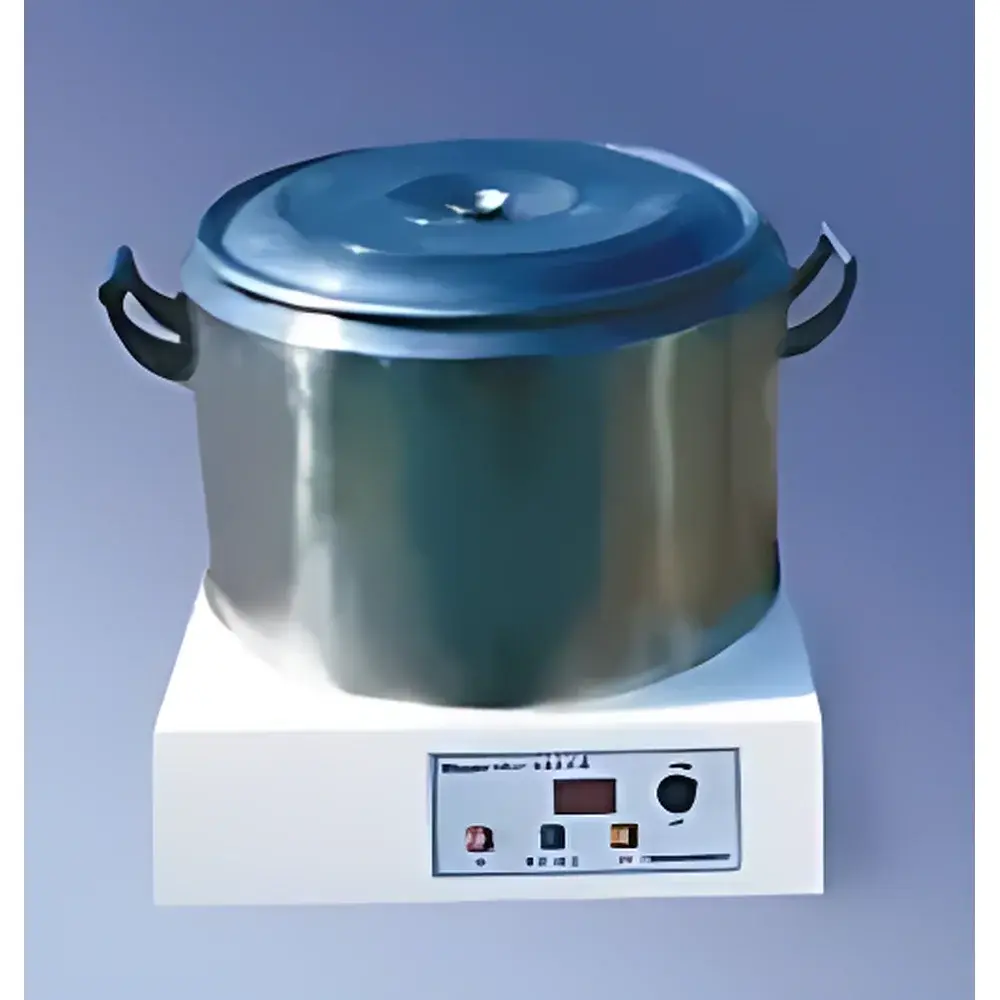
ZSQ-10 Constant-Temperature Oil Bath Circulator
| Origin | Shanghai, China |
|---|---|
| Manufacturer Type | Authorized Distributor |
| Origin Category | Domestic (China) |
| Model | ZSQ-10 |
| Quotation | Upon Request |
| Temperature Range | Ambient to 200 °C |
| Temperature Control Accuracy | ±2 °C |
| Chamber Volume | 32 L |
| Inner Chamber Dimensions | Ø400 × 260 mm |
| External Dimensions | 535 × 470 × 430 mm |
| Power Consumption | 2000 W |
| Bath Medium | Heat Transfer Oil (Oil Bath Mode Only) |
| Operation Mode | Continuous |
| Display | Backlit LCD with Real-Time Parameter Monitoring |
| Key Features | Microprocessor-Based PID Control, Acoustic-Optic Alarm System, Low-Level & Dry-Burn Protection, Power-Fail Resume Function, Parameter Locking & Memory Retention, 100-Hour Timer |
Overview
The ZSQ-10 Constant-Temperature Oil Bath Circulator is a precision thermal management instrument engineered for stable, uniform, and controllable heating of samples immersed in heat-transfer oil. Unlike water baths limited to ≤100 °C, the ZSQ-10 operates across an extended temperature range from ambient up to 200 °C—enabling applications requiring elevated thermal stability without phase transition risks. Its core architecture integrates a high-efficiency 2000 W heating element, a high-response platinum resistance temperature sensor (PT100-class equivalent), and a microprocessor-driven PID control algorithm to maintain thermal equilibrium within ±2 °C across the full 32 L working chamber. Designed for continuous-duty laboratory operation, the unit features a seamless stainless-steel inner tank (Ø400 × 260 mm) resistant to thermal degradation and chemical exposure typical of organic solvents and silicone-based oils. The system is not a circulating water bath but a static oil bath with optimized thermal mass and insulation—making it suitable for long-duration incubation, enzymatic reaction studies, sample preheating prior to HPLC or GC injection, and controlled solvent evaporation protocols.
Key Features
- Microprocessor-controlled PID temperature regulation with real-time deviation compensation and auto-tuning capability
- Backlit LCD display showing setpoint, actual bath temperature, timer status, and system alerts simultaneously
- Dual safety protection: low-oil-level detection with audible/visual alarm and hardware-integrated dry-burn cutoff circuitry
- Power-fail resume function—reinstates prior setpoint, timer value, and operational state upon grid recovery
- User-configurable parameter lock to prevent unauthorized modification of critical settings during shared-lab use
- Non-volatile memory retains last-used configuration (temperature, timer, alarm thresholds) across power cycles
- 100-hour programmable timer with auto-shutdown or hold-mode options for unattended overnight experiments
- Ergonomic, streamlined chassis (535 × 470 × 430 mm) with reinforced base and anti-slip feet for benchtop stability
Sample Compatibility & Compliance
The ZSQ-10 accommodates standard laboratory glassware—including 50–500 mL round-bottom flasks, test tubes, culture bottles, and reaction vials—via optional accessory racks or custom-fit immersion holders. Its oil bath configuration supports both open-vessel and sealed-system applications where inert, non-oxidizing thermal transfer is required. While not certified to ISO/IEC 17025 calibration standards out-of-box, the unit meets general-purpose laboratory equipment requirements per GB/T 28027–2011 (Chinese national standard for laboratory heating devices) and aligns with functional expectations under ISO 15190:2020 (laboratory safety management). For GLP/GMP-regulated environments, users may implement periodic verification using NIST-traceable thermometers and documented SOPs for temperature uniformity mapping (e.g., 9-point probe validation at 100 °C and 180 °C).
Software & Data Management
The ZSQ-10 operates as a standalone instrument with no embedded data logging or PC connectivity. All operational parameters are managed locally via the front-panel interface. However, its deterministic behavior—consistent ramp rates, repeatable setpoint holding, and robust alarm response—makes it compatible with external monitoring systems. Laboratories implementing 21 CFR Part 11 compliance may integrate the ZSQ-10 into broader environmental monitoring networks using third-party USB or RS-485 data loggers (e.g., Omega OM-DAQPRO series), provided temperature readings are captured via its analog output port (if equipped) or external PT100 probe input. Audit trails must be maintained separately in accordance with institutional data integrity policies.
Applications
- Pre-warming reagents and solvents prior to chromatographic analysis (HPLC mobile phase conditioning, GC liner equilibration)
- Controlled thermal activation of catalysts and polymerization initiators in synthetic chemistry workflows
- Long-term stability testing of biologics and excipients under accelerated aging conditions (ICH Q1A)
- Enzyme kinetics assays requiring precise thermal control above 100 °C (e.g., thermostable DNA polymerases)
- Calibration of temperature-sensitive sensors and transducers in metrology labs
- Material testing of thermoplastic elastomers and adhesives under sustained thermal load
FAQ
Can the ZSQ-10 be used with water instead of oil?
No. The ZSQ-10 is specifically engineered for oil-bath operation only. Its maximum temperature rating (200 °C) exceeds the boiling point of water, and internal components—including seals and insulation—are rated for hydrocarbon-based thermal fluids—not aqueous environments.
Is the inner chamber compatible with aggressive solvents like chloroform or THF?
The stainless-steel (SUS304) bath vessel offers broad chemical resistance, but prolonged exposure to halogenated or strongly polar aprotic solvents may compromise gasket integrity over time. Consult the included chemical compatibility chart before introducing non-standard media.
Does the unit support external temperature probe feedback for improved accuracy?
The standard configuration lacks an external probe input port. Temperature regulation relies solely on the integrated high-precision sensor located near the heater core. For sample-specific measurement, users must employ independent calibrated probes placed directly in the test vessel.
What maintenance is required for long-term reliability?
Annual inspection of thermal insulation integrity, verification of oil level sensor responsiveness, and cleaning of exterior vents to prevent dust accumulation in the cooling fan assembly are recommended. Oil replacement intervals depend on usage frequency and thermal cycling history—typically every 12–18 months under continuous operation.





