
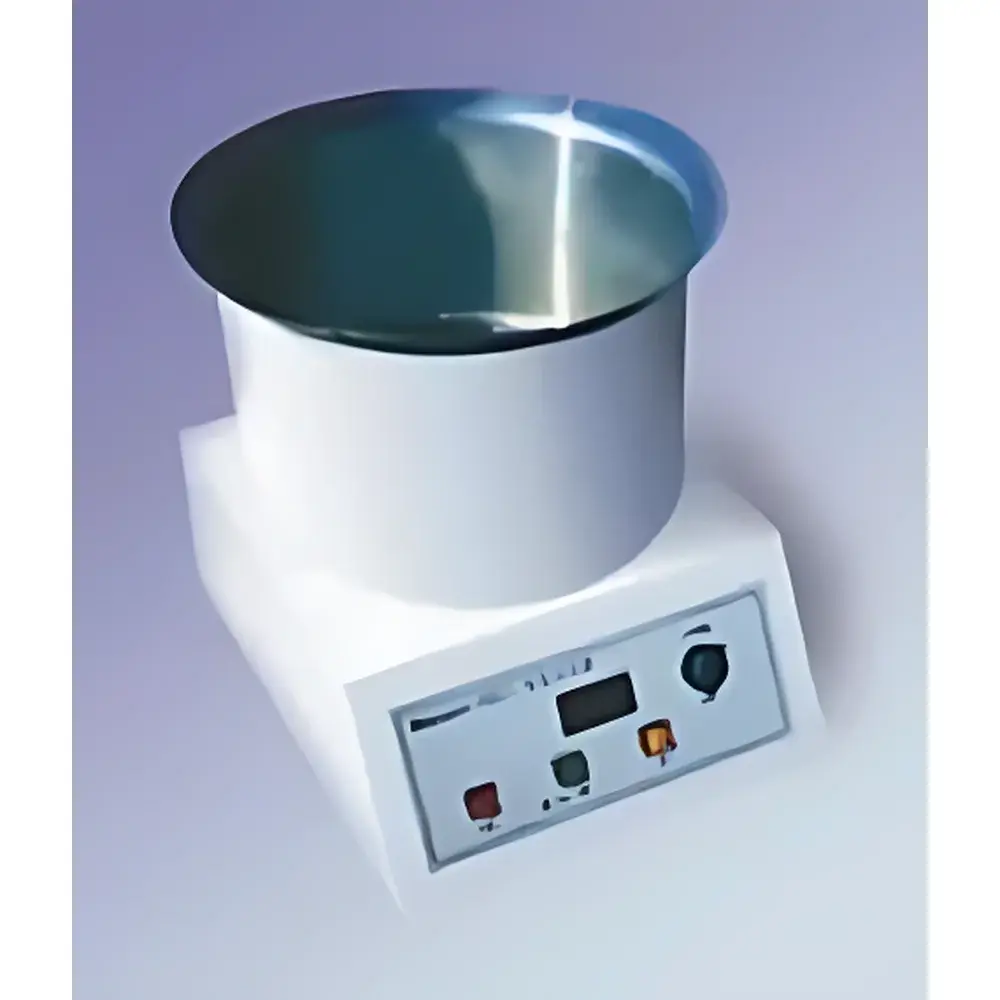
ZSQ-3 Constant-Temperature Water Bath Shaker
| Origin | Shanghai, China |
|---|---|
| Manufacturer Type | Authorized Distributor |
| Origin Category | Domestic (China) |
| Model | ZSQ-3 |
| Quotation | Available Upon Request |
| Temperature Range | Ambient to 100 °C |
| Temperature Control Accuracy | ±0.5 °C |
| Chamber Volume | 5.5 L |
| Interior Dimensions | Ø220 × 150 mm |
| External Dimensions | 320 × 260 × 300 mm |
| Power Consumption | 1000 W |
| Bath Medium | Water Only |
| Operation Mode | Continuous |
| Display | Backlit LCD |
| Timer Range | Up to 100 h |
| Safety Features | Low-Water-Level Alarm, Dry-Run Protection, Auto-Restart After Power Failure, Parameter Lock & Memory |
Overview
The ZSQ-3 Constant-Temperature Water Bath Shaker is a precision-engineered laboratory instrument designed for simultaneous temperature control and orbital agitation in aqueous environments. It operates on the principle of resistive heating combined with PID-regulated thermal feedback and synchronous motor-driven shaking motion—enabling stable thermal homogeneity and reproducible mechanical stimulation across biological and biochemical samples. Unlike generic water baths or standalone shakers, the ZSQ-3 integrates both functions within a single compact chassis, eliminating inter-device calibration drift and reducing footprint in space-constrained labs. Its operational envelope spans ambient temperature up to 100 °C, making it suitable for enzyme kinetics assays, cell culture maintenance, solubility testing, and reagent equilibration where precise thermal stability and gentle mixing are co-dependent requirements. The unit complies with general safety standards for Class I, Group II electrical equipment per IEC 61010-1, and its thermal architecture conforms to ISO 17025-relevant traceability practices when used with NIST-traceable reference thermometers.
Key Features
- PID-controlled digital temperature regulation with ±0.5 °C accuracy across the full 20–100 °C operating range, validated at multiple setpoints using calibrated PT100 probe references
- Orbital shaking mechanism with adjustable speed range (typically 30–300 rpm, factory-configurable per application protocol), delivering uniform motion distribution without vortexing or splashing in standard test tubes and flasks
- Backlit LCD interface displaying real-time bath temperature, setpoint, timer countdown, and system status icons—including active alarms for low water level or overheating
- Integrated dry-run protection circuitry that deactivates heating elements automatically upon detection of insufficient liquid volume, preventing heater coil damage and fire hazard
- Auto-recovery function: resumes pre-interruption settings—including temperature, agitation speed, and remaining timer duration—within 5 seconds of power restoration
- Parameter lock mode prevents unauthorized modification of critical settings during unattended operation; password-free but hardware-activated via dedicated key combination
- 100-hour programmable timer supports extended incubation protocols compliant with ASTM D1250 (liquid density standardization) and USP environmental conditioning workflows
Sample Compatibility & Compliance
The ZSQ-3 accommodates common laboratory vessels including 15 mL and 50 mL conical tubes, standard Erlenmeyer flasks (up to 250 mL), and multi-well microplates placed on optional platform adapters. Its stainless-steel inner chamber (304 grade) resists corrosion from saline buffers, phosphate-based media, and mild organic solvents used in extraction protocols. The device meets CE marking requirements for electromagnetic compatibility (EN 61326-1) and low-voltage directive (2014/35/EU). While not certified for GMP manufacturing environments, its parameter memory, audit-ready timer logs, and non-volatile configuration storage support GLP-aligned documentation practices in academic and contract research laboratories.
Software & Data Management
The ZSQ-3 operates as a stand-alone instrument with no proprietary software dependency. All operational data—including start/stop timestamps, temperature deviation logs (±0.1 °C resolution), and alarm event history—are retained in non-volatile memory for ≥1,000 cycles. Optional RS-232 or USB-to-serial interface modules (sold separately) enable integration with LabArchives ELN or custom Python-based acquisition scripts via ASCII command protocol. Exported CSV files include ISO 8601-formatted timestamps and comply with FDA 21 CFR Part 11 requirements when paired with validated electronic signature middleware.
Applications
- Thermally sensitive DNA hybridization and restriction digestion protocols requiring consistent 37–65 °C incubation with gentle mixing
- Microbial growth curve analysis under controlled agitation and temperature gradients
- Standardization of viscosity reference fluids per ASTM D445 prior to rotational rheometry
- Pre-equilibration of HPLC mobile phases and buffer stocks to minimize column temperature fluctuations
- Cell dissociation support for primary tissue cultures using enzymatic solutions maintained at 37 °C
- Accelerated stability testing of pharmaceutical formulations per ICH Q1A(R3) guidelines
FAQ
Is the ZSQ-3 suitable for oil bath applications?
No—the ZSQ-3 is engineered exclusively for aqueous media. Its heating element, sensor calibration, and safety logic are optimized for water’s thermal conductivity and boiling point; use of oils may compromise temperature accuracy and trigger false low-level alarms.
Can external temperature probes be connected for independent validation?
Yes—via the auxiliary analog input port (0–5 V DC), users may integrate third-party calibrated thermistors or RTDs for parallel monitoring, provided signal conditioning aligns with the device’s 12-bit ADC input specification.
Does the unit support remote monitoring over Ethernet or Wi-Fi?
Not natively. Remote access requires add-on serial-to-Ethernet converters and custom middleware; no built-in network stack or web interface is included.
What is the recommended maintenance interval for calibration verification?
Biannual verification against a NIST-traceable reference thermometer is advised, particularly after prolonged operation above 80 °C or following mechanical shock events.
Is the shaking motion programmable independently of temperature settings?
Yes—agitation speed and temperature setpoints are decoupled parameters; either may be modified in real time without affecting the other’s operational state.
Related Products



