
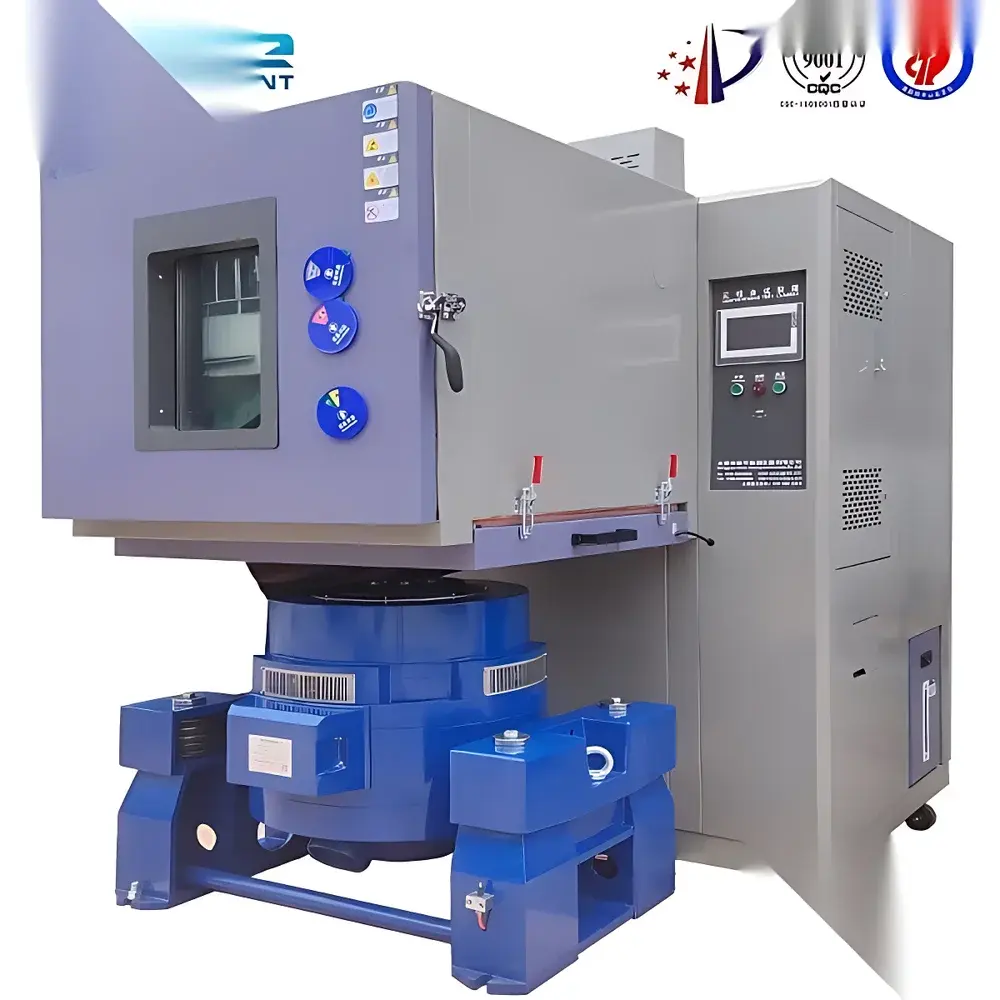
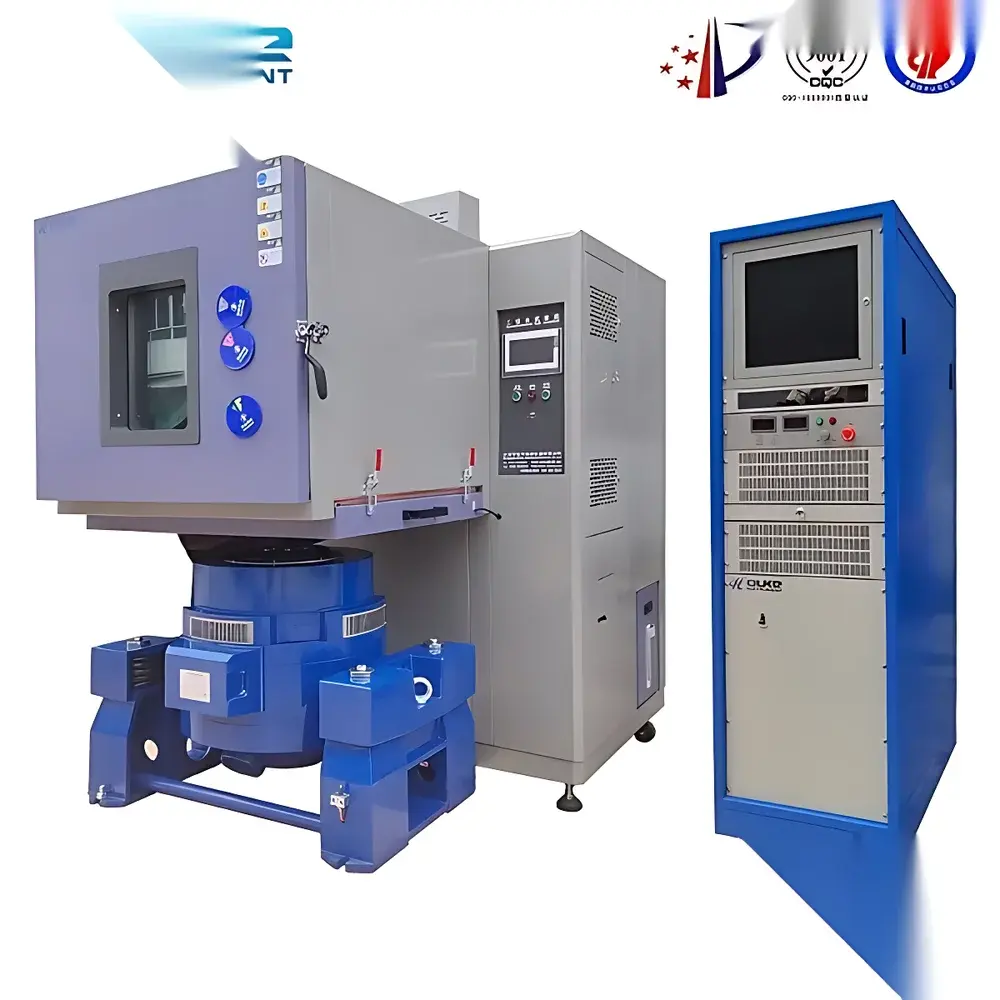
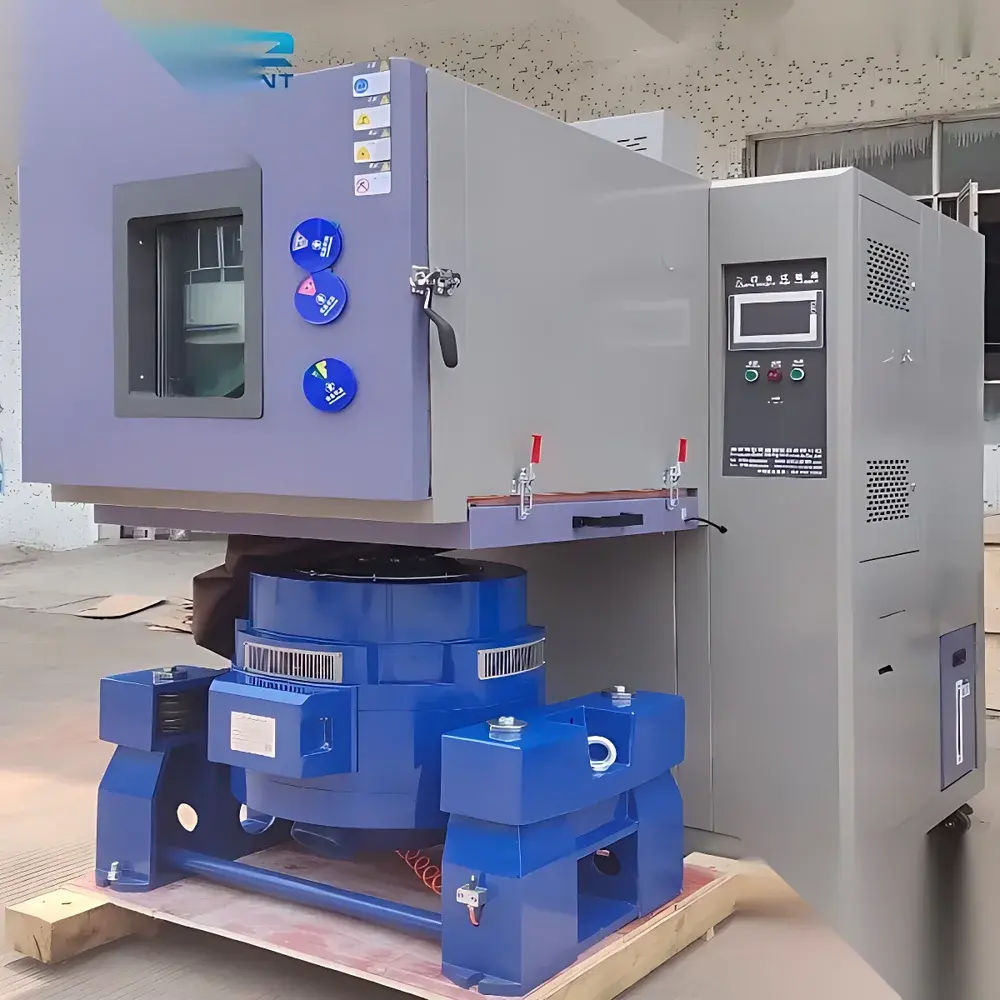
OK-ZTH Series Combined Temperature-Humidity-Vibration Test Chamber
| Temperature Range | -60°C to 150°C |
|---|---|
| Temperature Uniformity | ≤ ±2°C |
| Temperature Fluctuation | ±0.5°C |
| Temperature Deviation | ≤ ±2°C |
| Ramp Rate | 0.7–1.0°C/min |
| Vibration Force (Sine) | 2.94 kN (300 kgf) |
| Frequency Range | 5–500 Hz |
| Max Acceleration | 100 g (980 m/s²) |
| Max Velocity | 1.1 m/s |
| Max Displacement | 25 mm p-p |
| Load Capacity | 120 kg |
| Table Diameter | 150 mm |
| Vibration Axis | Vertical (Z-axis) |
| Test Duration Setting | 0–9999 h |
| Power Supply | AC 380 V / 50 Hz |
| Internal Dimensions (OK-ZTH-225) | 500 × 600 × 750 mm (D×W×H) |
| Internal Dimensions (OK-ZTH-500) | 700 × 800 × 900 mm |
| Internal Dimensions (OK-ZTH-800) | 800 × 1000 × 1000 mm |
| Compliance | GB/T 10592, GB/T 2423.1 (Test A), GB/T 2423.2 (Test B), JJG 190 |
Overview
The OK-ZTH Series Combined Temperature-Humidity-Vibration Test Chamber is an integrated environmental simulation system engineered for rigorous reliability validation of electronic components, aerospace subsystems, automotive ECUs, and military-grade hardware under concurrent thermal and mechanical stress conditions. Unlike sequential or single-stress test setups, this chamber implements true simultaneous three-stress testing—precisely coordinated temperature cycling (from –60°C to +150°C), high-fidelity electrodynamic vibration excitation (5–500 Hz), and optional humidity control (when configured with humidity module)—in accordance with the physical coupling mechanisms observed in real-world operational environments. Its architecture follows the Couette-type thermal-mechanical synchronization principle, where thermal gradients and vibrational strain fields are actively co-regulated via a master-slave control topology. This enables replication of field-relevant failure modes—including solder joint fatigue, interconnect delamination, thermal expansion mismatch cracking, and condensation-induced corrosion—that cannot be elicited by isolated stress application.
Key Features
- Triple-stress synchronization engine with microsecond-level timestamp alignment between thermal ramp profiles and vibration waveform generation
- Dual-refrigeration circuit with cascaded French Tecumseh compressors, enabling stable sub-zero operation down to –60°C without thermal shock or oil migration
- Electrodynamic shaker system featuring ThreeBand voice coil assembly and IMV temperature-compensated excitation coils, delivering rated force up to 2.94 kN (300 kgf) in sine mode
- PID+SSR temperature controller with PT100 Class A platinum RTD sensors, 0.1°C resolution, and auto-tuning capability for load-dependent thermal inertia compensation
- Stainless steel (SUS304) interior chamber with 100–120 mm thick high-density fiberglass insulation and double-layered, conductive-coated tempered glass observation window
- Integrated safety architecture including refrigerant high-pressure cutoff, motor overheat detection, water level monitoring (for optional humidification), and real-time vibration amplitude limiting
- Standard 50 mm diameter feedthrough port on left chamber wall, compatible with shielded signal cables, thermocouple harnesses, or external power feeds
Sample Compatibility & Compliance
The OK-ZTH series accommodates test specimens up to 120 kg mass and 150 mm mounting diameter, supporting standard MIL-STD-810H, DO-160G Section 25, and IEC 60068-2 test configurations. Its internal geometry (available in 225 L, 500 L, and 800 L variants) conforms to ISO 16750-4 for automotive electronics qualification and satisfies the spatial constraints defined in NASA-HDBK-7005 for spacecraft component screening. All thermal and vibrational performance metrics are traceable to national metrology institutes per ISO/IEC 17025 requirements. The system complies with GB/T 10592 (General Technical Conditions for Environmental Test Chambers), GB/T 2423.1 (High-Temperature Testing), GB/T 2423.2 (Low-Temperature Testing), and JJG 190 (Verification Regulation for Vibration Test Systems). Optional configuration supports ASTM D4729 (Thermal Shock with Vibration) and IPC-9701A (Performance Requirements for Solder Interconnections Under Thermal-Mechanical Stress).
Software & Data Management
Control and data acquisition are managed through a dedicated industrial PC running Windows Embedded OS, equipped with dual-channel charge amplifiers, DSP-based real-time vibration controller, and synchronized thermal logging at 10 Hz sampling rate. The software suite supports full-cycle test scripting—including ramp-hold-vibrate sequences, random PSD profile execution (per MIL-STD-810H Method 514.7), classical shock synthesis (half-sine, trapezoidal), and thermal gradient mapping across specimen surfaces. All test logs are stored in HDF5 format with embedded metadata (timestamp, operator ID, calibration certificate IDs, environmental chamber status flags). Audit trails comply with FDA 21 CFR Part 11 requirements when configured with electronic signature modules and role-based access controls. Export options include CSV, MATLAB .mat, and PDF-certified reports with digital signatures.
Applications
This chamber serves as a primary qualification tool for R&D labs and QA departments validating product robustness across mission-critical domains. In aerospace, it replicates launch-phase thermal transients coupled with Pogo vibration spectra. In automotive electronics, it simulates under-hood thermal soak followed by road-induced broadband vibration. For 5G base station RF modules, it verifies thermal management integrity during sustained high-power operation under mechanical resonance conditions. In medical device manufacturing, it supports accelerated life testing of implantable electronics per ISO 14971 risk management protocols. Additionally, it functions as a reference platform for developing physics-of-failure models used in prognostics and health management (PHM) algorithms.
FAQ
Does the system support humidity control?
Humidity functionality is available as an optional upgrade; standard configuration includes only temperature and vibration capabilities.
What is the maximum allowable specimen height inside the chamber?
Maximum specimen height is constrained by the internal chamber height minus 100 mm clearance required for airflow uniformity and shaker stroke margin.
Is remote monitoring supported?
Yes—via secure HTTPS web interface with real-time telemetry, alarm push notifications, and historical trend visualization.
Can the system perform HALT or HASS testing?
While not certified as a dedicated HALT chamber, its thermal ramp rate and vibration envelope meet preliminary screening thresholds specified in EIA-470A and JEDEC JESD22-A110.
What calibration documentation is provided?
Each unit ships with NIST-traceable calibration certificates for temperature sensors, acceleration transducers, and thermal ramp verification—valid for 12 months from commissioning date.



