
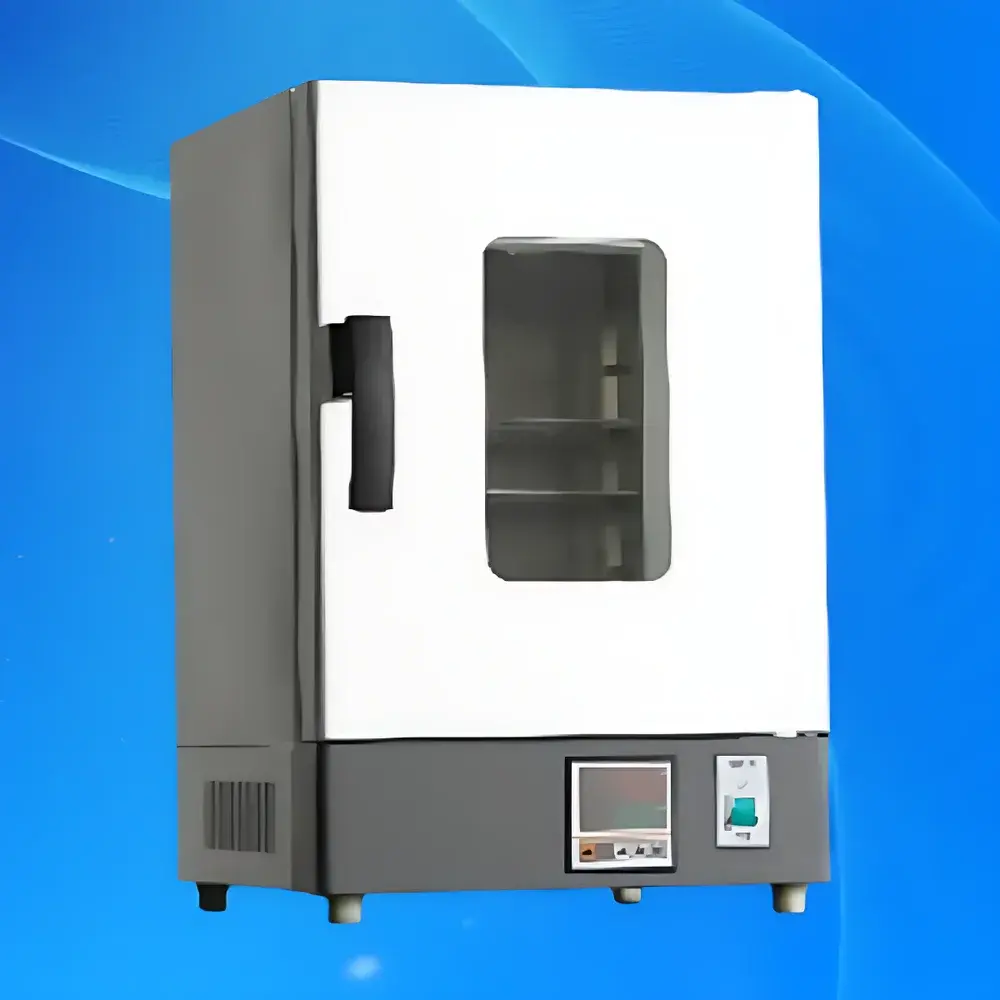
Zuofei DHG-9140A Forced-Air Constant-Temperature Drying Oven
| Brand | Zuofei |
|---|---|
| Origin | Shanghai, China |
| Manufacturer Type | Direct Manufacturer |
| Product Category | Domestic (China-Made) |
| Model | DHG-9140A |
| Instrument Type | General-Purpose Forced-Convection Oven |
| Temperature Range | RT+10 °C to 250 °C |
| Temperature Fluctuation | ±1.0 °C |
| External Dimensions (W×D×H) | 60×76×92 cm |
| Internal Dimensions (W×D×H) | 45×55×55 cm |
| Temperature Resolution | 0.1 °C |
| Operating Ambient Temperature | +5 °C to +40 °C |
| Interior Material | Mirror-Finish Stainless Steel |
| Heating Method | Bottom-Mounted Stainless Steel Electric Heating Elements |
| Temperature Uniformity | ±2.5% (measured at 100 °C) |
Overview
The Zuofei DHG-9140A Forced-Air Constant-Temperature Drying Oven is an industrially engineered benchtop convection oven designed for precise thermal processing in laboratory, quality control, and production environments. It operates on the principle of forced-air convection—using a high-temperature-rated centrifugal blower and optimized duct geometry to circulate heated air uniformly across the chamber. This architecture ensures consistent heat transfer to samples regardless of placement, minimizing thermal gradients that compromise drying kinetics, moisture removal efficiency, or thermal stability testing reproducibility. The unit complies with fundamental design expectations for Class I, Group A laboratory ovens per IEC 61010-1:2010 (Safety Requirements for Electrical Equipment for Measurement, Control, and Laboratory Use), and its construction supports routine operation under GLP-compliant workflows where traceability and environmental consistency are critical.
Key Features
- Microprocessor-based PID temperature controller with dual-line LED display, offering real-time setpoint and actual temperature readout, adjustable timer (1–9999 minutes), and audible over-temperature alarm.
- Robust chamber construction: interior fabricated from electropolished mirror-finish 304 stainless steel; exterior housing formed from cold-rolled steel with powder-coated finish for corrosion resistance and mechanical durability.
- High-efficiency bottom-mounted heating system using seamless stainless steel sheathed heating elements, engineered for long-term thermal cycling stability and minimal oxidation.
- Optimized single-channel forced-air circulation path with adjustable airflow velocity (stepless regulation available as optional configuration), enabling controlled convective heat transfer without turbulence-induced sample displacement.
- Double-layer tempered glass observation window with silicone-sealed frame, permitting non-intrusive visual monitoring while maintaining thermal integrity and operator safety.
- Integrated power recovery logic: automatic resumption of prior operating parameters—including set temperature, remaining timer value, and program stage—following unexpected power interruption or system reset.
- High-performance silicone rubber door gasket rated for continuous operation up to 250 °C, ensuring low-leakage sealing and extended service life with field-replaceable design.
Sample Compatibility & Compliance
The DHG-9140A accommodates standard laboratory glassware (e.g., Petri dishes, weighing bottles, crucibles), metal trays, ceramic substrates, polymer films, and pre-weighed particulate samples within its 136 L internal volume. Its temperature uniformity specification (±2.5% at 100 °C) meets typical acceptance criteria for ASTM E145-22 (Standard Specification for Gravity-Convection and Forced-Ventilation Ovens) and ISO 17025:2017 clause 6.4.3 regarding equipment suitability for assigned tasks. While not certified for hazardous location use (e.g., Class I Division 1), the oven’s electrical architecture conforms to EN 61000-6-3 (EMC emission limits) and EN 61000-6-2 (immunity requirements). Optional independent over-temperature cut-off (up to 280 °C) provides redundancy aligned with risk mitigation strategies required under ISO/IEC 17025 Clause 7.1.2.
Software & Data Management
The base configuration includes analog-digital hybrid control with local data logging capability via optional RS485 interface (Modbus RTU protocol), supporting integration into centralized SCADA or LIMS platforms. When equipped with the optional touchscreen multi-segment programmer, users can define up to 32 programmable steps—including ramp rates, dwell times, and soak temperatures—with full audit trail generation compliant with FDA 21 CFR Part 11 requirements when paired with validated third-party software. Optional thermal printer output provides hard-copy records of temperature profiles, timestamps, and alarm events—facilitating compliance with ISO 9001:2015 clause 8.5.2 (Identification and traceability) and internal SOPs governing calibration and validation documentation.
Applications
- Moisture content determination per AOAC 950.46, USP , and ISO 5518:2022 for food, pharmaceutical, and agricultural commodities.
- Pre-conditioning of test specimens prior to tensile, impact, or dimensional stability evaluation (ASTM D618, ISO 291).
- Thermal aging studies of polymers and composites under controlled isothermal conditions (ASTM D3045, ISO 188).
- Drying of filter papers, gravimetric precipitates, and lyophilized intermediates in analytical chemistry workflows.
- Heat treatment of metallographic samples, sintering aids, and ceramic green bodies during materials R&D.
- Depyrogenation validation support (when operated ≥250 °C for ≥30 min) in conjunction with biological indicator challenge studies.
FAQ
What is the maximum operating temperature, and is it validated at 250 °C?
The DHG-9140A is rated for continuous operation up to 250 °C. Temperature uniformity and stability specifications are verified at multiple points—including 100 °C and 250 °C—during factory calibration using NIST-traceable reference thermometers.
Can this oven be used for sterilization or depyrogenation?
While capable of reaching temperatures sufficient for dry-heat depyrogenation (≥250 °C), the DHG-9140A is not classified as a medical device nor validated per ISO 17665 for steam sterilization. Its use for depyrogenation requires user-defined validation protocols including BI challenge, load mapping, and cycle qualification.
Is the RS485 interface compatible with common laboratory data acquisition systems?
Yes—the Modbus RTU implementation supports direct integration with LabVIEW, MATLAB Data Acquisition Toolbox, and most industrial PLCs when configured with appropriate termination and baud rate settings (default: 9600 bps, 8N1).
How many shelves are included, and what is their weight capacity?
Two adjustable chrome-plated steel shelves are supplied as standard. Each shelf supports up to 15 kg evenly distributed load; maximum total payload is 30 kg.
Does the oven meet electromagnetic compatibility (EMC) requirements for laboratory installation?
Yes—it complies with EN 61000-6-2 (immunity) and EN 61000-6-3 (emissions) for residential, commercial, and light-industrial environments, ensuring stable operation near sensitive instrumentation such as balances and spectrometers.



