
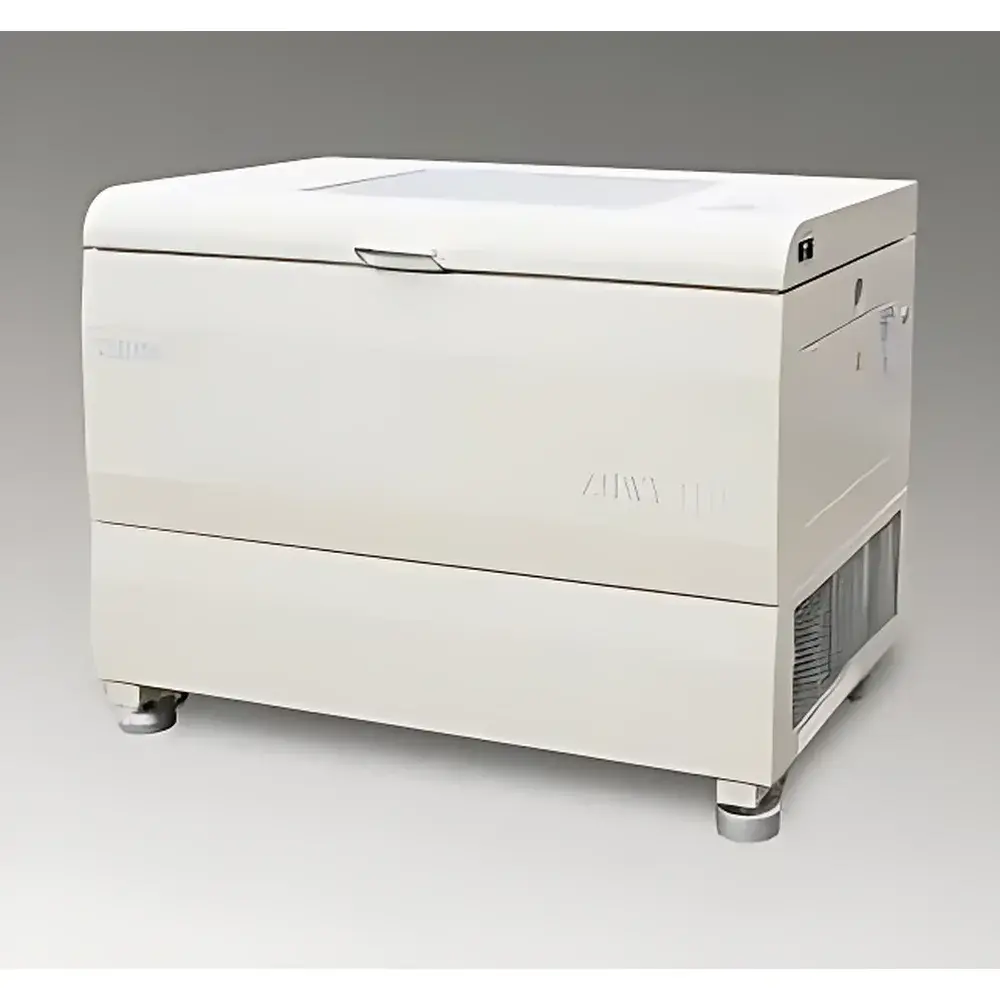
ZWF-211 Reciprocal Large-Capacity Full-Temperature Incubator Shaker
| Origin | Shanghai, China |
|---|---|
| Manufacturer Type | Authorized Distributor |
| Product Origin | Domestic (China) |
| Model | ZWF-211 |
| Pricing | Available Upon Request |
| Temperature Range | 4–60 °C |
| Temperature Uniformity | ≤±1 °C (at 37 °C) |
| Temperature Stability | ≤±0.1 °C (at 37 °C) |
| Temperature Resolution | 0.1 °C |
| Oscillation Mode | Reciprocal (Linear) |
| Speed Range | 30–240 rpm |
| Speed Accuracy | ±1 rpm |
| Stroke Adjustment | 0–50 mm (stepless) |
| Timer Range | 0–500 h |
| Chamber Volume | 284 L |
| Shelf Dimensions | 896 × 530 mm |
| Internal Chamber Dimensions | 975 × 565 × 515 mm |
| Max Load Capacity | 15 × 1000 mL or 6 × 3000 mL flasks |
| Power Consumption | 1380 W |
| Input Voltage | AC 220 V, 50/60 Hz |
| Net Weight | 213 kg |
| Gross Weight | 252 kg |
| External Dimensions | 1200 × 740 × 1070 mm |
Overview
The ZWF-211 Reciprocal Large-Capacity Full-Temperature Incubator Shaker is an engineered platform for scalable bioprocess development and high-throughput cultivation under tightly controlled thermal and mechanical conditions. Designed specifically for fermentation, pharmaceutical process validation, and industrial microbiology applications, this shaker employs a linear reciprocal oscillation mechanism—distinct from orbital or rotary motion—to generate consistent shear profiles ideal for aerobic microbial growth, suspension cell culture, and oxygen-sensitive biochemical reactions. Its 284 L chamber volume supports up to six 3 L flasks or fifteen 1 L vessels simultaneously, enabling seamless transition from lab-scale optimization to pilot-batch production. The unit integrates a PID-controlled microprocessor system with environmental scanning capability, ensuring precise regulation of temperature (4–60 °C) and oscillation parameters across the full operational range. Forced-air convection ensures uniform thermal distribution (≤±1 °C at 37 °C), while a robust AC induction motor delivers maintenance-free, brushless operation with constant torque and speed stability (±1 rpm).
Key Features
- Reciprocal oscillation drive system optimized for high-viscosity cultures and gas-transfer-intensive applications such as recombinant protein expression and antibiotic fermentation
- Large-format incubation chamber (975 × 565 × 515 mm internal) with electrostatically coated steel interior and tempered glass viewing window for real-time process monitoring
- PID-based digital controller with backlit LCD interface displaying setpoints and real-time values for temperature, speed, stroke length (0–50 mm stepless), and remaining time
- Comprehensive safety architecture: overtemperature cutoff (with independent sensor), motor overheat protection, power-failure recovery, and programmable alarm outputs (audible + visual)
- Secure parameter locking function prevents unauthorized modification during GLP/GMP-compliant workflows
- Extended timer (up to 500 hours) with automatic shutdown and alarm activation upon cycle completion
- Gradual acceleration/deceleration profile minimizes sample disturbance during start-up and stop phases—critical for fragile cell aggregates or low-density inocula
Sample Compatibility & Compliance
The ZWF-211 accommodates standard laboratory vessels including Erlenmeyer flasks (100–3000 mL), baffled bottles, and custom bioreactor bags mounted on the single 896 × 530 mm stainless-steel shelf. Its mechanical design complies with IEC 61000-6-3 (EMC emissions) and IEC 61010-1 (safety requirements for laboratory equipment). While not certified to ISO 13485 or FDA 21 CFR Part 11 out-of-the-box, the device supports audit-ready operation when integrated into validated workflows—its parameter memory, event logging (via optional RS-485 or USB data export), and password-protected settings align with ALCOA+ data integrity principles. Temperature performance meets ASTM E122-22 criteria for uniformity assessment in incubated shakers, and thermal stability conforms to USP guidance for biopharmaceutical cultivation systems.
Software & Data Management
Native firmware includes non-volatile memory for storing up to 10 user-defined protocols with recall functionality, eliminating repetitive reconfiguration. Optional communication modules enable connection to LabArchives, Empower, or custom LIMS platforms via Modbus RTU or ASCII serial protocol. All critical events—including temperature excursions, power interruptions, door openings (detected via magnetic switch), and alarm triggers—are timestamped and retained in internal flash memory for ≥30 days. For regulatory submissions, exported CSV logs include metadata fields compliant with 21 CFR Part 11 Annex 11 requirements when paired with qualified third-party software validation packages.
Applications
- Industrial-scale bacterial and yeast fermentation (e.g., E. coli, S. cerevisiae) under controlled dissolved oxygen conditions
- Stability studies of therapeutic proteins and monoclonal antibodies requiring extended incubation with agitation
- Enzymatic reaction kinetics assays where linear shear minimizes denaturation compared to orbital motion
- Seed train expansion for mammalian cell culture processes prior to bioreactor inoculation
- Environmental microbiology testing—including BOD analysis, wastewater treatment simulation, and biofilm formation studies
- Phytochemical extraction optimization using solvent-based shaking protocols at elevated temperatures
FAQ
What distinguishes reciprocal oscillation from orbital shaking in bioprocessing applications?
Reciprocal motion generates laminar fluid displacement along a single axis, reducing turbulent energy input and improving oxygen transfer efficiency in viscous media—making it preferred for high-cell-density fermentations and shear-sensitive organisms.
Is the ZWF-211 suitable for GMP manufacturing environments?
Yes, when deployed within a qualified infrastructure and operated under documented SOPs; its hardware-level parameter locking, event logging, and power-loss recovery support compliance with EU GMP Annex 11 and PIC/S guidelines.
Can the stroke length be calibrated per protocol?
Yes—the 0–50 mm stroke adjustment is digitally encoded and repeatable across cycles, with factory calibration traceable to NIST standards upon request.
Does the unit support external temperature probe integration?
No native port exists, but the chamber’s dual-sensor architecture (control + redundancy) allows third-party PT100 probes to be installed via auxiliary conduit ports for independent verification.
What maintenance intervals are recommended for long-term reliability?
The brushless AC motor requires no scheduled servicing; annual verification of door seal integrity, fan filter cleaning, and thermal sensor calibration is advised per ISO/IEC 17025 maintenance protocols.




