
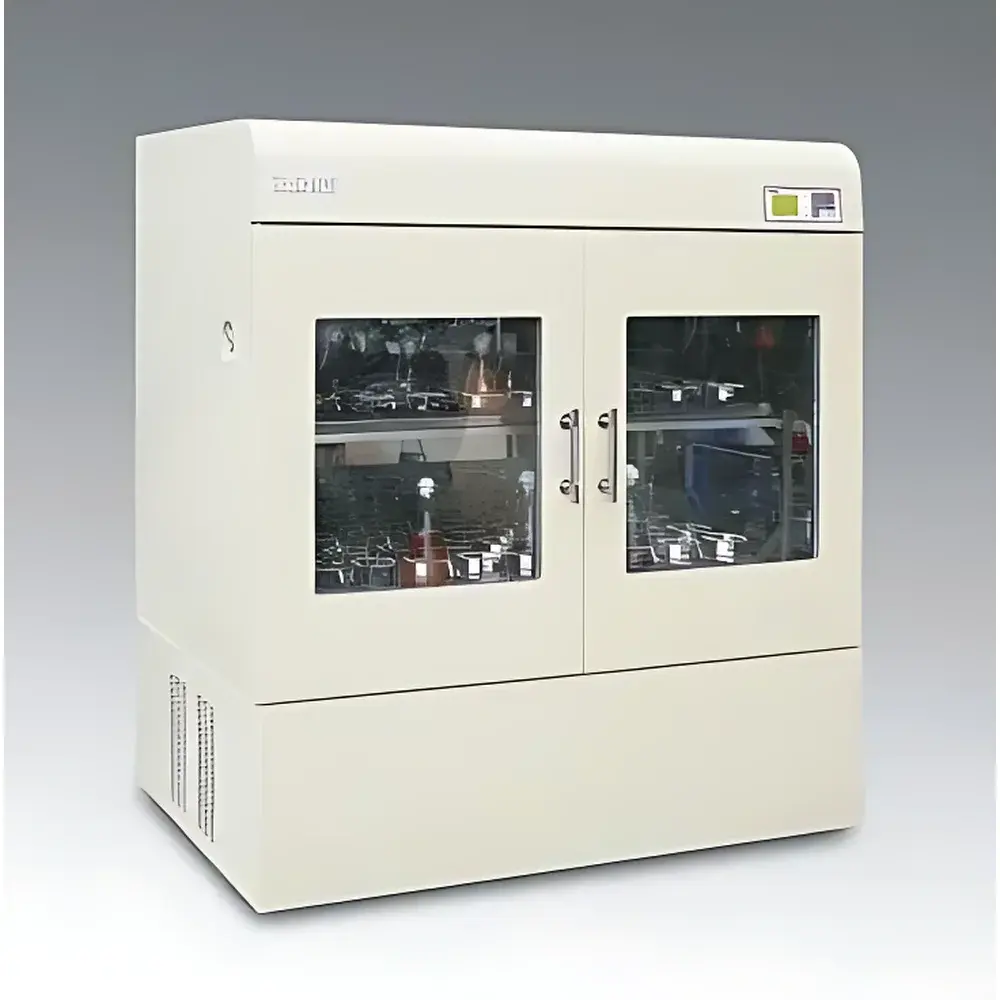
ZWY-A2112B Dual-Layer Programmable Temperature-Controlled Orbital Shaker
| Origin | Shanghai, China |
|---|---|
| Manufacturer Type | Authorized Distributor |
| Origin Category | Domestic (PRC) |
| Model | ZWY-A2112B |
| Pricing | Available Upon Request |
Overview
The ZWY-A2112B Dual-Layer Programmable Temperature-Controlled Orbital Shaker is an engineered platform for precision-controlled microbial cultivation, enzymatic assays, cell suspension culture, and biochemical reaction optimization under tightly regulated thermal and mechanical conditions. Utilizing orbital (circular) motion with forced-air convection and PID-based microprocessor control, the system delivers high reproducibility in temperature maintenance (±0.1 °C at 37 °C) and rotational speed stability (±1 rpm across 30–300 rpm). Its dual-layer design accommodates up to 582 L total internal volume—distributed across two independently accessible stainless-steel decks—enabling parallel experiments with differentiated protocols or scalable culture volumes. The shaker operates within an ambient environment of 5–25 °C and maintains chamber temperatures from 4 °C to 60 °C, supporting both mesophilic and thermotolerant applications without external refrigeration units. Integrated R134a-based air-cooling ensures frost-free operation and automatic refrigeration load modulation, critical for long-term unattended incubation.
Key Features
- Dual independent shaker decks (970 × 560 mm each), constructed from electropolished 304 stainless steel with removable spring-loaded clamps and universal bottle holders
- 6-segment × 12-step programmable logic: supports complex multi-stage protocols including temperature ramping, speed stepping, cyclic oscillation, and hold-to-stability sequences (each segment up to 100 h)
- Backlit LCD interface with real-time display of setpoints and actual values for temperature, speed, time, and program progress
- Comprehensive safety architecture: independent overtemperature cut-off (adjustable), door-open shutdown, leakage current protection, motor overcurrent trip, compressor overload safeguard, and dual-limit deviation alarms (temp/speed)
- Auto-recovery functionality: resumes pre-interruption settings following power loss, including timer continuity and parameter retention
- Water-level monitoring system with audible/visual low-water alert and auto-refill capability to prevent evaporation-induced sample desiccation
- Brushless AC induction motor with constant-torque output, wide-speed range (30–300 rpm), and soft-start acceleration profile to minimize shear stress on sensitive biological samples
- Electrostatically coated steel enclosure with tempered glass double-door access, ergonomic handle design, and corrosion-resistant interior (mirror-finish stainless steel liner)
Sample Compatibility & Compliance
The ZWY-A2112B accommodates standard laboratory vessels—including Erlenmeyer flasks (100–1000 mL), test tubes, and culture bottles—via configurable tray inserts and universal clamping systems. Maximum loading capacity per deck: 164 × 100 mL, 90 × 250 mL, 74 × 500 mL, 52 × 750 mL, or 36 × 1000 mL flasks. All wetted components comply with ISO 8573-1 (compressed air purity) and USP material compatibility guidelines. The device meets IEC 61010-1:2010 safety requirements for laboratory equipment and conforms to electromagnetic compatibility standards EN 61326-1. While not certified for GMP manufacturing environments, its audit-ready features—including parameter encryption, event-logged RS-232 data export, and time-stamped operational records—support GLP-compliant workflows in academic, clinical, and preclinical research settings.
Software & Data Management
The embedded controller supports local data logging via integrated thermal printer (micro-format, built-in), enabling hard-copy traceability of all active parameters and alarm events. RS-232 serial interface enables bidirectional communication with external PCs for remote configuration, real-time telemetry streaming, and batch export of time-series datasets (CSV-compatible). Firmware includes clock-synchronized timestamping, password-protected parameter modification, and non-volatile memory for ≥100 user-defined programs. Calibration offsets (temperature, speed) are stored per-channel and persist through firmware updates. No proprietary software installation is required; ASCII protocol documentation is provided for integration into LIMS or ELN platforms compliant with ASTM E1384 and FDA 21 CFR Part 11 (when paired with validated third-party data acquisition systems).
Applications
This shaker serves as a core platform in microbiology labs for aerobic bacterial growth (e.g., E. coli, Bacillus subtilis), yeast fermentation kinetics, and antibiotic susceptibility testing. In molecular biology, it facilitates plasmid amplification, protein expression in liquid culture, and hybridization buffer agitation. Biopharmaceutical researchers use it for mammalian suspension cell passaging, monoclonal antibody titration studies, and excipient solubility screening. Environmental labs deploy it for BOD assays, bioremediation simulation, and algal biomass propagation. Its precise thermal uniformity (≤±1 °C at 37 °C) and vibration consistency make it suitable for ISO/IEC 17025-accredited testing where inter-laboratory reproducibility is mandated.
FAQ
What is the maximum operating temperature and cooling capability?
The unit maintains temperatures from 4 °C to 60 °C. Cooling is achieved via R134a refrigerant with automatic load regulation; minimum setpoint is 4 °C under ambient conditions ≤25 °C.
Does the shaker support humidity control?
No—humidity regulation is not integrated. For combined temp/humidity applications, consider the ZW-C series variant.
Can I run different programs on each deck simultaneously?
No—the dual decks share a single control system and execute identical temperature and oscillation profiles.
Is the RS-232 interface compatible with modern Windows/macOS systems?
Yes, using standard USB-to-serial adapters and terminal emulation software (e.g., Tera Term, CoolTerm); ASCII command protocol documentation is included.
What maintenance is required for long-term reliability?
Annual verification of temperature/speed calibration is recommended. No motor servicing is needed—brushless design ensures >20,000 hours MTBF. Condensate drain inspection every 6 months is advised in high-humidity environments.




