
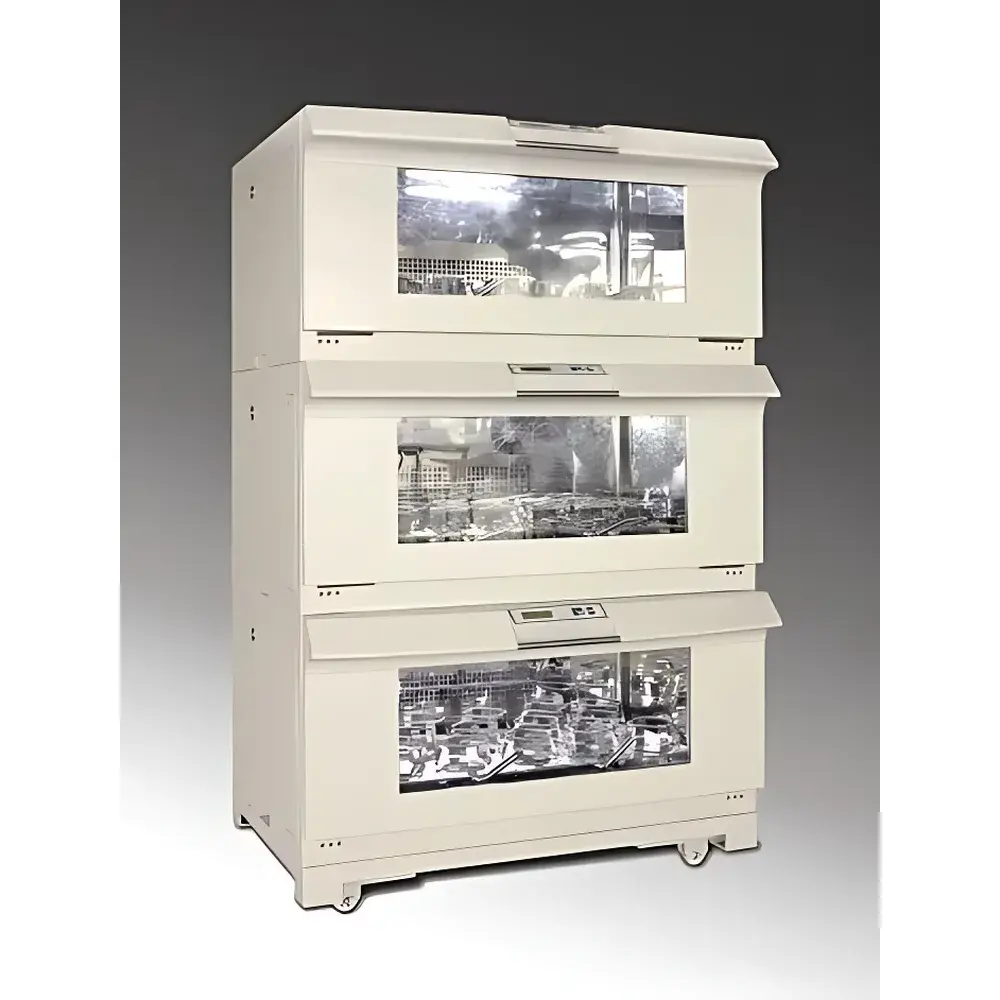
ZWYC-2403 Intelligent Stackable Multi-Chamber Orbital Shaker
| Origin | Shanghai, China |
|---|---|
| Manufacturer Type | Authorized Distributor |
| Origin Category | Domestic (China) |
| Model | ZWYC-2403 |
| Pricing | Available Upon Request |
| Control Method | PID Algorithm via Embedded Environmental Scanning Microprocessor |
| Display | Full-Color TFT Touchscreen |
| Air Circulation | Forced Convection |
| Oscillation Mode | Orbital (Circular) |
| Drive Mechanism | Single-Axis Drive |
| Door Operation | Manual Downward Buffering Lid |
| Ambient Temperature Range | 10–35 °C |
| Chamber Count | 3 |
| Temp. Control Range | 4–60 °C |
| Temp. Resolution | 0.1 °C |
| Temp. Stability | ±0.1 °C at 37 °C |
| Temp. Uniformity | ±1.0 °C at 37 °C |
| Programmable Segments/Steps | 9 segments / 18 steps |
| Timer Range | 0.1–99.9 h |
| Orbital Speed Range | 0–300 rpm |
| Speed Accuracy | ±1 rpm |
| Orbit Diameter Adjustment | Φ0–50 mm (Infinitely Variable) |
| Refrigeration System | Triple-Stage R134a Air-Cooled, Frost-Free, Power-Modulated |
| Acceleration Profile | Soft-Start Ramp Control |
| Shelf Quantity | 3 |
| Tray Dimensions | 800 × 430 mm |
| Chamber Volume per Level | 182 L |
| Internal Dimensions per Level | 920 × 532 × 373 mm |
| External Dimensions | 1100 × 910 × 1980 mm |
| Packaging Dimensions | 1220 × 1030 × 2150 mm |
| Net Weight | 580 kg |
| Gross Weight | 650 kg |
| Rated Power | 3600 W |
| Electrical Supply | AC 220 V, 50/60 Hz |
Overview
The ZWYC-2403 Intelligent Stackable Multi-Chamber Orbital Shaker is an engineered platform for precision-controlled, multi-condition microbiological and biochemical incubation. Designed around a robust single-axis orbital drive architecture, it employs PID-regulated temperature control combined with microprocessor-based environmental scanning to maintain high reproducibility in dynamic culture environments. Its triple-chamber stackable configuration enables independent or synchronized operation across three thermally isolated workspaces—each supporting programmable orbital motion (0–300 rpm), precise temperature regulation (4–60 °C), and integrated refrigeration (R134a, frost-free, triple-stage). The system operates on forced convection airflow, ensuring uniform thermal distribution (±1.0 °C at 37 °C) and minimizing condensation-induced sample variability. This architecture supports long-duration, unattended experiments under GLP-compliant conditions—particularly critical in cell line expansion, recombinant protein expression, fermentation process development, and assay standardization workflows.
Key Features
- Triple independent chamber design with full parameter decoupling—enabling simultaneous optimization of temperature, speed, and orbit amplitude across distinct experimental conditions
- Full-color capacitive touchscreen interface with intuitive icon-driven navigation and real-time graphical display of setpoints, actual values, and trend curves
- Advanced 9-segment / 18-step programmable curve control supporting ramp-hold, step-change, cyclic repetition, and temperature-gradient protocols
- Soft-start acceleration algorithm preventing shear-induced cell lysis or suspension destabilization during startup
- Triple-stage R134a refrigeration system with power-modulated cooling and automatic defrost—ensuring stable sub-ambient operation without ice accumulation or thermal shock
- Comprehensive safety architecture: dual independent overtemperature cutoffs (adjustable and fixed), over-speed protection, low-water-level detection with auto-refill capability, leakage current interruption, and motor overload tripping
- Corrosion-resistant construction: electropolished stainless steel interior, powder-coated steel exterior, tempered glass viewing window, and removable stainless steel trays with spring-loaded universal clamps
Sample Compatibility & Compliance
The ZWYC-2403 accommodates standard laboratory vessels including Erlenmeyer flasks (up to 5 L), Fernbach flasks, culture bottles, deep-well plates, and custom bioreactor sleeves—secured via adjustable stainless steel clamps or optional tray inserts. Its 800 × 430 mm platform supports high-density configurations while maintaining mechanical stability at maximum speed (300 rpm) and amplitude (Φ50 mm). The system meets IEC 61010-1:2010 safety requirements for laboratory equipment and complies with electromagnetic compatibility standards EN 61326-1:2013. While not certified for ISO 5 cleanroom use, its sealed chamber design and smooth internal surfaces support routine cleaning validation per SOPs aligned with FDA 21 CFR Part 11 data integrity expectations when paired with optional RS-232 logging and embedded thermal printer output.
Software & Data Management
All operational parameters—including temperature setpoint, speed, orbit diameter, segment timing, and alarm thresholds—are stored in non-volatile memory and retained during power loss. The built-in RS-232 serial interface enables direct connection to LIMS or laboratory PCs for automated data capture using ASCII protocol. Optional firmware upgrades support timestamped event logging (e.g., door opening, alarm activation, parameter change) with audit trail functionality suitable for GLP/GMP documentation. The embedded thermal printer provides hard-copy records of runtime profiles, final conditions, and error codes—facilitating traceability in regulated environments such as pharmaceutical QC labs or academic core facilities undergoing AAALAC or CAP accreditation.
Applications
This shaker serves as a primary incubation platform in academic research laboratories, biopharmaceutical process development suites, and clinical diagnostics centers. Typical applications include aerobic bacterial growth (E. coli, Bacillus spp.), yeast fermentation (S. cerevisiae), mammalian suspension culture (CHO, HEK293), enzymatic reaction kinetics, antigen-antibody binding assays, and environmental microbial enrichment. Its multi-chamber capability allows parallel screening of media formulations, antibiotic gradients, or pH-dependent expression systems—reducing inter-run variability and accelerating DOE-based optimization. In vaccine manufacturing settings, it supports seed train expansion under controlled oxygen transfer conditions where orbital speed and temperature directly influence kLa and metabolic yield.
FAQ
Is the ZWYC-2403 compatible with CO₂-enriched atmospheres?
No—the base ZWYC-2403 model does not include gas inlet ports or humidity control. For CO₂-compatible operation, refer to the ZW-D variant series, which integrates mass flow-controlled CO₂ injection and humidity regulation.
Can chambers operate at different temperatures simultaneously?
Yes—each of the three chambers features independent PID controllers, allowing concurrent operation at distinct setpoints within the 4–60 °C range.
What maintenance is required for the refrigeration system?
The triple-stage R134a system is sealed and requires no routine refrigerant servicing; only periodic inspection of condenser coil cleanliness and door gasket integrity is recommended.
Does the device support 21 CFR Part 11 compliance?
Out-of-the-box electronic records meet ALCOA+ principles; full Part 11 compliance requires implementation of user access controls, electronic signatures, and audit trail review procedures via external LIMS integration.
Are third-party calibration certificates available?
NIST-traceable temperature and speed calibration reports can be provided upon request, performed by ISO/IEC 17025-accredited service partners.



