
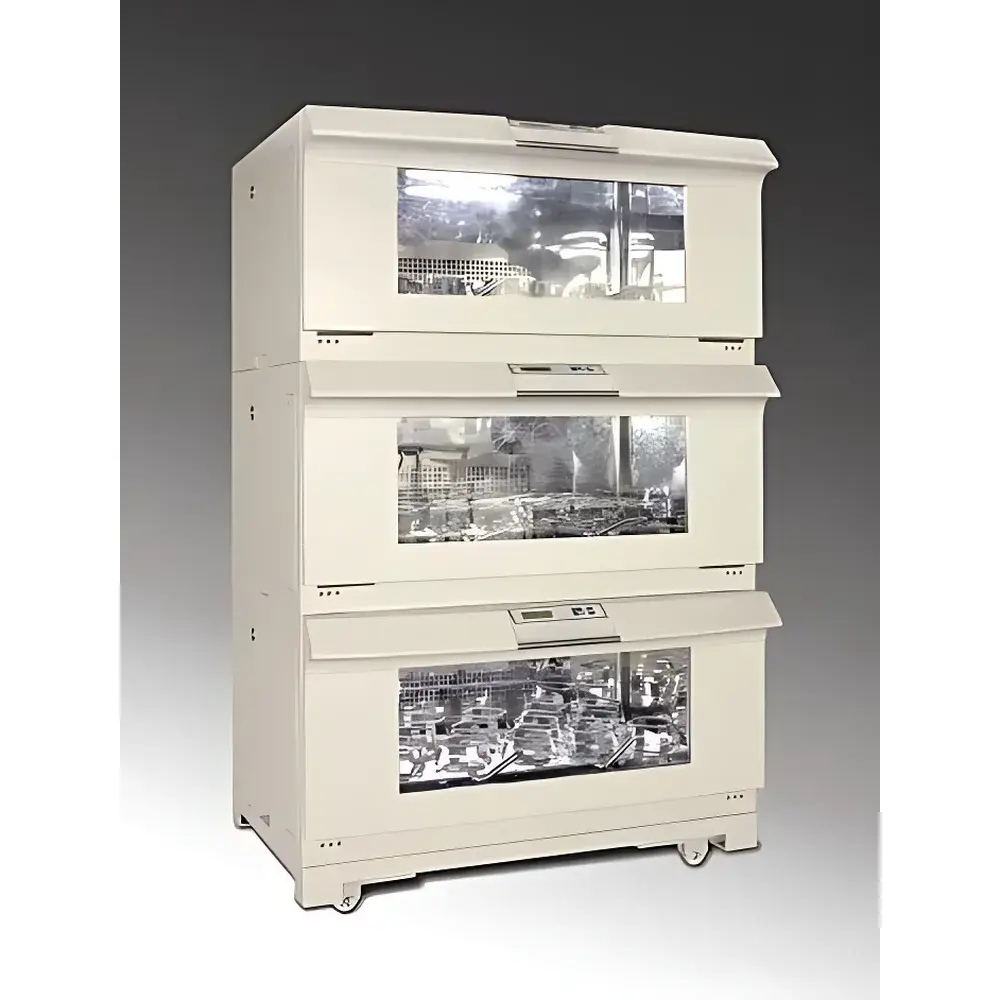
ZWYY-D2403 Intelligent Stackable Multifunctional Incubator Shaker
| Origin | Shanghai, China |
|---|---|
| Manufacturer Type | Authorized Distributor |
| Regional Origin | Domestic (China) |
| Model | ZWYY-D2403 |
| Pricing | Available Upon Request |
| Control Algorithm | PID with Environmental Scan Microprocessor |
| Display | 7-inch Full-Color TFT Touchscreen |
| Air Circulation | Forced Convection |
| Oscillation Mode | Orbital Shaking |
| Drive System | Single-Axis Synchronous Motor |
| Door Mechanism | Manual Down-Pull Damped Opening |
| Ambient Temperature Range | 10–35 °C |
| Chamber Count | 3 Independent Layers |
| Temperature Range | 4–60 °C |
| Temp. Resolution | 0.1 °C |
| Temp. Stability | ±0.5 °C at 37 °C |
| Temp. Uniformity | ±1.0 °C at 37 °C |
| Humidity Range | 40–85 %RH |
| Humidity Resolution | 0.1 %RH |
| Humidity Stability | ≤±2 %RH |
| Humidity Uniformity | ≤±6 %RH |
| CO₂ Range | 0–20 % |
| CO₂ Resolution | 0.1 % |
| CO₂ Accuracy | ±0.46 % |
| Programmable Segments/Steps | 9 segments / 18 steps |
| Timer Range | 0.1–99.9 h |
| Speed Range | 0–300 rpm |
| Speed Accuracy | ±1 rpm |
| Orbit Diameter | Φ0–50 mm (Infinitely Adjustable) |
| Refrigeration | Triple-Stage Air-Cooled R134a System, Frost-Free Operation |
| Humidification | Steam-Based Generation |
| CO₂ Sensing | NDIR Infrared Sensor |
| Acceleration Profile | Soft-Start Ramp Control |
| Shelf Quantity | 3 Removable Stainless Steel Trays |
| Tray Dimensions | 800 × 430 mm |
| Chamber Volume per Layer | 182 L |
| Internal Dimensions per Layer | 920 × 532 × 373 mm |
| External Dimensions | 1100 × 910 × 1980 mm |
| Packaging Dimensions | 1220 × 1030 × 2150 mm |
| Net Weight | 580 kg |
| Gross Weight | 650 kg |
| Power Consumption | 3600 W |
| Electrical Supply | AC 220 V, 50/60 Hz |
Overview
The ZWYY-D2403 Intelligent Stackable Multifunctional Incubator Shaker is an integrated environmental control platform engineered for precision cell culture, microbial fermentation, enzymatic assays, and hybridization protocols requiring concurrent regulation of temperature, humidity, CO₂ concentration, and orbital agitation. It operates on a robust PID-controlled microprocessor architecture with real-time environmental scanning, enabling dynamic compensation for thermal load shifts, ambient fluctuations, and chamber-opening events. Unlike conventional shakers limited to temperature and speed control, the ZWYY-D2403 implements triple-layer independent chamber design—each layer featuring full parameter autonomy—including programmable CO₂ setpoints, humidity ramping, and multi-segment oscillation profiles. Its forced convection airflow system ensures uniform thermal distribution across all three tiers, while the NDIR-based CO₂ sensor delivers trace-level stability essential for mammalian cell line maintenance under physiologically relevant conditions (5% CO₂, 37 °C, >95% RH). The device complies with fundamental mechanical safety standards for laboratory equipment (IEC 61010-1), and its data logging architecture supports audit-ready timestamped records suitable for GLP-aligned workflows.
Key Features
- Triple-tier stackable configuration with fully independent environmental control per chamber—enabling parallel experiments under divergent conditions (e.g., 37 °C/5% CO₂ vs. 28 °C/ambient air)
- Orbital shaking with infinitely adjustable amplitude (Φ0–50 mm) and speed range (0–300 rpm), driven by a brushless AC induction motor delivering consistent torque across the entire operating envelope
- Triple-stage R134a refrigeration system with frost-free operation and adaptive power modulation—maintaining precise sub-ambient temperatures without condensation or thermal shock
- Steam-based humidification with auto-fill water reservoir and optical low-water detection—ensuring uninterrupted high-humidity operation up to 85% RH
- True-color 7-inch capacitive touchscreen interface with intuitive drag-and-drop programming for up to 9 segments and 18 steps, supporting complex temporal profiles including temperature ramps, CO₂ gradients, and oscillation duty cycles
- Comprehensive safety architecture: dual independent overtemperature cutoffs (adjustable and fixed), leakage current protection, motor overload sensing, refrigerant pressure monitoring, and door-open interlock
- Soft-start acceleration algorithm minimizing shear stress on sensitive suspension cultures during initiation and speed transitions
- Electropolished stainless steel interior, powder-coated steel exterior, and reinforced tempered glass viewing window—designed for long-term corrosion resistance and routine decontamination with ethanol, hydrogen peroxide vapor, or quaternary ammonium agents
Sample Compatibility & Compliance
The ZWYY-D2403 accommodates standard microbiological and cell culture vessels—including Erlenmeyer flasks (up to 5 L), roller bottles, deep-well plates, and custom bioreactor sleeves—via interchangeable stainless steel trays with spring-loaded clamps and universal mounting rails. Its 182 L per-layer capacity supports high-throughput screening configurations without compromising airflow integrity. From a regulatory standpoint, the instrument meets structural and electrical safety requirements per IEC 61010-1 Ed. 3.0 for laboratory use. While not certified to ISO 13485 or FDA 21 CFR Part 11 out-of-the-box, its RS-232 serial interface enables integration with validated LIMS or ELN platforms that enforce electronic signature, audit trail, and data integrity policies. All firmware logs—including parameter changes, alarm events, and runtime statistics—are time-stamped and exportable in CSV format for internal QA review.
Software & Data Management
Data acquisition and system control are managed via an embedded Linux-based firmware platform with non-volatile memory for persistent parameter storage. The unit supports real-time monitoring of all active parameters (temperature, humidity, CO₂, rpm, orbit amplitude) through the touchscreen UI, with configurable alarm thresholds and hysteresis settings. Embedded micro-printer provides immediate hard-copy output of calibration certificates, session summaries, and alarm histories—formatted to align with internal SOP documentation standards. Remote supervision is enabled via RS-232 connection to host PCs running third-party SCADA or lab automation software; no proprietary drivers or cloud dependencies are required. Firmware updates are performed via USB flash drive, ensuring offline maintainability in regulated environments where network isolation is mandated.
Applications
This incubator shaker serves as a core platform in academic research labs studying aerobic/anaerobic microbial kinetics, industrial bioprocess development teams optimizing recombinant protein expression in E. coli or Pichia pastoris, and pharmaceutical QC units performing stability-indicating assays under controlled humidity and gas composition. Its ability to sustain simultaneous CO₂/humidity/temperature gradients makes it particularly valuable for stem cell differentiation studies requiring staged environmental cues, mycological growth profiling across hyphal development stages, and vaccine adjuvant formulation testing where antigen integrity depends on precise agitation kinetics and moisture content. In molecular diagnostics, it supports overnight hybridization of DNA probes under stringent wash conditions, while food safety labs utilize its reproducible oscillation profile for pathogen enrichment in buffered peptone water per ISO 6579-1.
FAQ
Is the ZWYY-D2403 compliant with FDA 21 CFR Part 11?
The device itself does not include built-in electronic signature or role-based access control features required for direct Part 11 compliance. However, its RS-232 output and audit-log-capable firmware allow integration into validated systems that meet those requirements.
Can individual chambers operate at different CO₂ concentrations?
No—CO₂ control is centralized across all three layers via a single NDIR sensor and proportional valve assembly. For fully independent gas control, multi-chamber CO₂ incubators with segregated gas manifolds are recommended.
What is the maximum flask size supported per tray?
Each 800 × 430 mm tray accommodates two 5 L Erlenmeyer flasks with standard neck geometry when using optional heavy-duty clamping kits.
Does the unit support external temperature probe input for sample-specific monitoring?
Yes—the system provides one analog input channel (0–5 V) compatible with PT100 or thermistor probes, allowing real-time validation of media temperature independent of chamber air readings.
How frequently must the humidification system be descaled?
Under continuous 85% RH operation with deionized water feed, descaling is recommended every 6 months using citric acid solution; the front-accessible steam generator module allows tool-free removal and cleaning.




